

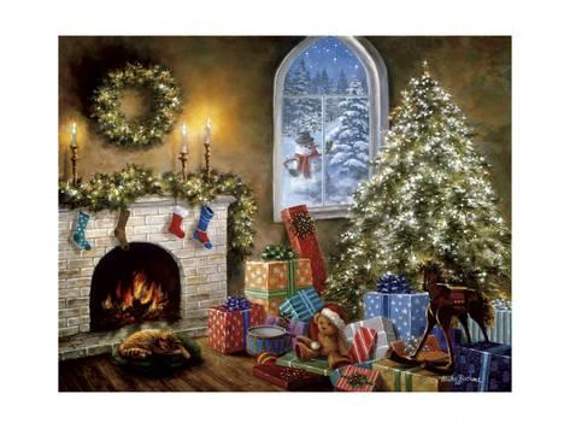
The seasonal picture!
I wonder if you’ve ever come across what purports to be a lost chapter by the Greek historian Herodotus. It tells of the customs, at this time of year, among the inhabitants of an island called Niatirb ... Niatirb (shades of Dylan Thomas here) lying to the northwest of the European continent - could this be us?
My source says this: In the middle of winter when fogs and rains most abound they have a great festival which they call Exmas and, for fifty days, they prepare for it in the fashion I shall describe.
First of all, every citizen is obliged to send to each of his friends and relations a square piece of hard paper stamped with a picture, which in their speech is called an Exmas-card. But the pictures represent birds sitting on branches, or trees with a dark green prickly leaf, or else men in such garments as the Niatirbians believe that their ancestors wore 200 years ago riding in coaches such as their ancestors used, or houses with snow on their roofs. ... And because all men must send these cards the market-place is filled with the crowd of those buying them, so that there is much labour and weariness.


But having bought as many as they suppose to be sufficient, they return to their houses and find there the like cards which others have sent to them. And when they find cards from any to whom they also have sent cards, they throw them away and give thanks to the gods that this labour at least is over for another year.
CHRISTMAS CARDS
But, when they find cards from any to whom they have not sent, then they beat their breasts and wail and utter curses against the sender; and having sufficiently lamented their misfortune, they put on their boots again and go out into the fog and rain and buy a card for him also.
I suppose I’m one of only a small number of people who don’t mind that the custom of sending Christmas cards persists. Along with the card manufacturers and the Post Office (although for different reasons), I think there is a good side to the Christmas card exercise, at least potentially. Of course I wish it didn’t take up so much time, and wasn’t so expensive. But, like a number of the other strange social practices that make up the holiday period as we know it, I think it can be turned into a little token of our appreciation for what Christmas is really about.
And what is Christmas really about?
Put simply, at Christmas, in celebrating the birth of the Lord, we dare to say that the eternal God has taken human form in this world, that the Word became flesh and dwelt among us. It is an astonishing thing to say. To many, it is not only astonishing. Many think it preposterous, or blasphemous, unworthy of the dignity of God.
BELEAGURED PEOPLE
But the experience people had, and continue to have, of Jesus Christ - in the days when he walked this earth and ever since - seems to leave many with no choice but to keep saying the astonishing thing again and again.
To profess the belief that God has reached out to us by taking the form of a particular person, born in a particular place and time: amongst a beleaguered people, living under occupation in ancient Palestine, born in the year 4 BC (or near enough as makes no difference).
That is where the story begins: with a God who wants to connect with us, to be in relationship with us. It is a story of humility and condescension, a story of paradox. The unfathomable source of energy that made the earth assumes a mortal body which is made of earth.
The Master and King of Creation is born like a slave and dies like a criminal. Of all the life stories in the world, this is the one which is most universally known, one which will not go away. To the eyes of faith, much of the power of the story of Jesus is his self-giving, his letting go of power and exaltation: an emptying out of glory, in the act of sacrifice which he makes on the cross.
This God who wants to be in relationship with us stretches out his arms in self-giving in a way which is unspeakably costly and painful. To him the price is worth paying: to free us from the void of meaninglessness, selfishness and despair.
BORN HELPLESS
To free us even from our ancient enemy, Death. To him it is a price worth paying. Worth being born as a helpless baby for; worth going to the cross for.
It’s in response to that great gift, that we celebrate Christmas. You may say we are now a very long way from the Niatirbian custom of sending Exmas Cards. And a long way from the mad rush to buy presents, from the overspending and overeating at family gatherings likewise chronicled by our pseudo-Herodotus.
After explaining the frantic extertions of what the Niatirbians call the Exmas Rush, he describes what they do on the day itself: ... when the day of the festival comes, then most of the citizens, being exhausted by the Rush, lie in bed till noon.
But in the evening they eat five times as much supper as on other days, and, crowning themselves with crowns of paper, they become intoxicated. And on the day after Exmas they are very grave, being internally disordered by the supper and the drinking and reckoning how much they have spent on gifts and on the wine.
It will have been easy for some of you to guess, at the end of this term of our commemorations, that the chronicler of Niatirbian customs is that man again - C. S. Lewis - it’s a little squib he wrote in the 1950s, for the weekly journal Time and Tide.
His pseudo-Herodotus goes on to describe an utterly different observance which apparently has nothing to do with Exmas: ‘But the few among the Niatirbians have also a festival, separate and to themselves, called Crissmas, which is on the same day as Exmas.
‘CRISSMAS’
And those who keep Crissmas, doing the opposite to the majority of the Niatirbians, rise early on that day with shining faces and go before sunrise to certain temples where they partake of a sacred feast. ... I myself conversed with a priest in one of the temples and asked him why they kept Crissmas on the same day as Exmas; for it appeared to me inconvenient.’
In reality, of course, none of us who keep Christmas are in with much of a chance of keeping it ‘separately and to ourselves,’ purged of secular trimmings and trappings. Nor do I think it especially desirable that we should.
The trappings of the season are, for us, a given - and one could probably escape them only by fleeing to a community of Cistercian monks (something members of this congregation have the opportunity to do only during the Easter Vacation, which is too late). But these secular trappings and trimmings present us with an opportunity, a chance to interact with a general season of goodwill and merrymaking common to all, enshrined in traditional and contemporary custom. We can try in vain to wish these things away, we can waste a lot of energy complaining about them ... or we can try to make something of them, to use them. To try to make something of them is, I would say, to follow the example God sets us in the coming of Christ. Better to write humanity off, or try to make something of it? Better, clearly, to avoid write-offs whenever we can.
BRASS TACKS
So, getting down to brass tacks. How can we assimilate rather than write off, this Niatirbian custom of the Christmas card - say, from the person who will keep sending a card year after year, when (year after year) we have left them out of our calculations? Just writing a card like that, to someone who thinks it of value to maintain some kind of connection, even that can be offered up to God as a little symbol, artificial though it may be, a respectful bow to the importance of relationship.
Remember, the gift of God in Christ is a gift of connection, of reaching out: a reaching out that took much longer than three or four minutes, and cost much more than a stamp. Think too of those cards to the occasional person by whom we might feel injured or offended - small, potentially healing gestures of reconciliation and good will.
Think of a card to the person who, unbeknownst to you or them, will die in the next year - to whom this will be your last wave of the hand.
‘ODD’ CUSTOM
All this is to say that even the odd, artificial custom of sending someone a ‘piece of hard paper stamped with a picture’ can be used to honour the importance God seems to attach to reaching out. Try it anyway. Let your time writing cards this year - even though it may otherwise seem tedious and superficial - try to let it be focussed on the value God seems to place on connectedness and relationship.
Think of him, too, when you go to that family gathering, especially if there are tensions under the surface all day, threatening to burst out and spoil it all. God has made us social creatures and wants us to get on with living together. One way that happens is through rituals of hospitality. Think of Christ the reconciler, try to offer the day to him, and be thankful.
Try to think of him when you buy people presents - giving away a symbol that says someone is valued, that they and their happiness matter to you. That doesn’t mean buying in to the Exmas racket of ridiculous overspending; in fact it might make you prioritise, it might mean buying less, so some of your giving can be directed to those in acute need. There are many things worse in the world than a short period of enforced generosity. Think of Christ the giver, and be thankful.
I like to hope that there are very few Christmas rituals that cannot be turned around and used in a good way, very few which, seen from a new angle, cannot at least be creatively reimagined. Give it a try. See whether they might not, here and there, yield genuine fruits: of self-giving, of relationship, of reconciliation.
And have a merry Christmas. (Contributed)
Comments
This article has no comments yet. Be the first to leave a comment.