
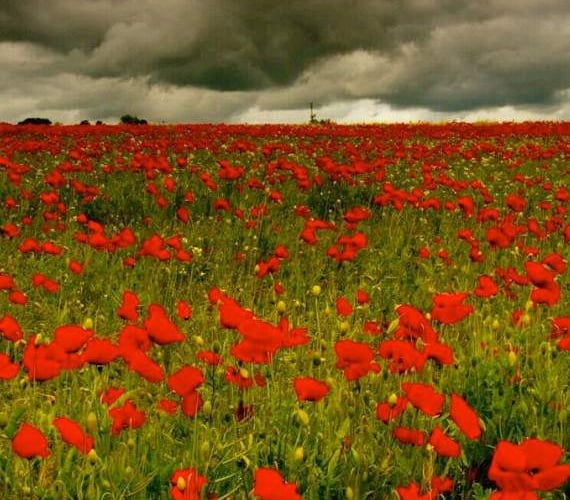
I’m sure readers of this column fully recognise that tomorrow is Remembrance Day (also known as Poppy Day or Armistice Day) - a memorial day observed in all our Commonwealth countries since the end of World War I to commemorate the members of their armed forces who have died in the line of duty.
This day, or alternative dates, are also recognised as special days for war remembrances in many non-Commonwealth countries.
Remembrance Day is observed on November 11 to recall the end of hostilities of World War I on that date in 1918. Hostilities formally ended ‘at the 11th hour of the 11th day of the 11th month,’ in accordance with the Armistice, signed by representatives of Germany and the Entente between 5:12 and 5:20 that morning. (‘At the 11th hour’ refers to the passing of the 11th hour, or 11:00 am.)
World War I officially ended with the signing of the Treaty of Versailles on June 28, 1919 - the day was specifically dedicated by King George V on November 7, 1919, as a day of remembrance for members of the armed forces who were killed during World War I.
The initial or very first Armistice Day was held at Buckingham Palace commencing with King George V hosting a ‘Banquet in Honour of the President of the French Republic’ during the evening hours of November 10, 1919.
The first official Armistice Day was subsequently held in the grounds of Buckingham Palace on the morning of November 11, 1919. This would set the trend for a day of remembrance for decades to come.
The red remembrance poppy has become a familiar emblem of Remembrance Day due to the poem ‘In Flanders Fields’. These poppies bloomed across some of the worst battlefields of Flanders in World War I, their brilliant red colour an appropriate symbol for the blood spilled in the war.
The national Poppy Campaign kicked off Friday, October 31, in support of our nation’s veterans and their families. Millions around Canada don the scarlet red poppy on their lapels for Remembrance Day, showing their support and appreciation for those who have served, fought or died on history’s battlefields.
While volunteers and veterans alike hand out poppies by donation across Metro Vancouver until Tuesday, November 11, the history of the Remembrance Day poppy symbolises a century-long movement to acknowledge the sacrifice of soldiers around the world.
The link between the red poppy and war dates back to the Napoleonic wars of the 19th century. After the battles, once desolate fields became saturated with lime from desecrated rubble seeping into the earth. Thriving from this unique addition to the soil, blood red poppies began to bloom, flowering over the remnants of war and loss. Nearly 100 years later, Lieut. Col. John McCrae, a Canadian doctor on the World War One front, observed this cardinal blooming and wrote ‘In Flanders Fields’ to document the tragic beauty of the poppy.


Not long after, Moina Michael, of the New York City YMCA, started to wear a poppy on her lapel in memory of the millions who died in the First World War. The custom spread internationally to France and beyond when others began selling the poppies to raise money for the children of war, and Canada adopted the custom in 1921.
Today, the Poppy Campaign distributes over 18 million poppies worldwide to raise money for veterans and their families in times of need.
Wartime memories
A Pembrokeshire exile remembers ‘There was very strict rationing of food and clothing. We were all given ration books and could only buy so much a week’.
Clothes had to be recycled by those handy with needle and thread. Farmers were watched very carefully. Milk was put out every morning in large churns, to be gathered up and taken away. Very often they would be opened and the depth of the cream measured! Technically we were not allowed to keep any of the cream but, somehow, many farmers managed to keep enough to make their own butter (a forbidden task!)
My great-grandmother was in her 90s and wore a big shawl and a man’s flat cap. One day when an inspector came to search for butter, eggs etc. she was helped quickly into bed. By the time all the outhouses and all the haystacks had been prodded with pitch forks, she was prone in bed with a large butter churn between her legs and a few dozen eggs amongst the bed clothes! These inspectors must have been pretty dim!
In winter, heavy overcoats were thrown on the beds as there was a shortage of fuel and no central heating. (Of course, if you had false teeth you might have well been named, Dai Central Eating! GROAN).
I know, I know that’s an old coal! Those winter coats on the beds hid a lot from the inspectors as well as keeping us all as warm as toast
I have very vivid memories of rabbits. Yes, rabbits! My grandfather was obliged to lay traps along the hedgerows of the fields and often in the night I could hear rabbits sqealing in those cruel steel traps.
Sometimes the low flying planes would drop strips of silver paper, about a foot long and two inches wide. I never found out why, or what for. We children had readymade strips to make into very pretty paper chains ready for Christmas. We could not buy decorations as there were very few to be found.
I wore cream pure silk dresses for special occasions during that time! A parachute had dropped in one of our fields and presumably a member of the forces had escaped on foot, leaving it there. For several years all the young ladies kept the two local dressmakers busy. The silk was shared out on first come first served basis and there was plenty to go around. Those with good sewing skills were very well paid for in their jobs, with milk, eggs, butter and cream!!!
We always welcomed a member of the forces home on leave with an impromptu Noson Lawen in the local school.
Yes, there were bad times but also good memories. Due to the rationing my grandfather kept all the sweets and chocolate locked up in a tin box in his chest of drawers. Every night the small key would appear and I was allowed to choose one sweet or one piece of chocolate. How times have changed. We can now devour a whole Kit Kat without inhaling!!! Then I always shared my sweet treasure with my boarder collie.
My grandmother would make sure that I said my prayers every night. She would tell me to remember the little children ‘over there’ who’s daddies also flew planes etc. and did not come home to their families. At that time I was too young to understand that bit! Now of course, I think, and pray that we all do. (Contributed)
Our country is in mourning, a veteran died today
He was getting old and paunchy
And his hair was falling fast,
And he sat around the Legion,
Telling stories of the past.
Of a war that he once fought in
And the deeds that he had done,
In his exploits with his buddies;
They were heroes, every one.
And ‘tho sometimes to his neighbours
His tales became a joke,
All his buddies listened quietly
For they knew where of he spoke.
But we’ll hear his tales no longer,
For ol’ Joe has passed away,
And the world’s a little poorer
For a Veteran died today.
He won’t be mourned by many,
Just his children and his wife.
For he lived an ordinary,
Very quiet sort of life.
He held a job and raised a family,
Going quietly on his way;
And the world won’t note his passing,
‘Tho a Veteran died today.
When politicians leave this earth,
Their bodies lie in state,
While thousands note their passing,
And proclaim that they were great.
Papers tell of their life stories
From the time that they were young,
But the passing of a Veteran
Goes unnoticed, and unsung.
Is the greatest contribution
To the welfare of our land,
Some jerk who breaks his promise
And cons his fellow man?
Or the ordinary fellow
Who in times of war and strife,
Goes off to serve his country
And offers up his life?
The politician’s stipend
And the style in which he lives,
Are often disproportionate,
To the service that he gives.
While the ordinary Veteran,
Who offered up his all,
Is paid off with a medal
And perhaps a pension, small.
It is not the politicians
With their compromise and ploys,
Who won for us the freedom
That our country now enjoys.
Should you find yourself in danger,
With your enemies at hand,
Would you really want some cop-out,
With his ever-waffling stand?
Or would you want a Veteran
His home, his country, his kin,
Just a common Veteran,
Who would fight until the end.
He was just a common Veteran,
And his ranks are growing thin,
But his presence should remind us
We may need his likes again.
For when countries are in conflict,
We find the Veteran’s part,
Is to clean up all the troubles
That the politicians start.
If we cannot do him honour
While he’s here to hear the praise,
Then at least let’s give him homage
At the ending of his days.
…..verse by Geraint Roberts.
NFU’s County branch marks 100 years
There can be no doubt that when the National Farmers Union of England and Wales was in it’s infancy, at the beginning of the 20th century, there was a great need to better promote the interests of all those engaged in agriculture at a very difficult period and to encourage an urgently needed improved general understanding.
Trade tariffs leading to marketing problems, political interference and the absence of a coherent and united agricultural pressure group as a result of divisions between landlord and tenant and between arable and livestock farmers had led to considerable unrest within the industry.
Tariff reform had become a major issue at the turn of the century and for a while, after pressures for tenancy reform had been appeased by the 1906 Agricultural Holdings Act, it was the dominant topic of agricultural politics and, indeed, national politics.
The division and weakness of the agricultural interests was nowhere more apparent than in their limited and contradictory contribution to the wider debate at that time which was fuelled mainly by resentment towards the foreign tariffs erected against British manufactures and a concern to preserve the unity of the Empire.
Early records indicate that the National Farmers’ Union of England and Wales was formed in 1908 and rapidly rose to prominence as the major representative organization for farmers -the Pembroke County branch was founded in 1917 and within a few years reported a membership of 1,862 with 18 local branches having been set up at Clarbeston Road, Croesgoch, Fishguard, Kilgetty, Letterston, Llanfyrnach, Llangwm, Maenclochog, Narberth, Newport, Pembroke, Steynton, St Ishmaels, St Nicholas, Haverfordwest and Camrose.
Group secretaries, mostly working from their own homes, were soon appointed to service the needs of members –especially helpful with essential form filling -and a central office was opened in Haverfordwest. For the convenience of members there were also mart day offices at many of the local marts.
[By that time Carmarthenshire had 2,450 members of 47 local branches and the Cardiganshire membership comprised 1,058 with 47 branches located in six specific areas. In the early 1920’s the national membership had reached more than 100,000.]
From the local branches delegates were appointed to attend County meetings and the various sub-committees which had evolved to meet specific needs. The member elected to serve on the NFU’s National Council usually reported back on the following day to the County meeting and, from it’s inception the Area representative on Milk Marketing Board reported to the County Milk Committee.
Other committees included Arable (dealing with wages and early potatoes), Parliamentary, Livestock, Poultry (to cover the growing turkey trade) and Finance with occasional meetings of the Hill Committee mostly at Crymych.
More recently the Union locally has also played major roles in dealing with animal health issues, marketing of livestock, turkeys, potatoes and vegetable crops, promoting school milk and in supporting the buying groups purchasing farm requirements and the machinery ring.
Over many years a liaison visit was arranged to another county branch affording members the opportunity of studyinh other aspects of current farming practice.
The NFU has effectively remained at the forefront of farmer representation in relation to political issues in Cardiff, Westminster and Brussels, labour concerns and marketing matters: animal health, fatstock, dairy products, cereals and potatoes, health and safety and the rural infrastructure with County Councils, Water and Electricity authorities and many more.
Two Pembrokeshire members of the Union presently hold top posts in the NFU: Meurig Raymond as National President and Stephen James, President for Wales –a good reason to celebrate.
Also, on Saturday of next week (November 18) the current Chairman of the Pembroke county branch, Jeff Evans, is arranging a Centenary Dinner at the County Showground Pavilion when the guest speaker will be Lord Plumb, someone who is no stranger to the county having spent many holidays in the area.
Better known as Henry Plumb he last addressed the annual dinner given by the Executive committee of the County branch as Union President in 1972. Now aged 92, Lord Plumb grew up within the Young Farmers Club movement; served the NFU very well and progressed to leading the main political group in the European Parliament.
Comments
We've recently changed our login process. If you have an account for commenting, you will need to re-register on the login window.
This article has no comments yet. Be the first to leave a comment.