

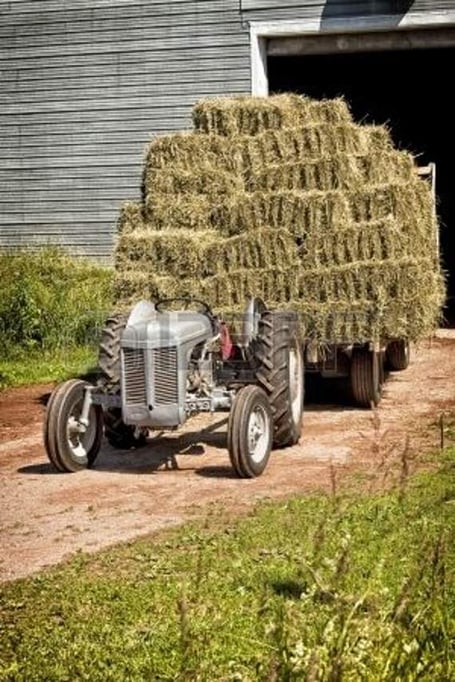
Thanksgiving time?
With the harvest almost complete, local farmers generally are reflecting upon a fairly good year as far as the weather is concerned with few long interruptions and pretty good crops.
Items for this column are usually compiled several weeks in advance of publication and I wrote the above paragraph towards the end of August. Quite obviously I couldn’t have been more wrong!
Due to the adverse weather during September, progress with the cereal harvest has been very slow and many acres have yet to be reaped with fields and field of valuable straw still waiting for the baler. Ground conditions have also held up potato lifting, late crops of silage have however been bountiful but thoughts of making a late crop of hay are fast being abandoned.




I recently came across an old record from 1954 which claimed that the weather that year was the worst in living memory: it hit every season - regarded as ‘a fact which will have had a very unhappy reduction in the balance sheets of every Pembrokeshire farmer.’
“From an agricultural standpoint, the weather was seen to be unfavourable from the start. It had set back the early potato crop by at least three weeks and the abnormality of rain and strong, blustering, cold winds caused throughout the year a bleak pastoral scene which reached the peak of dismalness towards the end of the year with hundred of acres of corn rotting in water-logged fields.
“With regards to the hold up in planting early potatoes, the crop was further retarded with piercing winds in April and early May through the cold weather. In fact wind and rain caused lifting in any substantial degree of a light crop (four tones per acre) to be as late as the second week in June and prices soon dropped to half of what the growers had hoped for.”
Welsh Pride
The success story of the Celtic Pride brand, dating from 2003, indicates consumer demand for consistently high quality Welsh beef has adhered to the highest welfare standards and in meeting these aims the partnership has grown to be one of Wales’ most recognised beef brands.
Now welcomed at a growing number of hotels and restaurants across the principality and West country, Celtic Pride Beef carries the coveted Protected Geographical Indication (PGI) status awarded to food products that have full traceability.
The aim of excellence in beef production has been achieved through collaboration with Farm Assurance schemes, the grassland management expertise of the Institute of Biological and Enviromental Studies (IBERS, formerly IGER) at Aberystwyth University and the experience of feed manufacturers Wynnstay.
All of these attributes are managed by the Celtic Pride team who are available to visit farms, conduct audits and liase across the supply chain.
A key element to the success of the scheme is the partnership developed with the farm producers. Farmers are members of the Welsh Meat Company and adhere to a practical protocol with members annually audited to meet farm assurance standards of husbandry and welfare. Producers are, in turn, rewarded for their stockman skills with a guaranteed market, recognised branded beef and premium price paid for their livestock.
The third link in the chain is the route to market. Castell Howell Foods and Weddel Swift distribute the beef throughout Wales and beyond. Celtic Pride Beef is available at a growing number of retail and catering outlets
The Celtic Pride Beef label authenticates the brand and underlines the integrity of the farming practices, whole chain traceability and quality assurance management. PGI provides consumer assurance that Celtic Pride cattle are born and reared in Wales, and that all further processes are at Castell Howells’ £5m state-of-the-art Celtica Foods butchery in Cross Hands and remain fully traceable from farm to retail or catering outlets.
Over this year, even discerning diners in the Far East have been tucking in to premium Welsh beef following the first shipment by Celtic Pride to Singapore.
Said Celtic Pride premium beef scheme manager, Gareth Evans: “We are encouraged that premium Welsh beef can supply a premium market in Singapore.
“Direct Meats in Colchester have been developing overseas sales for a number of years and we are proud to feature in their portfolio of quality beef. We shall continue to focus on this market and look forward to increasing the volume of cattle supplied.
“This is a great start to the year for Celtic Pride, they have selected certain breeds for this market including Welsh Black, Hereford, Angus, Highland, and Dexter,” said Martin Blackwell, managing director of Direct Meats.
“We have worked closely with Castell Howell, and Cross Hands abattoir Cig Calon Cymru, to ensure that the cutting plants are fully registered with the Singapore Agri-food and Veterinary Authority, andthese shipments mark the realisation of all those efforts.”
Celtic Pride is Wales’ currently processes beef from up to 85 farmers, processing an average of 75-85 cattle per week through well located abattoirs to reduce distance travelled, and improve animal welfare that ultimately produces consistency, great flavour and top quality beef.
Mobile ’phones, etc
The Farmers Union of Wales say a National Assembly for Wales committee has been misled into making a draconian recommendation that would play into the hands of multi-billion pound telecommunication companies. The Union has also suggested that the committee may have been naive in not identifying the true motives of those advocating such moves.
Last week, the National Assembly for Wales’ Economy, Infrastructure and Skills Committee published a report entitled Digital Infrastructure in Wales, which included a recommendation that ‘The Welsh Government should consider making future public subsidy conditional on supporting government policy to improve digital infrastructure, and to ensure that it meets the needs of consumers in the future, in particular any likely convergence between broadband and mobile internet connectivity.’
Responding to the report, Gavin Williams, chairman of the FUW’s Land Use and Parliamentary Committee, said: “The FUW has long been a proponent of increasing both broadband and mobile phone coverage in Wales, and has worked closely with Ofcom and others for more than a decade to highlight the needs of Wales’ communities in terms of both.”
Mr. Williams highlighted the fact that the union is unaware of any instances where farmers have refused to enter into a fair agreement with commercial companies responsible for digital infrastructure - but is aware of many cases where agreement has been reached between farmers and communication companies, but planning permission has been refused, and of instances where companies have behaved in unacceptable and unprofessional ways in order to try and install communication infrastructure on private land’.
He added: “We would suggest that the underlying motive for those who have suggested such a barrier exists at any scale is the wish to boost company profits by seeking changes which would allow farmers and landowners to be bullied into signing contracts which do not represent the commercial nature of work and installations.”
Quote
Rosalind Franklin, the English chemist and X-ray crystallographer who contributed to the discovery of the structure of DNA once said: “You look at science (or at least talk of it) as some sort of demoralising invention of man, something apart from real life, and which must be cautiously guarded and kept separate from everyday existence. But science and everyday life cannot and should not be separated.”
Comments
This article has no comments yet. Be the first to leave a comment.