

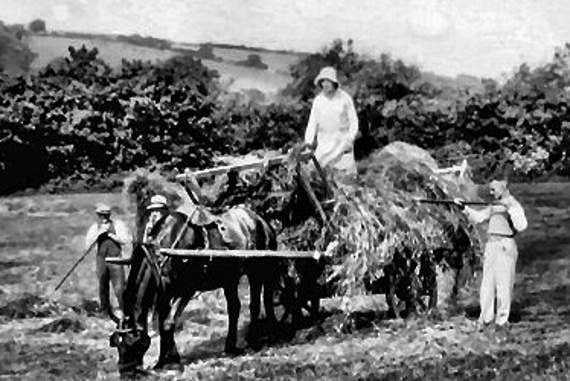
Thanksgiving time
with pic.
With the harvest almost complete local farmers generally are reflecting upon a fairly good year as far as the weather is concerned with few long interruptions and pretty good crops.
Some may still look back on the summer of 1949 in this county when, for four months with many areas not then having a mains water supplies, practically no rain fell and this caused a very serious situation from the water supply standpoint.



Wells, and even streams, ran dry and in many places - including villages and hospitals - water had to be transported and ‘rationed’. Broad and Little Haven in Pembrokeshire were amongst the places worst affected and much concern was expressed by the inhabitants and the summer residents - as well as the health authorities - about the sanitary conditions.
Moving on, by far the greatest body of harvest folklore and tradition is connected to the harvesting of grain, whether it be wheat, barley or oats. This should not be surprising, given that whatever grain was grown it provided the staple diet of most people, whether as bread, beer, porridge or oatcakes.
However, in thinking about harvest we must remember that our ancestors were directly dependent on nature and on the landscape around them for a much greater range of raw materials than purely grain and other foodstuffs.
To the grain, fruit and meat harvests should be added many more less obvious, and in some cases purely local, harvests such as the wool gathered during the May and June sheep shearings; the hop-picking in parts of the Welsh borderland counties; the gorse and bracken gathered on heath and moorland as fuel and thatching materials; the reeds gathered from the reedbeds of the Norfolk and fenland wetlands which were essential roofing and thatching materials in the eastern counties; the shellfish harvests of the eastern coast; and the harvest of coppiced hazel poles from managed woodlands around the country to name just a few of the vast range of other materials which our ancestors gathered as essential ingredients to their everyday lives.
Think outside the box!
Welsh farmers are being actively encouraged to think outside the box and investigate new streams of income.
Farming Connect - which is funded by the Welsh Government and the European Agricultural Fund for Rural Development - has arranged a series of diversification events this autumn where the focus will be on encouraging farmers to venture into new areas of working which could boost farm profits.
With goats milk, sheep milk, and venison production on the agenda at each event, a number of specialists in these particular fields will give presentations based on their own experiences and knowledge of the sector.
Rob Bunn is a livestock schemes manager for Dovecote Park, which supplies the finest British beef, veal and venison to Waitrose supermarkets nationwide. Rob will give an overview of the British farmed deer scheme and touch on a new funding initiative set up by Dovecote Park with Lloyds Bank, which assists young entrants to the sector, by helping finance deer calves purchased for finishing.
FUW Brecon and Radnor president, Kath Shaw, runs a herd of red deer on an 80-acre farm. Having grown up near London she has, after completing a HND in Agriculture and an ANC in Deer Management, achieved a great deal in the farming world.
After setting up her own deer herd in 2004, she now supplies the Welsh Venison Centre in Bwlch, who supply local pubs, restaurants and shops.
Nuffield scholar Gary Yeomans, who farms near Abergavenny, is generally regarded as one of the country’s leading goat milk producers. Gary says goats gave him his first step on the farming ladder in 2002 because he saw that there was declining viability of small dairy cow farms.
By today, despite increasing competition, he has turned the business into a profitable commercial enterprise with 750 head of British Saanen and Saanen cross British Toggenburg goats.
Bethesda (North Wales) cheesemaker Dr. Carrie Rimes learned her trade in the fromageries of France before returning home to North Wales with ambitious plans for a new cheese dairy using sheep milk.
Carrie, who says that with the price of cow’s milk currently being so low, there is considerable interest in switching to a product which can sell for two to three times as much as cows milk, and she is doing all she can to persuade more farmers in Wales to meet the rapidly increasing demand for ewes’ milk.
Targeted at those new to these niche areas of farming, the speakers will cover a wide range of issues, including market research, breeding, genetics, processing and adding value to the products in readiness for selling.
Each event will take place from 7.30 pm to 9.30 pm and places must be booked in advance.
For more details of these meetings contact [email protected] / 01970 631 424
Hands on
I am delighted to learn of people who set out to take a look at new enterprises and a non milk producer, Paul Baker from Stowmarket, recently went on a flying visit to New Zealand to view at first hand a dairy business that has been developed from a greenfield site over the past five years.
There was a most telling statistic: land value five years ago had been £750 (value converted) per acre, but now that the farm had the benefit of a Fonterra assured milk contract, this had risen to over £1,500 per acre [that is not a misprint and I thought it worthy of record].
The working partner/manager and his wife moved onto this bare land site nine years ago and now run 1,800-2,000 milking cows, maximising returns per litre and per hectare.
Another couple have equity in the cows, although they are thinking of getting out, which is creating uncertainty.
There are three managers on the farm, one for the herd, another for cropping and the third is machinery manager.
The cows are milked on a 116 stall rotary parlour, and there are two block calvings in the year. 500 cows calve February - March, and the other 1,500 in August - September. This means that there are a minimum of 800 in milk at any given time and up to 2,000 in the period end September - Christmas which, of course, is their spring.
The cows were Holstein and milked three times a day with a herd average of 9,000 litres and a replacement rate of 30 per cent. The farmer buys in oil seeds, brewer’s grains and potato waste and grows a proportion of his own cereals.
The majority of the rainfall is between April-November. His farming is very dependent on water and, if drought conditions strike, he can dry off and destock if necessary, sending the animals to some land he owns further north.
His chalky land is naturally dry and he puts plenty of cocksfoot into his leys.
He found there was a 30-50 per cent difference in the grass produced if the cows were kept off a paddock for at least 14 days as opposed to their returning within seven to14 days. 450 of his acres were irrigated by eight centre pivots, one of which was used for the maize crop.
Paul remarks: “I couldn’t help wondering why this partnership had chosen to dairy-farm at this particular spot, when neither topography, environment or access to market gave them any competitive edge.”
Twitters
Speaking to an old friend from yesterday it’s the same in his area as it is in mine - the big farming guys are not looking back, it’s one thing after another: expansion at a scary rate: turbines and AD plants in so many areas with guys farming 6,000 acres of cereals, a guy growing 1,800 acres of potatoes guys milking 2,000 cows and then I look at the normal farmers and it’s clear to see most are struggling, being forced to sell cows, being forced to sell kit for cashflow and get the big guy to contract farm the place.
I’m worried that current prices and being a traditional mixed family farm mean I haven’t progressed much lately and can’t see how I can compete in the future guys like this. It seems there are a few successful farmers in each area and heaps of unprogressive ones which will after this generation no longer exist.”
There is a recurring theme amongst many farmers about people/businesses and overdrafts and borrowings. It is very peculiar. Stuff like: ‘All that kit must be on finance’, or ‘huge farms with massive overdrafts’ and the like, and the feeling seems to be that anyone doing such a thing is an idiot/foolhardy or doing something unusual or very risky. This kind of view would be nearly alien to the vast majority of businesses outside of agriculture, where, even the huge blue chip companies will have massive overdrafts and borrowings. I have explained this before.
The reason is so very simple - it is basically cheaper to borrow someone else’s money than to use your own! Today you can borrow a million quid for less than four per cent, meaning you can potentially control an immense amount of capital for around 40K a year. This basically means that if you can spend that million in a way that will return you more than four per cent, you are quids in! In the world of farming, where people already own some assets, and the value of these is increasing year on year (which it basically does), and you can take advantage of tax concessions from the government, suddenly borrowing does not seem so daft after all. You can use finance to accelerate your business, at a rate that could cause major upset to the business if you attempted to do it organically, so to speak”.
If only
I dream of living in a free world where a chicken may cross the road without having its motives questioned.
Comments
This article has no comments yet. Be the first to leave a comment.