

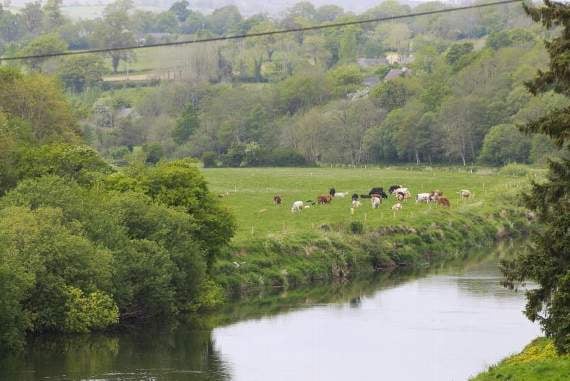
There is an over-emphasis on agriculture when it comes to Wales’s water quality, according to an environmental authority.
Speaking in a radio interview he said that agriculture has made massive improvements in the last 20 years.
“The amount of seriously polluted rivers has declined in that time as well. We are doing more and will continue to do more, but the Government needs to put more resources in to let that happen.”
Commenting on an Environmental Protection Agency’s National Assessment of Water Quality report he said that only a very limited number of locations where waste water is being discharged need to be dealt with.




On the role of agriculture, it was considered that there are a number of things that can be done and called for a ring-fenced budget put in place to deliver the following:
a. A progressive approach to the current review of the nitrates regulations.
b. Greater focus by government agencies on working with farming and the wider rural community to address water quality challenges, rather than mainly focusing on imposing penalties and fines.
c. Increased support for locally led initiatives, such as smart farming, which demonstrates clear and tangible benefits to the environment from better resource management.
d. The re-opening of voluntary schemes, which provide targeted supports for farmers to improve water quality and future proof for environmental challenges
The latest report from Welsh Water states that 100 per cent of planned improvements to the company assets, due for completion between 2016/17, were completed on time -these improvements will mean assets achieve higher standards and deliver water quality improvements.
Overall the report confirms that Welsh Water remain a good performing company but there are areas that can be improved upon. By 2020, they will strive to achieve the highest EPA status of a leading company by delivering the following results:
i. Further reduction in pollution incident numbers; ii. Aim to achieve zero serious pollution incidents; iii. 100 per cent compliance with environmental permits; iv. Increase self reporting of pollution incidents in line with the water industry sector; v. Achieve the targets for SoSI and sludge disposal; vi. Continued delivery of improvement schemes to meet the specified deadlines.
Lessons from life
At one time or another in our lives we will be faced with the fear of failure but, if you don’t take that chance - take that first step forward, follow the path unknown - how do you know that you won’t succeed?
After all - we need to understand failure to be able to measure success, don’t we?
Failure is as a lesson that should catapult you into success and, like so many others, we wouldn’t be where we are today without some measure of failure.
Many people who will have excelled in business will have made a mistake from time to time - but never twice!
Most failures occur when we stretch ourselves beyond our limits. Maybe we have too much on our plate. Maybe we’re just seeing the end goal and not considering what it will take to execute flawlessly. Maybe the objective is unrealistic for some reason.
In these cases failure will do one of two things to us: it will either force us to cower into a safe place where comfort becomes more important than achievement; or it will stretch the limits of our ambition - the latter will inspire us to apply the lessons we learned from the failure to our next venture.
Of course, not every endeavour will prove to be successful. We win some and we lose some, and the unexpected can happen at any time.
So what happens when you don’t succeed? Do you sink as low with failure as you fly high with success? Not really. And if you do, we have to understand why.
I like to think of it this way - life isn’t a game where every loss is subtracted from your list of victories. Failure is never a disaster but shows you how to improve, and how to work toward more and better victories in the future.
Everyone fails - we just can’t afford to dwell on it. All we can do is identify where and how we failed, choose the best way to avoid repeating it, then move on. All failures carry lessons with them so what have you learned from yours?
A second chance
I’m reminded that 50 years have past since a South African surgeon, Dr. Christian Barnard, successfully performed the first ever heart transplant.
One wonders just how amazingly medical research has progressed to overcome high blood pressure, blocked arteries, and various other heart diseases and conditions in that time.
Do we fully appreciate that, thanks to this pioneering procedure, many hundreds of heart transplants now take place each year in the British Isles together with stents and pacemakers being implanted to give patients a second chance of life.
Research is ongoing through the good auspices of the British Heart Foundation and West Wales fundraiser, Jayne Lewis, says the BHF network are working with local communities to help fund further vital work (Jayne can be contacted on 07860 727547).
Work in progress
Under current wildlife regulations, hedge cutting and gorse burning is restricted between March 1 and August 31. The laws at present determine that cutting, grubbing, burning or destruction by other means of vegetation growing on uncultivated land or in hedges or ditches is restricted during this period.
Hedge-cutting season got under way last weekend and lasts until February 28, where hedges in fields and along roadsides can be cut.
Farmers and contractors planning to cut hedges are advised again to check for adequate clearance before passing underneath powerlines, as many hedges are below power lines.
Support for biofuels
“President Trump and his administration have assured family farmers and rural residents that this administration plans to support biofuels and uphold the intent of Congress as it relates to the Renewable Fuel Standards,” says Roger Johnson, chairman of the American NFU.
“While we appreciate that the Environmental Protection Agency’s proposal maintains the implied conventional biofuel RFS volume at 15 billion gallons, the agency continues to consider ‘constraints’ on ethanol use, when it should continue to support ongoing efforts to increase use of higher ethanol blends in this country.
“In addition, EPA’s proposal significantly reduces the statutory volume for advanced biofuels and, thereby, the total renewable fuel volume,” Johnson continued. “As such, the overall proposal falls short of preserving the integrity of the RFS - which is to drive the biofuels market and grow the industry.”
“As family farmers navigate a severely depressed farm economy, this is a time the administration should be raising expectations for a policy that drives many economies in rural America. We urge the administration to increase these proposed volumes and reject any calls to further reduce the required volumes,” he concluded.
The US NFU has been working since 1902 to protect and enhance the economic well-being and quality of life for family farmers, ranchers and rural communities through advocating grassroots -driven policy positions adopted by its membership.
Where there’s a will
The tale is told of a West Wales farmer who is said to have taken his dead wife’s hand and completed her will in his favour, after which he married again.
The house became haunted and strange noises, such as the breaking of crockery and the locking and unlocking of doors were heard.
This even continued after he moved to another house - even in chapel, where he was a deacon, the man would suddenly stand up appearing to be struggling with some unseen adversary.
The atmosphere changed whenever he came near, and his children were greatly disturbed.
Peace was finally restored by the transference of the dead woman’s money to her relatives!
Comments
This article has no comments yet. Be the first to leave a comment.