

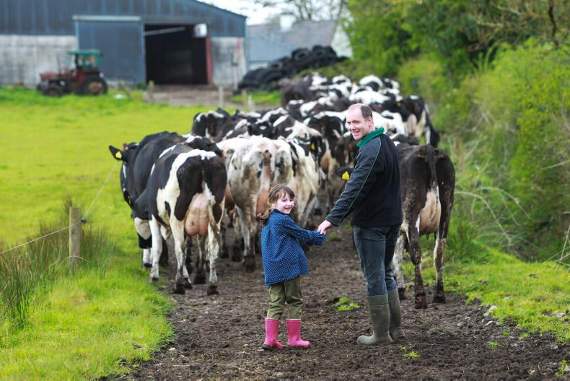
Whither now?
Is there still a future for the family dairy farmer?
The agricultural industry is almost coming around to a hundred years after the stark depression of the 1920s when farmers were taking their cattle and sheep to market and a buyer could not be found.
Tenant farmers, and their employees, were working for a pittance and many landowners could not let their farms once a tenant had moved out because he or she could no longer afford the rent.



The situation had become really bad in most parts, but in the harsher areas of England, most of Wales, Scotland and Ireland it was only family farms that were able to barely survive, largely by living off the land and only buying in the basic necessities.
After First World War hostilities had ended, prices had collapsed and dairy producers, through the NFU, were threatening to strike.
Where farms were located not too far from a railway station limited quantities of milk from West Wales - conveyed in 17 gallon churns - was being put on trains for dairies in Gloucester and London but there were many stories of the supplier not getting paid.
In 1923, a negotiating forum was established to stabilise prices, which established a differential price structure for liquid and manufacturing milk.
The UK was highly exposed to imports from Commonwealth trading partners and so the scheme protected the fresh liquid part of production. Through the on-going farming depression in the 1930s, however, this body was not enough and the NFU was instrumental in setting up of the Milk Marketing Scheme with government support.
Not surprisingly, 96 per cent of producers voted in favour and the Board was created in 1933 - MMB was committed under statute to buy everything produced by dairy farmers so it also had to take an interest in processing and selling that milk.
Milk was, and still is, awkward to transport, highly perishable and sourced from multiple small production units.
It naturally lends itself to farm level collaboration to improve the negotiating position of farmers and such cooperative structures evolved in one form or another in all of the major dairy producing countries.
In its day, the MMB served to protect farmers both against instability and from a buyer dominated market and was the largest such organisation of its type in the world, at its peak marketing 13,000 million litres of liquid milk a year (not a great deal considering today’s levels of production).
In the early years, the MMB became a party to the contract between the producer and the buyer, however, the Second World War and the intervention of the Ministry of Food pushed the MMB to become the direct purchaser of all liquid milk.
This allowed the rationalisation of farm collections and deliveries, the founding of the National Milk Records service to improve production and the delivery of AI services through Genus.
Thus MMB evolved into four core areas: the Milk Marketing Scheme (promotional activities), Dairy Crest (collection, processing and delivery), Genus (AI services) and National Milk Recording.
At its peak, the whole organisation employed 7,000 people but, after the war years, the then Labour government embarked on a period of decontrol despite production still being depressed from war shortages.
The MMB, in consultation with buyers, offered a price guarantee for the liquid market and producers carried the cost of overproduction in the manufacturing sector.
From the ’30s until recent times the monthly milk cheque has been something of a salvation to around 3,000 dairy farms in the counties of Carmarthen, Cardigan and Pembroke, but, post Brexit, time may well be running out for this section of the agricultural industry…..
Inspire, innovate, integrate?
Cereals and oilseeds growers from across Wales may learn more about issues in their sector following a seminar being jointly organised by AHDB and the NFU in Wales in Cowbridge next week.
A high quality line-up of speakers has been secured for the morning event taking place on Thursday, February 2, at The Bear Hotel from 10 am.
Amongst the topics for discussion will be: variety choice in south Wales, approaches to building up soil health and productivity whilst cutting chemical input and the outlook for global grain markets.
Working Group Chairman, Perkin Evans, remarked: “Once again, the AHDB have been able to draw together some first class speakers, who are experts in their fields, to cover topics that are of relevance to Wales’ arable farmers.”
Co-ordinating the seminar is Richard Meredith, AHDB’s knowledge exchange manager who grew up on a family farm in Herefordshire, and is based in Ledbury.
Richard is passionate about helping to strengthen UK farm businesses, making them more resilient in the long term.
He joined AHDB first as a regional benchmarking officer, providing benchmarking support to AHDB Cereals and Oilseeds, Eblex and DairyCo levy payers.
Prior to that, Richard worked for five years with The Machinery Ring co-ordinating contracting and hire services in the agricultural and related sectors.
Carbon budgeting
The Environment (Wales) Act which received Royal Assent in March 2016 sets a 2050 target to reduce emissions by at least 80 per cent and provides the legislative framework for establishing a carbon budgeting approach in Wales.
The Act requires that before the end of 2018, Welsh Ministers must set in regulation interim emissions targets for 2020, 2030 and 2040, together with five-year carbon budgets for the periods 2016-2020 and 2021-2025.
The committee on so-called climate change has been asked by the Welsh Government to provide advice on these emissions targets and are themselves seeking evidence to help with that task.
The committee will provide advice in two stages: advice on carbon accounting and design of Welsh carbon budgets/targets this spring and on the level of ambition embodied within the targets and budgets and sectors in which there are particular opportunities to decarbonise next autumn.
Irritating
I find that, just as much a nuisance as dozens of unsolicited ’phone calls are, since Christmas the continual negative remarks in the press and on tv and radio relating to politics, sport, the health service, education, whatever.
Isn’t reporting on something positive news anymore? Mindful of my main story here this week, perhaps I should not be posing the question!
Strong arm
A recent prosecution taken by the Welsh Government serves as a timely reminder that compliance with regulatory standards should be a priority for all concerned.
A Llandrindod Wells poultry farmer, John Edward Morgan, has two free range hen houses which have a maximum capacity of 18,000 and 16,000 hens respectively.
Over the course of the period 2013-2015, a number of inspections were undertaken by egg marketing inspectors which revealed significant discrepancies which included: false declarations with regard the number of hens which had been placed in the second hen house; significant anomalies surrounding the number of eggs laid on a particular date, and the number of additional birds in house two also exceeded the allowed maximum stocking density permitted by law and the business should not have been marketing the eggs produced from that house as free range.
John Edward Morgan had pleaded guilty to fraud, by making false representations that his company was producing free range eggs, when they knew that they were contravening regulations governing their egg production.
The magistrates fined him £1,800, awarded a cost contribution of £1,000, with a statutory surcharge of £120, a total financial penalty of £2,920 to be paid within 28 days.
Morgan was sentenced to 18 months’ imprisonment, suspended for two years, in respect of the Fraud Act offence.
The Welsh Government is now considering a Proceeds of Crime Act application in order to recover the unlawful benefit obtained by Mr. Morgan’s actions.
It is clear from the sentences imposed that this type of offending will not be dealt with lightly by the Welsh Government or the courts and sends a strong message that compliance with regulatory standards should be a priority for all concerned.
That’s the way!
Desmond, who was a real town dweller, drove his car into a ditch when out on the country roads. Luckily, a local farmer came passing by with his big strong horse called Dobbin.
He hitched Dobbin up to the car and shouted loudly, ‘Pull, Dolly, pull!’ Dobbin didn’t move one inch.
Then the farmer yelled, ‘Pull, Robbie, pull.’ Still Dobbin failed to respond.
Once more, the farmer commanded in a stentorian voice, ‘Pull, Ringo, pull.’ Again - nothing.
Then the farmer nonchalantly and quietly muttered, ‘Pull, Dobbin, pull.’ Immediately, the horse easily dragged the car out of the ditch.
Desmond was very appreciative but also very curious. He asked the farmer why he called his horse by a different name three times.
The farmer whispered by way of reply, ‘Oh, Dobbin is blind and if he thought he was the only one pulling, he wouldn’t even try.’
True story
Each evening, bird lover Tom Rowe stood in his backyard in Devon, hooting like an owl and, one night, an owl called back to him.
For a year, the man and his feathered friend hooted back and forth. Rowe even kept a log of the ‘conversation.’
Just as Rowe thought he was on the verge of a breakthrough in inter-species communication, his wife had a chat with next door neighbour, Nancy Hollis.
‘My husband spends his nights ... calling out to owls,’ laughed Mrs. Rowe.
‘That’s odd,’ Mrs. Hollis replied. ‘So does my John.’
Then it dawned on them!
Comments
This article has no comments yet. Be the first to leave a comment.