

Under pressure
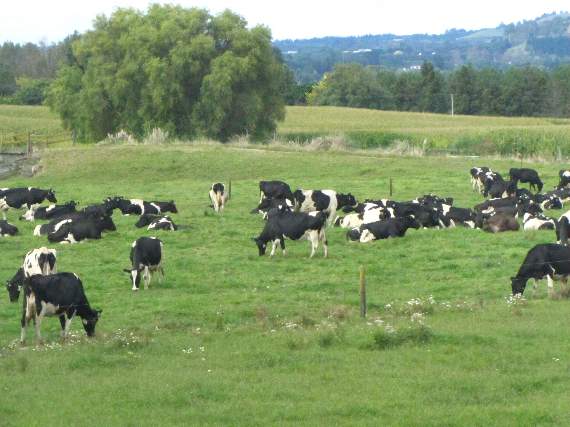
The Welsh rural economy is being short-changed by a massive £220,000 a day because buyers are failing to pass back the full value of improved market returns to Welsh milk producers.
After an extremely turbulent two years on global commodity markets, the message from the NFU at last week’s Welsh Dairy Show was that, over recent months, the market for dairy products has been seen to recover slightly but most milk buyers are slow to pass these price rises back to local dairy farmers - many of whom are continuing to produce milk at well below the cost of production.
Speaking for the NFU in Wales, Aled Jones said: “The most recent published figures for farmgate milk prices show average payment to farmers across the UK at 21.34ppl - in reality, with the scarcity of retailer aligned contracts in Wales, average returns are considerably less.



“Farmers have understood the difficulties there has been in the marketplace for the last two years and accept that the collapse in commodity prices put pressure on the whole supply chain, but what we cannot accept is the widening of the gap between farmgate prices and market returns.”
The top value being paid nationally by Muller to farmers on a Marks & Spencer contract is reported to average 21.07p/litre. Average payments to producers supplying the Welsh creameries are 16.73p/litre by First Milk to the Haverfordwest factory; 16.35p/litre by Glanbia (Llangefni) and 16.83p/litre -all of which include a significant volume from West Wales.
Aled continued: “With 2015-2016 average net farm incomes for dairy farmers forecast to have fallen by 47 per cent, farmers are in urgent need of price rises being passed back down the dairy supply chain.
“If we take a conservative estimate of the average milk producer price in Wales lagging at 5ppl behind what it should be, that means the Welsh rural economy is losing out on a massive £220,000 a day, or £6.7 million a month, from a failure of milk buyers to fully pass price increases to Welsh dairy producers.
“This money is vital not just for farmers, but to the agricultural merchants, vet practices, machinery dealers, builders, electricians, plumbers, accountants and others who rely on dairy farmers for a significant part of their income and who, as a result of cash flow problems on dairy farmers, have also suffered through this dairy downturn -Welsh dairy farmers’ patience is running thin - many have racked up huge debts during this difficult period and are struggling with the pressure of repayments.”
Christmas focus
Christmas is coming and everyone seems to be posting up their wish list of desirable presents.
I’m told that there are plenty of men out there who would almost give their right arm for a shed - what has a shed got to offer?
While the main concept of the men’s sheds is the provision of a space for men to come together, it’s the diversity of projects that is truly remarkable.
Sheds already operate at a local level through their members where everyone is treated equally and everyone has a say on the projects and activities the sheds participate in.
Often the question that’s asked is: “Who are the sheds for?” The simple answer is that the sheds are for everyone - we are providing spaces for men just to be men, have a cup of tea, learn new skills, meet new friends and get involved with their community.
You don’t have to be unemployed or retired or young or old - once you enter a men’s shed, everyone is equal. It is a space where men can go and gather and work on projects together. Most importantly, the sheds are a place where men find friendship and belonging, meaning and purpose - it is where they can get support and participate fully in society while giving back to their communities.
Sheds throughout Wales are having a major impact on their families and the communities they operate in: one I heard of has availed of the Heart Foundation’s full health checks which takes about 30 minutes, with instant results -the check comprised of blood pressure, cholesterol, glucose, body mass index, waist measurement, and a carbon monoxide (for smokers) check.
Another is embracing technology and offering men around the country an opportunity to connect and learn whilst another has (surprisingly arranged cookery classes and have been involved in the refurbishment of outdoor furniture.
Healing properties
Following my reference last week to the Hedgerow Doctor, I am reminded that the herbalist to King Charles I, John Parkinson (1567–1650) was a master apothecary, herbalist, and gardener.
Famous in his own lifetime for his influential books, his magnum opus, the Theatrum Botanicum, was published in 1640 and ran to 1,766 large pages.
The sheer scope and size was perhaps to prove the book’s downfall, because while it was much revered -and plagiarised - it was never reprinted and, centuries later, has attained the status of an extremely rare and valuable book.
Parkinson was writing at a time when Western herbalism was at its zenith, and his skills as a gardener (from his grounds in Covent Garden) combined perfectly with his passion for science, observation, and historical scholarship.
In the The Herbalist’s Bible, Julie Bruton-Seal and Matthew Seal have beautifully combined selections from Parkinson’s book with their own modern commentary on how each plant is used today to create a truly one-of-a-kind, comprehensive collection of herbal information old and new.
Parkinson’s clear and lively description of a chosen plant’s ‘vertues’ or healing properties side-by-side with the editors’ notes, including copious herbal recipes - make this the perfect book for students and practitioners of herbalism, historians, and gardeners, all of whom will welcome this restoration of Parkinson’s lost classic.
The Herbalist’s Bible: John Parkinson’s lost classic rediscovered is available in hardcover from around £19.99.
Still amongst the thorns
How could I have written about the Hawthorn and not made any reference to the bounty of the Blackthorn, readers ask.
The Blackthorn’s fruit, the sloe berry, ripens and sweetens after the first frost. Tasting the berry in August, it can be found to be extremely bitter. An alcoholic drink, Sloe Gin is made from this small dark blue berry, which is used both medicinally and magically. This berry has been found in archaeological sites from the Mesolithic and Iron Age periods (8000 - 2700 BC), proving that the blackthorn berry was a part of early man’s diet.
Sloe berries are a very bitter tonic. They are astringent, said to stimulate the metabolism, clean the blood and may be used as a laxative and diuretic. They supposedly help with indigestion, eczema, herpes, allergies, colds, catarrh, neurosis, weak heart, kidney stones, skin, bladder, and prostrate problems.
Blackthorn is depicted in many fairy tales throughout Europe as a tree of ill omen. Called Straif in the Ogham, this tree has the most sinister reputation in Celtic tree lore.
In Irish tales, heroes were aided by the Blackthorn tree - if they threw a twig of Blackthorn after them, it would take root and form an impenetrable hedge or woods, thwarting the pursuing giant.
Often in fairytales, such as ‘Sleeping Beauty,’ Blackthorn forms the thick, impenetrable thorn bramble that hides the magic castle from intruders and princes alike! In order to prove worthy, the prince must cut through this thorn forest to rescue the princess.
Blackthorn is said to bloom on Christmas Eve, as is the holy thorn at Glastonbury. It is one of the trees, which were reputed to form the thorny crown of Christ at His crucifixion.
Blackthorn is used for purification, as well as protection, ridding the atmosphere of negative energy. It deals the issues on a Karmic level, which cannot be avoided. Meditating on Blackthorn can purify our minds of negative thoughts and impulses at the deepest level of our psyche. It can aid us in combating fear, depression and anger. The thorns of the Blackthorn can be imagined to lance the built up abscess of negative thoughts, and release the emotional toxins, which can then begin to heal. Using the gentler sister tree, Hawthorn, in conjunction with Blackthorn, can aid the process of healing.
Top dog!
A bloke walks into a bar at the Millennium Stadium on international match day with a dachshund under his arm. The dog is wearing a Scotland rugby jersey and is festooned with Scotland pom-poms.
The bartender says: “Hey! No pets are allowed! You’ll have to leave.”
The guy begs him: “Look, I’m desperate! We’re both big fans, the TV’s broken at home, and this is the only place around where we can see the game.”
After securing a promise that the dog will behave, and warning him that he and the dog will be thrown out if there’s any trouble, the bartender relents and allows them to stay in the bar and watch the game. The big game begins with the Scots receiving the kick-off. They march down field, get stopped at the 22, and kick a penalty goal.
Suddenly, the dog jumps up on the bar and begins walking up and down the bar giving high-fives to everyone.
The bartender says: “Wow, that is the most amazing thing I’ve seen! What does the dog do if they score a try?”
The owner replies: “I don’t know, I’ve only had him for three years.”
Comments
This article has no comments yet. Be the first to leave a comment.