
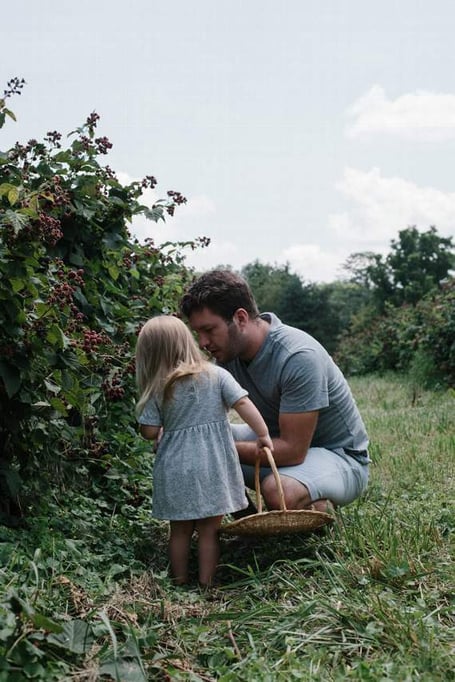
Let’s go blackberrying!
In years gone by, something of a family tradition, not least at weekends or on a Sunday afternoon, was to go out into the country lanes or around the fields harvesting blackberries.
Few things sum up British summertime better than a scramble through a blackberry bush clutching an empty margarine or ice-cream tub and, provided you’re not trespassing on private property, blackberry picking is a great way of sourcing a cheap summer pud.
Like many things in life, the most successful blackberries will be ones that stand out from the crowd. I’m told that they should be shiny and firm when you pick them though fruits do seem to vary in flavour from place to place.




Seasoned blackberry hunters often have favourite bushes whose harvest they prefer to any neighbouring bush. As you can try before you ‘buy’ shop around to find what suits you, avoiding bushes by busy, dusty roads or fruit low enough to be ‘watered’ by passing dogs.
Grown in abundance in all manner of hedgerows across the country blackberries are not restricted to rural areas but regularly spotted along river paths, across open wasteland and near the cliffs.
Blackberries are normally at their best at the end of August to September, but by October the damp weather will have certainly soiled many crops.
Clear signs for some?
Irish dairy farmers have expressed their delight that, following a two-year price slump, a nearly 13 per cent leap in the overall price index at the Global Dairy Trade auction has been reported.
IFA chairman Sean O’Leary has commented: “The recent positive GDT results mirror the EU market price evolution, reflecting the lower global availability of milk, the utilisation of stocks, and the relatively good demand growth.
“This is why we believe there is a genuine sign that the long overdue dairy recovery, has now taken hold.”
The National Farmers Unions, in England and Wales, Scotland and Northern Ireland, has said they are seeking to meet with retailers and milk processors on the urgent need for the dramatic upturn in dairy markets to speedily feedback to farmers.
The unions say that recent downturns in production had led to a turnaround in wholesale prices for products like cheese, cream and milk powders, after two years in the doldrums.
However, they report that the response to the market changes from milk buyers and processors has been hugely variable, causing great frustration amongst dairy farmers.
For NFU Scotland, milk committee chairman, Graeme Kilpatrick suggested that all involved in the dairy supply chain should use this current upturn as an opportunity to embrace culture change and move away from what it called the ‘damaging approach of the past, where dairy farmers are left to bear the brunt of extreme volatility in dairy markets.’
He added: “It is in the interests of consumers, retailers, processors and farmers that we use this huge improvement in the market to drive change and confidence. Longer-term, the entire supply chain must act collaboratively to ensure a sustainable and more stable future for the UK dairy sector.”
We don’t want to be ‘just the same’
After what he considered to be positive discussions with the Cabinet Secretary for Environment and Rural Affairs, Lesley Griffiths, FUW spokesman Eurwyn Roberts reported: “In our discussions, we made it clear that Wales needs to decide what it wants to be and decide what Wales is about. For us, it is clear that if those in power do just that they will understand the importance of agriculture. We don’t want to be the same as other countries, we want to create our own future and, in order for us to create this, Welsh Government has to realise that hiding behind state-aid rules is no longer an option: our schools, hospitals, armed forces and all other public services deserve access to the top quality produce that we grow here in Wales, and our farmers and rural economies deserve recognition for what they produce.
“If we want to see Wales and rural Wales prosper and be the Powerhouse, it has the potential to be, then we must recognise that family farms lie at the centre of our rural economy, culture and landscape and fully appreciate that it makes innumerable other contributions to the well-being of Welsh and UK residents. There are still many uncertainties ahead of us, but Welsh Government has it in its power to show its support for our Welsh farming industry by making a commitment to its food producers and custodians of the countryside.”
Stay or get out
A major talking point at the County Show was the future of the industry now that we propose to leave the EU.
One well-known farmer I spoke to said the three main considerations that he had come up with in favour of leaving was democracy followed by over regulation and the World Trade and soon he had felt himself overwhelmed with other reasons to leave the organisation.
“I had considered that as a Welsh dairy farmer in receipt of subsidies from the common agricultural policy (CAP), this was a big decision for me to make.
“Farming under the CAP has been chaotic to say the least. In the early days in Europe, we were encouraged, via cash incentives, to produce as much food as possible. This inevitably resulted in cereal mountains and milk lakes making the news.
“In 1984, the EU intervened, imposing milk quotas across the community and the UK lost 15 per cent of its production to other member states. The knock-on effects were severe and damaging. At our farm, 20 productive cows were sent to slaughter. All over the country, farmers were forced to do the same and herds that were, now, too small to be viable were sold.
“The UK was left with less dairy farmers, less cows, less processing capacity and a larger trade deficit which stands today at £1.2 billion.
“It took until 1999 for a radical change in the subsidy regime and environmental based subsidies to arrive. The change away from production subsidies was a step in the right direction, but it wasn’t long before the EU were interfering once more with the Renewables Energy Act, allowing subsidised energy crops to be grown for producing electricity. The clamour to grow crops for the new subsidy caused a huge demand for arable ground in this area, doubling farm rents and forcing less profitable enterprises, such as dairy, beef, sheep and cereals, off the land. Some of my rented ground went from £100 to £200/acre overnight.
“However, much of EU governance is less visible, far more subtle, but no less problematic. In the office, I have a stack of books three feet high, telling me how to farm - EU style.
“From cattle passports to crop rotations - they had a say in it all. There are directives for virtually everything. Which crops we plant, on which fields and in which order and we shouldn’t forget ‘cross compliance.’
The volume of milk the herd produces and the equipment we use to do so. How we cultivate the soil, the type of machinery used. Where we buy protein, fertilisers, medicines and how we apply them - it is all dictated to us by EU policy. A policy designed to span all the cultures across the whole continent - a blue print that is designed for everyone but suits absolutely no one. Rules and regulations across the member states, but many do not comply.
“Take the failed milk quota regime for instance - the Italians still owe 1.34 billion euros for their non-implementation of the regime from1995 to 2009. On the other hand, DEFRA were fined for attempting to simplify the single farm payment regime and handed over millions for their error within the year. Why the difference?
“As a farmer, I deplore the interference from a distant, unaccountable, organisation. Are these the best people to tell us what crops we should be planting or how I should be milking my cows? Of course not. The days of the distant EU governance must come to an end. I have spent my lifetime making decisions for the sake of EU officialdom, rather than the cows, my farm and my customers and I want it to change.
“I am delighted we are getting out and well-pleased.”
Wise words
“Don’t let schooling interfere with your education” -Mark Twain.
“One small crack doesn’t mean that you are broken. It means that you were put to the test and did not fall apart” - Linda Paindexter.
“Some cause happiness wherever they go. Others whenever they go” - Oscar Wilde.
Comments
This article has no comments yet. Be the first to leave a comment.