
Dairy crisis worsens
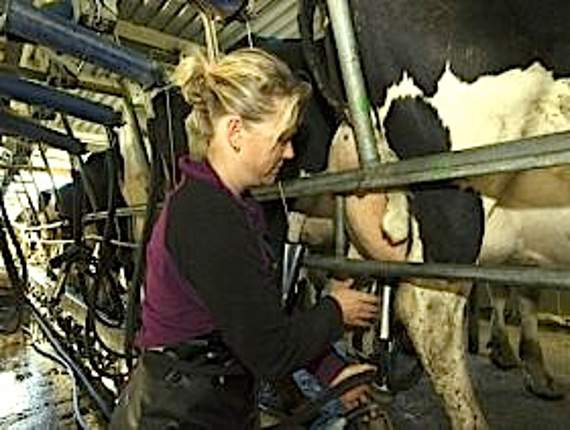
A report on the current state of the Welsh dairy sector has been launched by the Farmers’ Union of Wales in order to look again at the main issues affecting the sector and those mechanisms which might mitigate some current problems.
The Union’s Dairy Committee Chairman, Rhydian Owen said: “The Welsh dairy industry continues to reel under months of continuing low prices and minimal profitability and almost half of milk producers across Britain are positively considering quitting the sector.
The report highlights that a year after all curbs on output have been abolished, and in the absence of any observable or predicted changes to current global supply and demand dynamics, the need is imperative that the milk market is managed in a manner which stabilises prices and ensures a fair standard of living, protects producers from the effects of unfair practises and strengthens their position in the supply chain.

-cropped_cropped.jpeg?width=209&height=140&crop=209:145,smart&quality=75)
The report further concludes that measures which enhance the sustainability and viability of the Welsh dairy sector will therefore be essential to ensure future competitiveness and innovation.
Our roots
On a visit to the Royal Welsh a couple of years ago I met up with one of the very many foreign visitors who come to these shores each year.
He had grown up in a farming family in the US and he recently sent me the following:.
“Farming is THE last great industry to not be “farmed out” our “outsourced” to foreign countries. American farmers lead the world in productivity, quality, and conservation.
It is also probably the last area where your own personal effort puts you on the line for results. That is because many things can wipe out your crop (weather, insects, economic forces), and therefore an inordinate amount of skill and wisdom is necessary to survive in farming. Hard work is just the beginning.
In today’s social media driven world, our society is increasingly homogenous, and individual personal responsibility seems to be close to wiped out. Greatness is measured in trackpad clicks, when to be truthful, most internet content is un-original and impulsively dinged out on a keyboard off the top of the author’s head – not the product of great thinking and true insight. The rest of society can learn a lot about America’s heirloom values which made our country great, such as integrity (not passing the buck in committee), honesty (not making up a story or some line about the meaning of “is”), and personal accountability (not looking to the government to supply you with anything, let alone money to live on).
The work ethic that I still think of as uniquely American is most likely going to die during my lifetime. It will be replaced by mediocrity, and entitled expectations. No one will dare to be great out of a taught fear of offending the lazy masses, AS IF that is a bad thing (it is not).
When you take on farming, you have to hustle or you don’t eat. When something breaks, you can’t just call a repair guy at 10:30pm on Sunday. You are the guy. You have to rely on yourself. You can’t cry in your cornflakes and blame anyone else. Why? Because no one will care. No one will come to your rescue. No one will bail you out. Show me anywhere else where that is still true other than farming”.
Providing for the living
Pembrokeshire Coast National Park Authority (PCNPA) are about to receive £105,000 to support a range of projects which focus on developing disability access to a number of the Park’s most popular sites as well as some new ones. These projects will provide wheelchair access to a number of flagship sites, such as Abereiddy, Freshwater East and St David’s.
Natural Resources Minister Carl Sargeant tells me “Our world renowned National Parks and Wales Coast Path attract millions of visitors to Wales every year, and help create and support many jobs in the rural economy. It’s vital that the National Park Authorities and Natural Resources Wales continue to maintain and improve their popular paths. This funding will help ensure that essential work can take place so local communities and visitors to Wales can continue to enjoy everything they have to offer.”
Remembering the dead
In our cemeteries across West Wales lay the remains of so many of our own service men and women together with those from other countries of the Commonwealth and elsewhere cared for by the Commonwealth War Graves Commission.
The CWGC owes its existence to the vision and determination of one man - Sir Fabian Ware.
Neither a soldier nor a politician, Ware was nevertheless well placed to respond to the public’s reaction to the enormous losses in the war. At 45 he was too old to fight but he became the commander of a mobile unit of the British Red Cross. Saddened by the sheer number of casualties, he felt driven to find a way to ensure the final resting places of the dead would not be lost forever. His vision chimed with the times. Under his dynamic leadership, his unit began recording and caring for all the graves they could find. By 1915, their work was given official recognition by the War Office and incorporated into the British Army as the Graves Registration Commission.
Ware was keen that the spirit of Imperial cooperation evident in the war was reflected in the work of his organisation. Encouraged by the Prince of Wales, he submitted a memorandum to the Imperial War Conference. In May 1917, the Imperial War Graves Commission was established by Royal Charter, with the Prince serving as President and Ware as Vice-Chairman.
The Commission’s work began in earnest after the Armistice. Once land for cemeteries and memorials had been guaranteed, the enormous task of recording the details of the dead began. By 1918, some 587,000 graves had been identified and a further 559,000 casualties were registered as having no known grave.
The Commission set the highest standards for all its work. Three of the most eminent architects of the day - Sir Edwin Lutyens, Sir Herbert Baker and Sir Reginald Blomfield - were chosen to begin the work of designing and constructing the cemeteries and memorials. Rudyard Kipling was tasked, as literary advisor, with advising on inscriptions.
Ware asked Sir Frederic Kenyon, the Director of the British Museum, to interpret the differing approaches of the principal architects. The report he presented to the Commission in November 1918 emphasised equality as the core ideology, outlining the principles we abide by today.
The Commission continues to preserve its cemeteries and memorials and encourage the act of remembrance. Occasionally military remains are found - a human reminder of the reason the Commission came into being and why its work is still so important today. These casualties are buried with honour in one of the Commission’s immaculately maintained war cemeteries. In 2009 the discovery of 250 Australian and British casualties from the Battle of Fromelles required the construction of an entirely new cemetery, Fromelles (Pheasant Wood) Military Cemetery. This was unveiled in 2010.
Renovation and maintenance forms a major part of our responsibility. Each year around 20,000 headstones are either replaced or repaired by our staff.
Our work is never ending and we are proud to continue to work to the high standards set by the Commission in 1917.
By preserving the memory of the dead with simple dignity and true equality, the Commission hopes to encourage future generations to remember the sacrifice made by so many.
“X’s” mark the spots
With much more yet to come, we have, over recent weeks and months endured just about a bellyful of politics from radio and tv, loud hailers going around the streets and villages and countless hustings all promising the same and a better tomorrow! On the lighter side some interesting facts have come to light. Women, it was said, were far more likely than men to be contesting marginal seats. The Electoral Reform Society also identified eleven battleground constituencies that might have change hands but, of the eleven, ten are being defended by women. Men were overwhelmingly defending the 29 constituency ‘safe seats’ outlined – with women defending just eight (28 per cent of the total)
The number of women in the new Assembly will flat line – the ERS project when all the votes are declared, between 22 (37 per cent of the Senedd) and 28 (45 per cent) women AMs will be elected, compared to 25 (42 per cent) elected in 2011.
The ERS also concluded that, until this election, 17 constituency seats have never been won by a woman, and of them, 10 have never had a female MP. Eight constituency seats after May are likely to have still never had a female -AM or MP.
The ERS believes a larger Assembly with a greater proportion of proportional list seats would create more opportunities for women to be elected, as it would increase the number of marginal and contested seats, where women are more likely to stand.
The report, which contains a foreword by the University of Liverpool’s Professor Laura McAllister, states that “During the last decade, the National Assembly for Wales and the Welsh Government were world leaders in women’s representation. From 2000-2005 over half of all cabinet ministers, and from 2005-2007 over half of all Assembly Members were women – a global first. But that early promise has stalled and as this report shows, Wales may already have fallen back.”
The report outlines four possible scenarios for the result in Wales, drawing on previous elections and current information, as well as data from the Wales Governance Centre at Cardiff University.
Prof McAllister said: “I’ve always warned that there’s a real vulnerability around Wales and the Assembly’s gender balanced status. There has always been limited goodwill about positive action amongst the political parties and a resistant culture around selecting women in key winnable seats. Without positive and sustained interventions to promote more women, it was always likely that Wales’s status as a beacon of political equality would be at risk, as this excellent report demonstrates.”
Comments
This article has no comments yet. Be the first to leave a comment.