

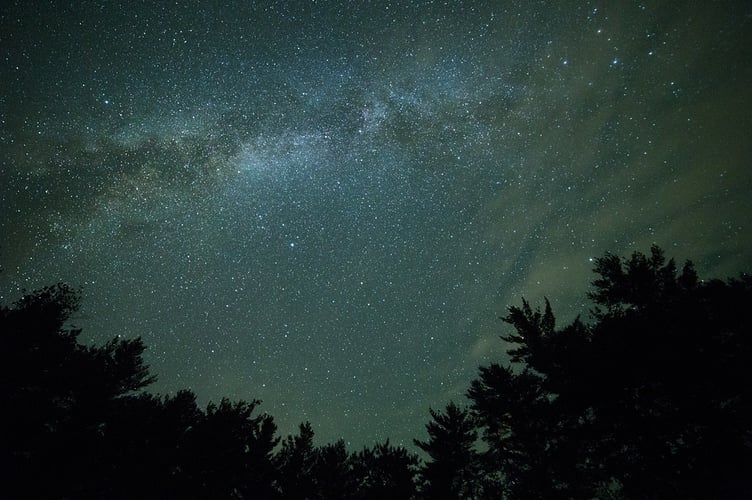
Amid this rising interest in viewing stars, it can be revealed that St Davids in Pembrokeshire, is the ultimate destination for stargazing with the clearest view in the UK.
As we head into ‘International Dark Sky Week’ (April 15 to 22), searches for “where to see stars” have soared in the UK by 9469% between March 28 and 29.
The UK location estimated to have the clearest view of stars this ‘Dark Sky Week’ is Britain’s smallest city, St Davids - with a star visibility score of 74.4/100.
That’s according to the latest study from www.bestgamblingsites.com who analysed light pollution data to predict the best and worst locations in the UK for stargazing this April.




St Davids, has a Borte Scale classification of 3. As the scale runs from 1 (darkest, best for stargazing) to 9 (worst for stargazing), St Davids has the lowest level of light pollution of all 82 cities analysed, making it the ultimate dark sky location to view stars.
In comparison, Cardiff, Glamorgan, has a classification of 7, just two points away from having the worst possible grade for stargazing.
According to the study, in second place is Uckfield in East Sussex, England, with a star visibility score of 73.8/100. Uckfield has a Sky Quality Meter reading of 20.84 (mag./arc sec2), which is just 1.16 points away from being the darkest score possible, certifying that the area has very minimal light pollution and is extremely dark — making it a perfect location to view stars. Not only this, but Uckfield has a Borte Scale classification of 4, just 1 point higher than St Davids, further highlighting the darkness of the sky above the town.
Ranking third is Truro in Cornwall, England, with a star visibility score of 73.5/100. Truro has an artificial brightness score of just 335 μcd/m2, guaranteeing a low light intensity and dark sky. Truro is the only area in Cornwall to make the list and has a Sky Quality Meter reading of 20.82 (mag./arc sec2),10% darker than the reading in nearby Plymouth, Devon (18.74 mag./arc sec2). In comparison, Plymouth’s score is just 2.74 points from having the brightest reading possible (16).
James Roy, brain health expert from Brainworks Neurotherapy, comments on the impact of light pollution and not seeing stars regularly: “As humans, we are biologically inclined to be awake during the day and asleep at night.
“Daylight is the natural regulator of our circadian rhythms, so the more light we introduce into our nighttime skies, the harder it is for our bodies to determine what time it actually is,” he continued.
“Even low levels of artificial light intensity at night have been found to suppress melatonin production, our sleep hormone which induces drowsiness, making it harder for us to fall asleep. This can lead to insomnia which will cause tiredness, fatigue and poor mental health.
“On a brain level, the 'out of sync' daylight hours and sleep disruption weaken the power of our all-important frontal lobes. A weakening of our frontal brain activity impairs memory, decision making and our ability to regulate our emotional reactions.”
Comments
This article has no comments yet. Be the first to leave a comment.