
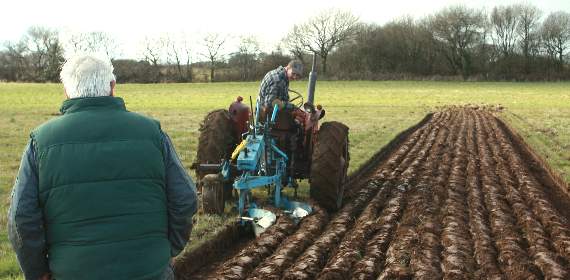
Probably for a century or more ploughing matches have taken place, mostly in the springtime, when farmers and their workers would take up the challenge at parish level to test their true abilities in the field and crowds would gather to acclaim the winner.
Ploughing matches are still held across the UK throughout the year. They offer the chance for both novice and experienced ploughmen and women to take part. It also remains a fantastic day out for families and people who enjoy the countryside and rural living.
More recently these competitions have become fewer and much more meaningful, so much so that there are now national matches each year leading up to the World championship which, in 2016, will be held in Yorkshire.
Many tasks on the farm demand less skills than actually ploughing a field and it has become the remit of the Welsh association to organise training courses not only for competitors, but for match judges as well - this makes the standard of judging less varied in the level of points awarded for different aspects and, hopefully, judges will work together and learn from each others experiences, making the quality of judging throughout the country better overall.



Ploughmen can also benefit from attending courses as they can see exactly what the judges are looking for in their ploughing. Different styles of ploughing plots are completed by some of the country’s top craftsmen and judged by the expert group leaders, and then in turn by all the attendees.
Knowledgeable ploughman, Gordon Harries, of St. Florence, says: “We have received very positive comments from people who have attended past courses, all saying how helpful it was and they have learnt much from it.”
A plough is made of many parts: To help bury the turf (or stubble from a previous cereal crop) a skimmer may be fitted just behind the coulter -this is a mini-mouldboard that trims a shallow slice off the top and tucks it in so that not even the edge of the turf will be visible at the surface after the plough has passed.
The plough point makes a horizontal cut at a preset depth and a slice of soil is lifted onto the clean mouldboard which turns it over and everything must be in line, sharp and firmly mounted or the tractor will have extra work to do.
The plough must be carefully aligned with the tractor and there must be exactly one furrow width between the inside of the rear right-hand wheel of the tractor and the first ploughshare.
A properly set-up plough will cut and turn the soil so that all of the weeds, grass and crop residue are buried with not a scrap of green showing - originally ploughs turned only one furrow at a time as that was all a team of horses could manage. On light soils now a powerful tractor can turn four or more furrows: there is always a trade off between the number of furrows ploughed at a time and the speed at which the plough can be drawn.
The object is to turn the whole field in as little time as possible as adverse weather can make the soil unsuitable for ploughing for weeks on end.
Expert ploughmen and judges gave up their time last week to instruct and encourage the less skilled at a training day held at Summerton Farm, near Tenby, by kind invitation of Mr. Andrew Mathias.
Comments
This article has no comments yet. Be the first to leave a comment.