
Race Awareness Training
No, not that sort. This refers to two sessions run at the clubhouse on Fridays, April 7 and 14, the first aimed at race officers, the second at race entrants, both to bring the participants up to speed on latest developments in RYA rules and on a potential hot potato - the club's policy on local handicaps for club racing and for the Coppet Week Regatta. Time well spent by those who attended - the problem being as always, that of preaching to the converted. The ones who should have attended were the ones missing - those for example who do not know the Unwinding Rule and who are doomed like the Flying Dutchman to sail the seas for ever waiting for the race officer's finishing signal which will never come as long as they fail to master the Unwinding Rule. There were signs of potential rebellion from hardened race officers like Ancient Mariner on receiving news of the latest wheeze from the RYA - that competitors should be pursued 'as soon as practicable' to be told 'Excuse me, but the OOD thinks you were over the line at the start and would be most appreciative if you would kindly come back and start again'. Diplomacy of that sort will come hard to SSC patrol boat crews.
Local Handicaps
During the winter months, while competitors were preparing their boats or not as the case may be, SSC's equivalent of a steward's inquiry has been beavering away behind the scenes, in the shape of the handicap committee - John Griffiths, Tricia Crew and Ancient Mariner. Speaking a strange language about RYA-YR2 procedure, Standard Deviation of Mean, Binomial Theorem, their efforts have borne fruit in terms of a most revealing analysis of past performance at Coppet Week events since 2002. To cut a long story short, there is a RYA analyis procedure which can deduce a standard corrected time for an individual race. Working backwards, this can be related to the actual time taken to calculate an 'Individual Performance Number' for each competitor in that race, i.e. the handicap to which they sailed on that occasion. These IPNs prove to be remarkably stable having regard to the variations imposed by wind weather and hangovers. In all classes, there are hot shots regularly sailing to 100+ points below the official Portsmouth yardstick for their class and at the other extreme, trundlers sailing to 100+ points above the class handicap. The hot shots can relax - there is no proposal to use this evidence to peg all competitors to a personal handicap, so that, as in golf or horse racing, the more you win, the more difficult it gets. Article of Faith No 1 of the SSC committee is that in every race, the best sailor should win. Nevertheless, the fundamental principle of the RYA handicap system is that the best sailor has an equal chance of winning, whether sailing an Asymmetric Whizzbang or a bathtub. The evidence is being used to rein back the faster boat classes where it is clear that advances in boat design are running ahead of the RYA objective. These changes will be used on a trial basis for both Coppet Week and club racing and closely monitored to promote fair competition.




Club Racing
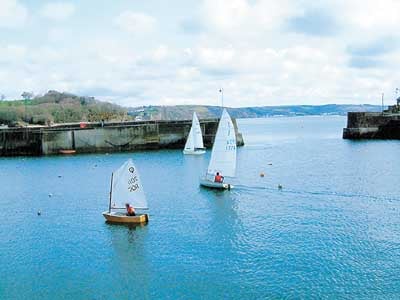
At this early stage of the season and after so much uninviting weather, it was commendable that there were 12 starters for the race on Sunday, which ended in a victory for Paul Griffiths (Laser), with Alistair Davies (Laser) in second place and Leighton Price (RS300) third. The accompanying photo shows that the weather was relatively calm, nobody tried to strangle the patrol boat crew, and alarums and excursions were few and far between.
Ancient Mariner