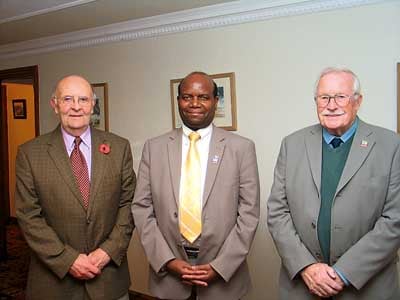
Members of the Rotary Club of Saundersfoot received an excellent presentation last week from past president Ian Nicholls, who was also a founder member of the club.
Ian was born in Tenby in 1929 and has real but mixed memories of the war years (1939-45).
When Ian was a lad, there were no Health and Safety risk assessments and he almost died before the outbreak of war. Together with other boys, he was excitedly running through the annual fairground in Tenby when he was struck on the head by a swinging boat. He collapsed to the ground, but fortunately a local doctor was passing and took him immediately to Tenby Cottage Hospital where he was operated on without delay. This prompt action probably saved his life. Nevertheless his injuries were such that he was forbidden to take part in sports such as football where he might 'head the ball'.
On September 3, 1939, he can remember sitting with his parents when Neville Chamberlain announced the outbreak of war, but little changed in the weeks thereafter in Tenby and some regarded it to be a 'phantom war' in those early days.


One of Ian's early and sad memories was the arresting of Italian and German nationals before internment. Ian had attended school with some of the children whose families were interned and he was shocked to hear that the Arandora Star had been torpedoed off the coast of Ireland in 1940. The Arandora Star was carrying some 1,500 passengers, mainly German and Italian nationals, for internment in Canada. The war suddenly had a local impact on him.
Soon after, Ian became aware of increased aircraft activity in the skies linked with Carew Airfield and the Sunderlands stationed in Pembroke Dock. He and his mates soon became adept at identifying all the aircraft that crossed their skies and he well remembers the noise from their engines.
At school everyone had a gas mask in a protective case and the boys used to play games, using them like large conkers. When they were asked in class to don their masks, the boys took great delight in blowing raspberries through the masks to the annoyance of the teachers. The songs sung at school also changed to those patriotic songs that are linked forever to the wartime period. This patriotism extended to the lads joining the Cadets so that they could take part in the numerous parades and salute anyone in uniform going about town.
The Americans arrived in great numbers with additional planes and, after the Dunkirk evacuation, even more uniformed personnel arrived.
Ian has vivid memories of the concrete pill boxes placed on Tenby's coastline and the concrete installations on the beaches.
Although he remembers seeing the pall of black smoke on the horizon from the bombing of the oil tanks near Pembroke Dock; as a lad it had little impact on his life. Whereas the four bombs that fell in the Tenby area provided a wonderful opportunity for Ian and his friends to gather shrapnel from the resultant craters, with no thought given to Health and Safety.
At the age of 14, Ian became a telegram boy and delivered telegrams all over Tenby. They provided a major source of communication to the service personnel, but unfortunately they were also used to inform families of the loss of life of a loved one in battle. Thanks to our cultural development, no 14-year-old children would be used today to perform similar duties.
There was a much brighter side to being a telegram boy, though, as the American personnel welcomed their arrival and gave them chewing gum and other freebies such as cigarette cards.
Thankfully, on May 5, 1945, Victory in Europe (VE day) was celebrated by the nation and Ian's life started to take on a more conventional role.
Ian recognises that this was only a small insight into a schoolboy's memories of events in Tenby during those difficult years; and it is important, especially at this time of the year, to remember what sacrifices were made by others at that time.
Ian's talk generated a lot of questions and the photographs that were passed around generated even more interest.
A vote of thanks was proposed by immediate past president, Keith Leighfield.
Comments
This article has no comments yet. Be the first to leave a comment.