

Plans are in place for a special event in Tenby this year to commemorate the connection between the seaside town and Belgium’s armed forces.
Tenby has a very important place in the national history of the Kingdom of Belgium, with the key fact pointing to the re-formation of the Belgian Armed Forces which took place in 1940 in Tenby after the catastrophic events on the continent during World War II.
The work achieved by the Belgian Ambassador, and General Van Strydonck, in May 1940, supported by the UK authorities was of national importance to Belgium and impacted on national morale for the Belgians.
Tenby epitomises the place where the restoration of Belgian respect and pride was restored in 1940. As a result of this decision Belgium was able to create a Brigade sized force and contribute skilled Royal Naval and Air Force es to the Allied war effort.



Without the decision the Belgians would have to reform the Belgian Army at Tenby in 1940. The Free Armed Forces of the European nations, the French, the Dutch, the Belgians, the Norwegians, and the Poles with others subsequently made a significant contribution to the war effort, politically and militarily.
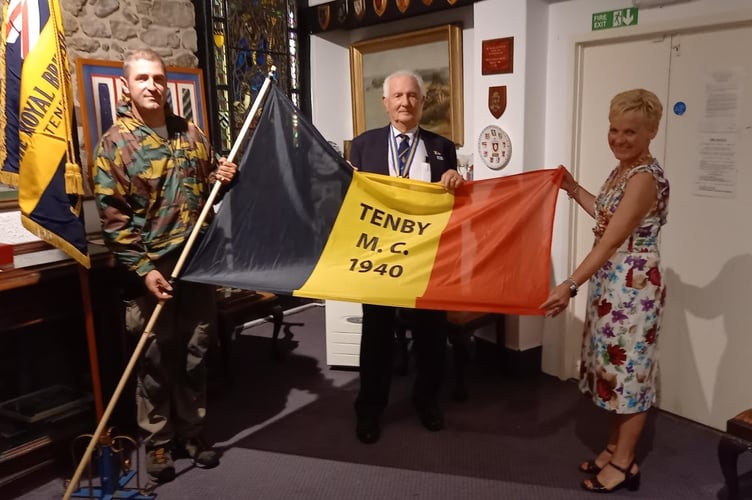
A Belgian Standard from the ‘Tenby Memorial Committee’ was presented to the seaside town’s branch of the Royal British Legion last year, to commemorate the re-formation of the Belgian Armed forces, with the Standard presented to Tenby’s Mayor, Cllr Sam Skyrme-Blackhall in the Mayor’s Parlour at the De Valence Pavilion by Captain Bruno Despret, a reserve officer of cavalry of the Belgian Army.
An Anglo Belgian Commemoration ceremony will take place over September 23/24 in Tenby this year to commemorate the 80th Anniversary of the re-formation of the Belgian Armed Forces - and event that had been previously postponed due to the pandemic.
Discussing plans for the event at a recent meeting of the Tenby Events Working Party, the town clerk Andrew Davies said that he’d held a recent meeting with Pembrokeshire County Council and those organising the visit from the Belgian side.
He explained that the original idea for the Sunday was a church service followed by speeches in Tudor Square and then a parade to the War Memorial to lay a wreath.
Although Tenby became the base for the Free Belgian Forces in 1940 - the Belgians appeared to want to replicate their ‘passing out’ parade in 1942 in Tudor Square, which was where they felt the commemorative plaque should be located.
It was felt that Tudor Square would be an inappropriate location for the memorial with the War Memorial Gardens or the Esplanade near the Atlantic Hotel (headquarters of the FBF during the war) being more suitable. The War Memorial grounds was deemed the best place.
It was anticipated that any wording for the commemorative plaque would have to be in four languages - English, Welsh, Walloon Flemish.
Mr Davies explained that PCC had become involved as this was developing into a big event, with the Belgian side wishing Armed Forces, the Lord Lieutenant and Chair of PCC to all be in attendance. There were also suggestions that Wales’ First Minister and the Belgian Ambassador were to be invited.
The event would require road closures for the town and the Town Council would have to fund the cost of these. Although PCC were going to see if this could be classed as a community event, meaning that the admin fees for the road closure would be waived, the costs of traffic management would still have to be met.
The ESAG had talked about the possibilities of not holding the element in the Square which would reduce the costs of road closures. PCC felt the parade could then be held under a rolling road closure rather than having to go to the expense of traffic lights on Crackwell Street.
The meeting felt that it seemed that the Town Council was being expected to be taking on more than was initially planned, and costings needed to be worked out, before approaching PCC for their help.
Comments
This article has no comments yet. Be the first to leave a comment.