
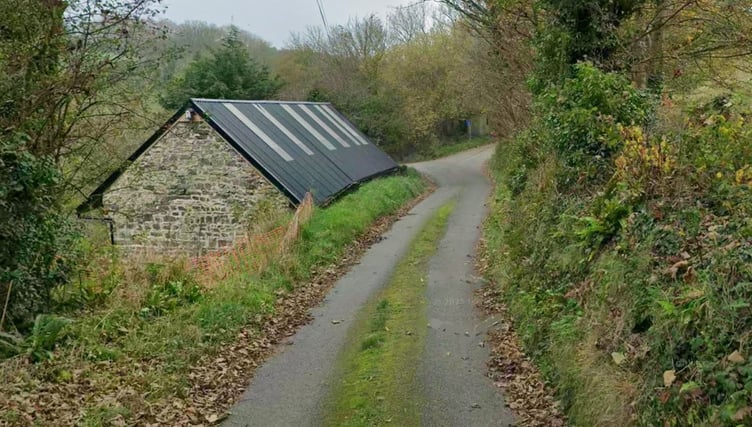
A call to convert a Pembrokeshire agricultural barn, part of a previously approved scheme for a ‘forest farm’, to a residential dwelling for an Oxfordshire couple has been refused.
In an application to the Pembrokeshire Coast National Park Authority, Mr and Mrs Stevenson, through agent JCR Planning Ltd, sought permission for the conversion of an agricultural barn to a two-bedroom residential dwelling with an ancillary office and workshop at Ty Llwyd Bach, Cippyn, St Dogmaels.
The previously ruinous barn was “brought back into productive agricultural use” in a 2023-granted scheme for a fruit and nut orchard ‘forest farm’ enterprise, a condition in that scheme preventing the building from being used for any residential accommodation.
A supporting statement accompanying the application said the applicants and their family “have been facing an extremely harrowing personal situation, which has contributed to their desire to relocate to a new, more calming and therapeutic rural environment, within which the family’s well-being and overall health can be prioritised”.
It added: “The benefits of working and further developing the forest farm enterprise will also undoubtedly assist in helping to heal their personal trauma, and indeed, provide a place of restorative sanctuary.”
An officer report recommending refusal said: “The absence of historical character of the original bwythyn [Welsh for a small cottage or small house] means the proposal is not considered a building appropriate for conversion to a dwelling.”
It added: “The previous scheme was supported by a business plan which demonstrated a commitment to establishing a horticultural business of a fruit and nut orchard based on permaculture principles of food forests with a view to offering training and workshops. Prior to [that consent], the building was in a ruinous state. A condition imposed with the [2022] scheme prevents the building from being used for any residential accommodation.”
It went on to say: “The building in question is the only agricultural building associated with the business and the only building occupying the overall land holding,” adding the proposed scheme “would represent 75 per cent residential use and 25 per cent agricultural use”.
It said the business “has not progressed as anticipated and is still very much in its infancy,” adding: “The planning statement acknowledges that the applicants are unable to satisfy the ‘functional test’ of rural enterprise dwelling policy guidance to justify the proposal, however state that ‘residing on site 24/7…is an essential requirement in order to take the enterprise forward’.
“The planning statement discloses that the applicants live in Oxfordshire and the authority consider that residing in the local vicinity alone is critical for progressing the business.

“The lack of an established rural enterprise does not justify the substantial change of use to residential in order to establish the business that gave rise to the previous proposal.
“This would wholly undermine the previous application which demonstrated that the building was necessary to support a rural enterprise.
“It is considered that the significant extent of change of use to residential and resulting loss of agricultural use space would not comprise a genuine mixed-use building.”
Find out about planning applications that affect you by visiting the Public Notice Portal.
The application was refused on the grounds of the barn not being an appropriate building for conversion, and its substantial loss for agricultural purposes “is considered to fundamentally undermine the establishment of the rural enterprise in terms of local and national policy and guidance on which the previous proposal was justified.”
Comments
This article has no comments yet. Be the first to leave a comment.