
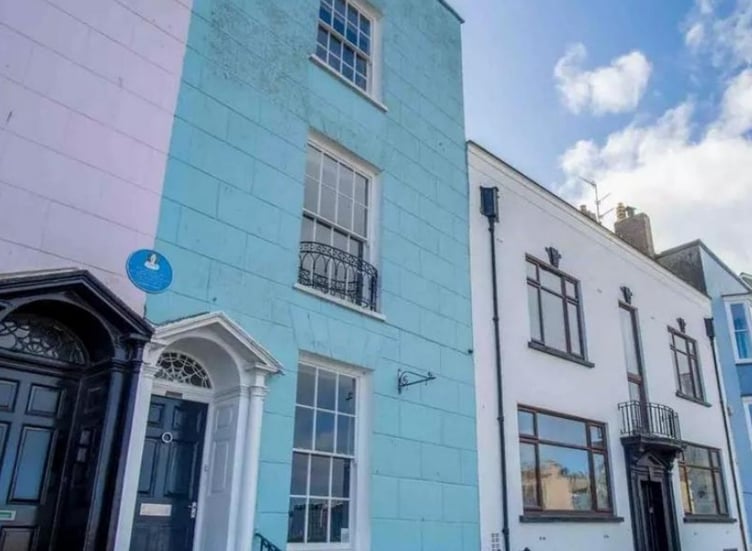
A call to allow a Tenby property, that overlooks the seaside town’s harbour, that is said to have inspired the Victorian author of acclaimed novel Middlemarch, to continue partly operating as a holiday let has been submitted to planners.
In an application to the Pembrokeshire Coast National Park Authority, Pavel Stepanek of Ty Gwynne Ltd, through agent Hayston Developments & Planning Ltd, seeks permission for a certificate of lawfulness for the use of the ground and upper floors of Gwynne House, Bridge Street, Tenby as a holiday let.
The property is a Grade-II-Listed building and forms one of a pair of early 19th-century houses in overlooking the town’s harbour and in the conservation area.
An application for a certificate of lawfulness allows an applicant to stay at or keep a development which has not had planning permission if they can provide proof of occupancy or use over a prolonged period.
A supporting statement accompanying the application says, back in 2014, the Park approved an application for the retention of Gwynne House as a mixed-use property; residential accommodation at basement level, with guesthouse accommodation on the ground and upper two floors.
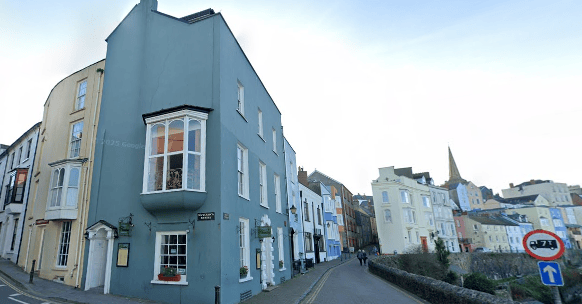
The property was purchased by Mr Stepanek in July 2021; a witness statement saying Gwynne House was already operating as a holiday let at the point of purchase, despite only having permission to be a guesthouse, the bookings honoured by him “demonstrating that the holiday letting use had commenced prior to his acquisition of the property”.
“Following acquisition, the property underwent a period of required refurbishment between late 2021 and early 2022. Upon completion of those works, Gwynne House resumed operation as a self-contained short-term holiday let and has continued in that use thereafter. The residential use and flat at the basement continued under the 2014 consent.”
It added: “At the time, Mr Stepanek was not aware of the subsequent introduction of Use Class C6 in Wales in late 2022 or of the potential planning implications arising from the classification of short-term holiday accommodation.
“His understanding was informed by the property’s established history as visitor accommodation, previously authorised as a bed and breakfast/guesthouse. For the purposes of this application, however, the relevant consideration is the factual nature, commencement and continuity of the established use now of a holiday let that has immunity under the four-year rule.”


It said that last September Mr Stepanek received enforcement investigation correspondence from the Park relating to the alleged breach of the 2014 planning permission; the change from the authorised bed and breakfast/guesthouse use to short-term holiday accommodation.
For the lawfulness call, it says the application is supported by evidence, including historic booking information, records relating to the management of the property and existing holiday bookings were in place at the time of purchase, as well as customer reviews of Gwynne House as a single-property holiday let back in 2020.
The lawfulness call will be considered by Park planners at a later date.
Gwynne House on Bridge Street in Tenby features a shared heritage plaque with next door commemorating the author ‘George Eliot,’ actually writer Mary Ann Evans, who it is said, while lodged at the property, was inspired to write her first novel.
Find out about planning applications that affect you by visiting the Public Notice Portal.
George Eliot’s most famous and acclaimed work is the 1871–1872 novel Middlemarch.
Comments
This article has no comments yet. Be the first to leave a comment.