
Border Country and the Tudor connections
Those of you who follow this page will know that from time to time, my husband Stuart and I take off in our camper van and, when visiting other places, like to look for connections in the hope of finding interesting snippets of history of relevance to Pembroke.
Great Malvern Priory
Our travels led us to Great Malvern, an attractive former Victorian spa town set in the beautiful countryside of the Malvern Hills. Great Malvern was particularly interesting for us in that it possesses a fine Priory which once belonged, like Monkton, to the Benedictine order of monks and it too has a link with Tudor history. In 1501, King Henry VII bestowed upon it a fine stained glass window, a window known as the Magnificat window because it contains the words of Mary's Magnificat song in which she praises God for making her the mother of Jesus. The bottom row of the window contains the kneeling figures of Henry VII and his eldest son and heir Prince Arthur, who was born in 1486. The guide book claims that this is widely considered to be the best portrait of Arthur anywhere in the country and a copy of it is in the National Portrait Gallery. Prince Arthur was the great hope of the newly established House of Tudor, a symbol of the union of the Lancastrian House of Tudor and the House of York and the end of the Wars of the Roses. The Tudors were great propagandists: during his exile, Henry's party had been at pains to establish his genealogy as Welsh, of the ancient British race, to gain support in Wales. His victory would be the fulfilment of the prophesy that a British King would sit once again upon the throne. Appropriately, Henry named his heir Arthur after the great British hero. However, another King Arthur was not to be: tragically, Arthur died in 1502 at the young age of 15.
Ludlow
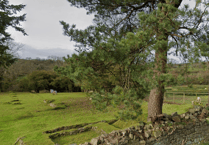
We followed the story to Ludlow, where Henry had established his Council of Wales and the Marches. He sent Arthur to govern there, under the guardianship of Rhys ap Thomas (of Carew), following his arranged marriage with the Spanish Princess, Catherine of Aragon. The young couple travelled to Ludlow in January 1502 to set-up their household in the royal apartments in Ludlow Castle. However, misfortune struck when both Arthur and his bride became ill, and on April 2, Arthur tragically died of what was described as 'sweating sickness'. It was a huge blow to his father the king, who was reported as being devastated at his loss. Catherine however survived, later to be married to Arthur's brother Henry, the future Henry VIII. Arthur's heart was buried in Ludlow and his body was taken to Worcester Cathedral where a fine canopy was erected over his tomb. Visiting the beautiful St. Lawrence's Church in Ludlow, we saw a plaque in the Chancel 'Arthur Prince of Wales died at Ludlow Castle 2nd April 1502 aged 15 years 7 months. His heart was buried near this place'. Arthur by all accounts was a very intelligent and well educated young man who had the makings of a fine king. Had Arthur lived to succeed his father, how different this country might have been - this is one of the great 'what ifs' of history.
Easter memories
In the Easter edition, I wrote about the practice of egg rolling at Easter, and this has evoked memories for many of you. As I have been away and out of television contact for 10 days, I missed the piece on the news which reported that Barack Obama led the egg rolling event when thousands of people rolled their eggs down the banks of the White House. So the practice still lives! This was told to me by Melanie Phillips, who often contributes to this page, and she went on to tell me that in Pembroke the term for egg rolling varied from street to street: "In the prefabs we called it 'trulling egg and cake', while in Owen Street, it was 'trolly egg and cake.' We rolled ours down the hill at the back of Jogram Avenue, which we called 'the Bank' where we liked to play. My friend Pru Pattison from Owen Street rolled hers down St. Daniels Hill." Mel also told me that the practice apparently is symbolic of the rolling away of the stone from Jesus' tomb. Customs die out and if anyone has any recollection of Easter customs, or any others for that matter, please get in touch so that they can be recorded. I was reading a little book on Pembrokeshire by M. Wight published in 1947 found in the little second hand book shop in Tenby. It had this to say: "Good Friday had its ancient customs. It is said that, in the Englishry, reeds were gathered and woven into the form of a man, fixed upon a wooden cross and laid in a field; this was called 'making Christ's bed.' Until the end of the 18th century, people in Tenby walked barefoot to church on Good Friday, 'so as not to disturb the earth'; this is said to be a pre-Reformation custom. Hot cross buns were eaten, and some of them hung up in the kitchen 'til the following year; these were thought to have healing virtues and to frighten away evil spirits.'
World War One project
This photograph, belonging to George Lewis, is of the opening of the Memorial Park Pembroke Dock in May 1925. It was opened by the Mayor W. G. Lloyd. Note the imposing County School in the background. Built in 1899, it became a grammar school following WW2 until the mid-50s when the new grammar school was opened at Bush. The old school became part of the Coronation School as a secondary modern school, closing in the 1970s, when Bush became a comprehensive school. The main part of the building was then demolished and the former Pembroke Dock Junior School built in its place. (Information from John Hogg's 'Lost in Time'). The remainder was later demolished and the Argyle Street Surgery now stands on the site.
Memory Lane
This photograph was given to me by David Williams and belongs to his brother-in-law Tony McTaggert. David does not know the date, place or occasion and wonders if anyone can? He can recognise some of the people in it: Top row (left to right): Mr. Greenslade (churchwarden at Monkton for over 20 years), Stanley Rowlands (headmaster of Monkton School) and David Williams (churchwarden at St. Mary's). Bottom row: unknown person then Lady Mary Meyrick and Tudor Evans (Vicar of Monkton).
May events
Tomorrow (Saturday, May 3) at Monkton Church Hall we have a local history coffee morning 10.30-12.30. At 11 am, there will be an audio visual presentation 'tales of the Pembroke River' and an update on our community history 'Through My Eyes' and WW1 project. Free event, all welcome. Friday, May 16, 7.30 pm, at Monkton Church Hall there will be a talk 'A History of the Castlemartin Tank Range' by Craig Stringer, of PCNP. Free admission. Friday, May 23, quiz night and social at Monkton Church Hall. £4 includes a delicious buffet. Bring your own bottle if you wish.
Freshwater West exhibition
I have been asked to draw your attention to an exhibition to be held on Bank Holiday Monday (May 5) on the history of Freshwater West Corse: comprising maps, drawings, photographs and documents at Angle Village Hall between 10 am and 4 pm. Vistors are encouraged to share their memories and bring along any photographs if they have any. Any queries, contact Thalia Campbell on 01646 621449.
Contact
If you have any stories, photographs or feedback for this column, please contact me, Linda Asman, on 01646 622428, email [email protected]">[email protected] and visit our website http://www.pembrokeandmonkonhistory.org.uk">www.pembrokeandmonkonhistory.org.uk
Comments
This article has no comments yet. Be the first to leave a comment.