
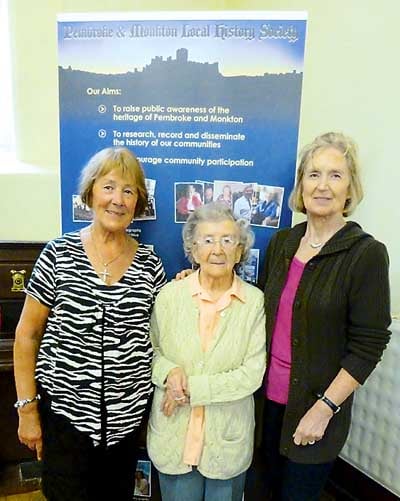
A week last Friday, April 19, I was not able to be present at our Friday evening meeting as I was, as those of you who regularly read this column will know, in Bergen with Pembroke Town Council. I was disappointed however, in missing our meeting in which our president, George Lewis, gave a talk on the Pembroke and Tenby Railway - which drew, I am told, a very large crowd: evidence of the popularity of the speaker and the very great interest in the subject.
Our forthcoming exhibition
This year is the 150th anniversary of the Pembroke and Tenby Railway and we are making this the subject of our major exhibition which will be featured in the Town Hall throughout the summer as part of the Court Room museum initiative of Pembroke Town Council in which we are participants.
In this exhibition, we will be looking at the Age of Steam. Steam had powered the Industrial Revolution of the 18th century which changed our society for ever. It also changed the way we travelled during the 19th century with the advent of the railways.



Getting about before the train
Road traffic at the beginning of the 19th century was still horse drawn. Great improvements had been made in road construction and likewise improvements in coach services: Pembroke's coaching inns: The Lion, The King's Arms and the Green Dragon (now the Nat West Bank) date from the end of the 18th century. Transportation of goods still relied upon sea and waterways or the huge lumbering stage-wagon. This was drawn by a team of six or eight horses and had a big canvas tilt or cover. Its wheels were about 15 inches broad to prevent the wagon from sinking where the going was soft.
Steaming along the roads
The mid-1820s began the great era of road steamers. The first successful one was built by Gurney. In 1827, he patented a steam coach; weight two tons, speed 10 mph carrying 18 passengers. Gurneys steam coaches were famous in SW England - they must have played havoc with the roads and were also much lampooned by cartoonists. Ha, ha, horseless carriages? Never take on!
However, with heavy tolls, opposition and enmity of the railway promoters he ceased to run his vehicles in the early 1830s. The end came with the Locomotive and Highways Act of 1861 which came into force in 1865. All mechanical road vehicles were restricted to a speed of 4 mph on country roads and 2 mph in towns; there had to be three persons in charge of the machine and a man with a red flag had to walk in front of it. This also had the effect of holding up the development of the motor car in Britain,
The Railways
And so effective land transport steamed ahead with the Railway Companies. In 1844, the South Wales Railway (the SWR) was formed to expand the railway into Pembrokeshire to promote trade with Ireland. Initially, Brunel planned to lay his main line to Fishguard with a southern branch to Pembroke from Whitland. But the plan changed. In 1846, it was decided to proceed with a main line through Haverfordwest to Neyland, where a harbour was to be built on the shores of Milford Haven. The North Pembroke railway opened in April 1856 with its terminus at Neyland, named New Milford by the SWR: the southern route to Pembroke was abandoned altogether.
And so Pembroke remained unconnected. Communication was as before by stage coach to meet the train at Narberth Road, now Clunderwen, or across the ferry from Hobbs Point to Neyland.
The P & T Railway Company
In 1859, The Pembroke and Tenby Railway Company was formed and an Act of Parliament (July 21, 1859) authorised the construction of the Tenby to Pembroke Dock section with powers to raise £80,000 and to borrow an additional £26,000. The scheme was to be completed within five years. Eventually, after delays and difficulties in raising the money, David Davies of Llandinam, a much-respected railway builder, agreed to take on the task in partnership with Eszra Roberts. They agreed to construct the Pembroke and Tenby line for £106,000 within the two years remaining of the five allowed in the Act. In 1862, construction began on the first stage of the railway from Tenby to Pembroke.
The opening ceremony
The P & T Railway's opening day, on July 30, 1863, was a quite an occasion. A general holiday was declared in both Pembroke and Tenby so that people could witness the historic event and there was great excitement: public buildings were decorated with flags and streamers and streets were adorned with arches of evergreens. Twelve trains ran each way that day, the first leaving Tenby at 7.30 am. The official opening train left Pembroke at noon carrying the Directors of the Company, Mayor of Pembroke (Alderman Henry P. Jones), the town clerk and Corporation of Pembroke, the High Sheriff of Pembrokeshire and the Mayor of Haverfordwest and other gentlemen. Crowds greeted the train at different places along the line and, on arriving at Tenby, the directors were met by the Mayor of Tenby (George White) and Corporation who congratulated them on the success of the undertaking. Thronged by crowds, the dignitaries then made their way to the Market House where they enjoyed a lavish public breakfast served with great ceremony and accompanied, no doubt, by numerous toasts and speeches.
The first train service
This first section was some nine-and-a-half miles long, with intermediate stations at Penally, Manorbier and Lamphey. All the stations were modest affairs with one platform each; Tenby was the Company HQ. Trains left Tenby at 7.30 am, 1 pm and 5.15 pm. Departures from Pembroke were at 10 am, 3.15 pm and 7.30 pm and the journey would cost you two shillings (10p) for a first class ticket or 1/6 (7.5p) for second class. Fares to and from Manorbier were charged at half price. By the end of 1863, 40,000 passenger journeys had been made. However, no Sunday trains were run, despite demand, because Sunday working ran counter to the Contractors' religious beliefs.
The Pembroke Dock connection
A coach connection ran from Pembroke station to Hobbs Point where passengers could board the ferry for a short trip across the Haven to new Milford, while work proceeded on the extension of the line to Pembroke Dock. Physical obstacles had to be overcome with bridges across roads, an embankment over the Millpond and a tunnel - but the work pressed on with remarkable speed.
Despite the engineering problems, only one year later on August 9, 1864, the Pembroke Dock line had its official opening - would take a lot longer than that today! Apparently, weather marred the celebrations, the first train arriving in a heavy shower of rain. However, when the weather suddenly improved a procession set off, a band leading the way, to the Victoria Hotel where a luncheon was held presided over by Jonas Dawkins, Mayor of Pembroke.
The daily service increased to four trains each way and passenger traffic increased. The P&T was a success and paying its way and looking to expand to Whitland ...
Looking ahead
This was the beginning and it is hoped that we can collect more photographs, reminiscences, memorabilia and information on the P & T Railway and its subsequent history during the course of the exhibition. It is also hoped we can prevail on George to repeat his talk on this most fascinating subject.
Contact
If you have any stories, photographs or feedback for this column, please contact me, Linda Asman, on 01646 622428, email [email protected]">[email protected] and visit our website http://www.pembrokeandmonkonhistory.org.uk">www.pembrokeandmonkonhistory.org.uk
Next
Event
Tomorrow (Saturday, May 4), 10.30 - 12.30, at Monkton Church Hall, coffee morning with slide show by Gordon Smith - 'the farms and buildings of the Castlemartin Range.'
Friday, May 17, 7.30 pm, quiz night at Monkton Church Hall. £3.50 includes a buffet - bring your own bottle if you wish.
Comments
This article has no comments yet. Be the first to leave a comment.