
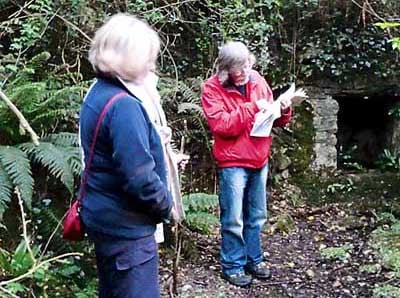
If you think researching our history is all about pouring over books, then you are wrong. Members of the Pembroke and Monkton Local History Society have been trekking over fields, clambering over fences to investigate our past.



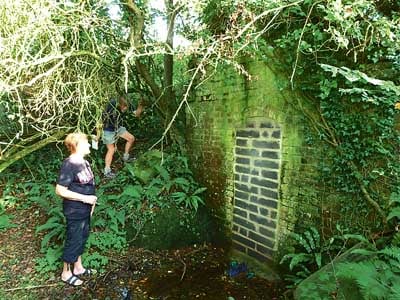
Whilst researching Monkton's history, we came across an entry in the 'Royal Commission on Ancient Monuments in Wales' (1922) which listed St. Nicholas's Well. No one seemed to know anything about the well, but we found it described in 'Sacred Springs: in Search of Holy Wells and Spas of Wales' by Paul Davis. Apparently it once served the Benedictine priory: the priors were responsible for tapping the source and directing the stream to the Priory along an open culvert. So we decided to go in search of it. With considerable difficulty we found a quite amazing, domed stone chamber, well hidden in undergrowth between fields at the head of the spring. It is this well that actually feeds into the 'old conduit' at the Watery Lane junction, opposite Church Terrace and the Priory Church. This is described in our heritage leaflet as the place where once the drovers watered their cattle.
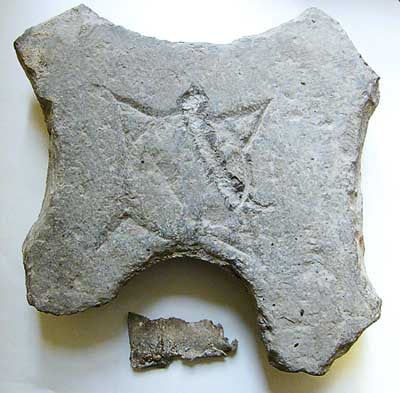
Spurred on by this discovery, we went to look for another Monkton well and close by is Norgan's well which is rather better known. The structure we found was in a bad way, with a tree growing through it and this had dislodged some of the brickwork. Breeze blocks now replace the old iron grill which lay discarded on the ground beside it and this had obviously been done recently. Norgan's Well has a really interesting story attached to it, a story I first heard from Terry John who took us on a 'Civil War' walk last year. In May 1648, Pembroke was besieged by a Parliamentary force of around 6,000 men and for six whole weeks the garrison, led by Pembroke's Mayor, John Poyer, held out against the might of Cromwell himself. However, the story goes that Pembroke was forced into submission by the cutting off of its water supply which was directed from Norgan's well along pipes into the castle. Its location was betrayed by a traitor named Edmunds who, it is said, did not benefit from his treachery: he was hanged near the spot and a cat stone placed over his grave. Some people dismiss this story, but others believe it: it is in any case part of local legend and it is stories like this which make history so interesting. That being said, the stone does exist. It was later incorporated into the perimeter wall of the old Monkton School and, after its demolition, taken to the Castle.
Comments
This article has no comments yet. Be the first to leave a comment.