
by Linda Gunning
In 1956, British writer Michael Bond bought a teddy bear from the London store Selfridges, upon which he based the famous Paddington Bear 'From Darkest Peru' stories.
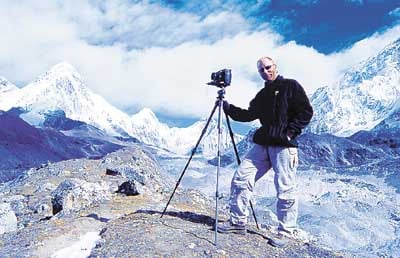
Fifity years later, relaxed and sipping a glass of wine in his Hodgeston home, award-winning photographer and one-time Tenby Observer journalist Rob Fraser talks to Linda Gunning as he recalls not only his expedition to Peru - where he accompanied Stephen Fry as the stills photographer in the making of the documentary 'In the Footsteps of Paddington Bear' - but also about discovering a passion for trekking which has taken him across the startlingly beautiful, if often rugged mountain ranges of Pakistan and Nepal.
Having been interested in photography as a young boy he spent most of his time taking shots of local wildlife, and was disappointed but not surprised when his family and school teachers discouraged him from turning his hobby into a career.

"I was told 'Forget this nonsense, university is the way to go'," smiles Rob, somewhat nostalgically. But his hunger for capturing the moment never diminished; this quiet yet determined young man had other ideas and he decided to join the Royal Air Force as a photographer.
He did not stay in the armed forces for the 22 years his father had, but maintains that it was a rewarding experience.
"But it was tracing 'Paddington Bear's roots in Darkest Peru' with Stephen Fry that really changed my attitude to travel and exploration. Having grown up with the Paddington Bear books and Michael Horden's animations, I felt an affinity with the eccentric little bear that was based upon the incredibly rare Peruvian Spectacled Bear, the reason for the BBC documentary," (shown Christmas 2001).
Once in Peru it was not long before Rob was involved with more than photography, as he became a member of a team of only five, their quest being to track the elusive bear in the Andes.
As Stephen Fry mused, a Brazilian explorer once spent six months following the bears, but never glimpsed one. But such was the determination of the team they went so far as bartering with locals offering shovels, corn and flour in return for the hunters releasing a bear destined to be eaten.
Eventually, after agreeing a settlement, the bear was airlifted to safety by helicopter.
On return to the UK and entranced by the beauty and wilderness of the Andes, Rob felt the world beckoning to him and decided to take up an offer to become a trek leader in the Himalayas. This presented him with the chance to explore one of the most photogenic areas in the world, from the North West Frontier to Nepal.
"I've recently spent 20 weeks trekking in the Himalayas, six trips back to back: two in Karakoram, one in India, one in Tibet and two in Nepal.
"The Karakoram is a vast and complex mountain range in Northern Pakistan, which boasts the greatest concentration of big peaks in the world including K2, and The Throne of the Kings. But of course it was Nepal which recently provided me with the award-winning shot of Mount Everest.
"However, pushing yourself to the limit is not without hardship. On the way to my last Nepal trip, I had to land in Islamabad due to fickle weather, then spent 30 hours on a bus travelling to Sakardu where I had to hire a jeep and driver, and spent a further nine hours driving over hostile terrain. This turned out to be an exhausting journey with unscheduled stops to help clear a path through a recent landslide. We had to lift rocks and boulders with our bare hands to remove them from the road."
Rob is now planning future trips, one of which will include a return visit to the country where people are warm and friendly and Spectacled Bears roam free.
"Paddington Bear not only lit the fires of children's imagination through adventure stories, he also influenced people's careers," proclaimed Rob.
And this eccentric, amusingly English little bear that donned a duffle coat and hat and carried a suitcase, must surely be held responsible for inspiring the rescue of a real live bear.