

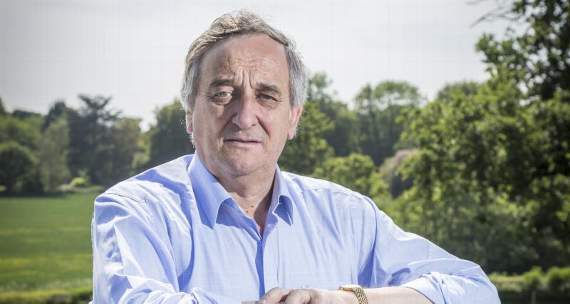
Local farmer, Meurig Raymond - as NFU national president (pictured) - was in Washington last week attending the 38th annual NA-EU World Conference examining the future of global agriculture and looking at 2026 forecasts for European products (based on the European Commission’s medium-term market outlook), farm incomes, in real terms, are likely to fall by 14 per cent over the next decade.
In summary, the EU report against a backdrop of low energy and raw material prices, consider that the price of agricultural products is expected to remain relatively low, in particular in the cereals sector. This should boost the production of animal protein.
Despite the current difficulties in the European dairy sector (drop in Chinese demand and the Russian embargo), there are still considerable export opportunities for cheese and milk powder.
The European livestock sector is unlikely to benefit much from the strong upward trend in global meat consumption (+13.5 per cent in 2026). Only the poultry sector could benefit from growth of five per ent in Europe. There is reason to hope that there may be stagnation in the pigmeat sector (+1.3 per cent in 2026) - the trend in these two sectors is primarily based on new export opportunities.



However, the European beef sector is expected to see a drop in production. The main driver of this change is the dairy herd (70 per cent of meat marketed in Europe).
The outlook for agricultural income in real terms is negative (-14 per cent by 2026). This downward trend is primarily due to the drop in global prices as well as an increase in production costs.
Agricultural employment is expected to drop further.
Environmental constraints are not taken into account in econometric models. With the implementation of the climate agreement (the ‘Paris Agreement’), there will be greater pressure on the dairy and meat sectors.
EXCHANGE RATES
The uncertainty surrounding exchange rates is also an important factor that could cause a significant shift in the market balance. There may be fluctuations of up to almost 20 per cent compared with the baseline scenarios. The reasons behind these currency fluctuations are both economic and political.
Econometric models struggle to assess demographic change and food demand in Africa where the population is expected to double over the next 30 years, to reach one billion inhabitants. Speculation remains on what kind of food will be in demand from these African countries: commodities to be processed domestically or imported products that are already finished?
Connecting to world markets is also proving difficult. Changes in infrastructure and the accessibility of storage capacity are all factors that can upset the market balance.
We are working with the European Commission to improve statistical data on production as well as storage capacity. Administrative authorities are increasingly withdrawing investment in data collection. To counteract this trend, we are carrying out studies under a public-private partnership on issues linked to production and storage capacity in the EU and are exploring the potential of big data.
We have set-up a market observatory for different production areas (cereals, milk, red meat), enabling all operators to help improve knowledge of the market. These observatories meet two to three times a year and bring together producers and their ooperatives, traders, the agri-food industry (biscuit production, semolina product, etc.) and the animal feed industry.
We contribute to the diplomatic missions of the European Commissioner for Agriculture in order to better understand market developments and consumption in third countries and to thereby adapt European products to global demand.
BREXIT
The decision of the UK electorate to leave the EU will have a major impact, and farmers and agri-businesses, both in the EU-27 and the UK, are likely to be hit hard and there are serious concerns about the potential trade and budget impact of Brexit on European farmers and their cooperatives.
It is important to ensure that the farming community in Europe, both in the UK and EU-27, does not pay the price of Brexit - Copa and Cogeca expect the UK government to honour its commitments, not only in terms of the current EU budget framework (until 2020), but also in terms of the programmes that it has subscribed to which go beyond 2020.
The impact on the future EU budget is clear, and as far as the current budget is concerned, it is fundamental that the negotiations provide solutions which prevent major disruption. Despite the obvious political challenge, the negotiations between the EU-27 and the UK should preserve the solidarity of the European farming community. A constructive relationship should be maintained in the interest of all parties involved.
The EU-27 is one of the main suppliers of the UK market and has a positive net trade balance in agri-food products with the UK totalling 45 billion euros. The UK imports between 70 per cent and 99 per cent of all UK imports from the EU-27. Brexit negotiations therefore represent more of a market loss risk than an opportunity.
Agricultural trade between the UK and the EU-27 is mostly concentrated in five EU countries: Ireland, Germany, France, Spain, Belgium and the Netherlands ‘hub.’ This clearly shows a deep level of integration among these economies. Organisation among sectors will be a factor of stability.
Fluctuations in the euro/pound sterling exchange rate are already having a significant impact on commodity prices, and this will be an additional volatility factor for all European agricultural markets.
However, Brexit can also offer opportunities for European agricultural markets given that certain goods (wine, dairy products and other agri-food products) are sometimes re-exported from the UK to the EU.
Nevertheless, in the medium to long-term, issues relating to production standards and mutual recognition of sanitary rules (single market recognition) will be of fundamental importance for future trade relations between the EU-27 and the UK.
Securing the economic resilience of the sector is particularly important in view of the 20 per cent drop in EU farmers’ income over the past four years. Farmers’ income stands at only 40 per cent of average earnings in other economic sectors.
The commission’s reflection paper recognises that it is better to combine resources than to have uncoordinated national spending. However, the implications for agriculture of the five scenarios presented in the commission’s paper are not particularly positive.
Even if the added value of common spending through a common budget is recognised as a good starting point, the level of the EU budget must clearly reflect the level of political ambition of the European Union.
Nevertheless and regardless of the level of the future EU budget, there is a need to finance new and emerging policy areas in order to meet the EU’s commitments including the subject of climate policy.
Comments
This article has no comments yet. Be the first to leave a comment.