
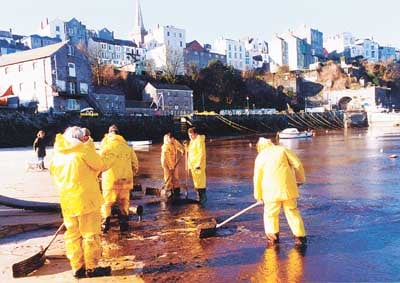
Ten years ago, Pembrokeshire was at the heart of one of the worst environmental disasters to hit Britain's coastline. The grounding of the 147,000-ton supertanker Sea Empress at the mouth of Milford Haven on that fateful day, Thursday, February 15, 1996, grabbed international headlines as the county faced a pollution nightmare which threated its economic and environmental future. A cloud hung over the area's popular resorts that was almost as dark as the mass of oil that flowed onto the beaches. Bitterness, sadness, anger and frustration were just a few of the emotions felt by local people looking on helplessly as our beautiful beaches were desecrated before their very eyes. A mammoth effort from armies of council workmen offered hope that Pembrokeshire's magnificent coastline could be returned to its former glories. And those efforts were rewarded, for now, a decade on, there is little evidence of the oil spill horror... although memories still remain.



A decade on, it has emerged that the Government has still not provided adequate emergency tug cover for the area. This failure has been condemned by Friends of the Earth as penny-pinching and irresponsible. On February 10, 1998, Glenda Jackson (Shipping Minister) announced in the House of Commons that "the Government was satisfied that the trials carried out since 1994 by the Coastguard Agency had demonstrated the capabilities of emergency towing vessels in preventing or lessening such risks." The areas provided with protection were the Dover Straits, The Minches (NW Scotland), Fair Isle (Shetland, NE Scotland) and Falmouth (SW approaches and western English Channel). Despite lobbying from Milford Haven Port Authority (which has also offered a free berth), local MPs and others, no emergency towing vessel (ETV) has been provided for the Irish Sea area. This leaves Milford Haven badly exposed with a huge gap between the Falmouth ETV (approximately 14 hours journey away) and the Minches ETV (approximately 24 hours away). The government announcement followed the recommendations made in reports completed after the disastrous oil spills caused by the loss of the tanker Braer (1993) near the Shetland Islands and the grounding of the Sea Empress (1996) at Milford Haven. Pembrokeshire Friends of the Earth spokesperson, Charlie Mason, said: "Given the pre-eminence of Milford Haven as the nation's premier oil port, the busyness of the Irish Sea's marine transport sector and the nature of some of the hazardous cargos carried through Irish Sea shipping lanes, it is hard to understand why the Government refuses to fund an emergency towing vessel for the area. "Government sources claim that a vessel for Milford Haven cannot be justified on cost grounds, but for the people and businesses of south-west Wales, this is equivalent to being told we must do without an ambulance service because it cannot be justified on cost. The Government levies taxes on every drop of crude oil imported into Milford Haven and on refined product exported from the port. The cost and impact of another oil spill will far outweigh the funding of an emergency vessel. "The situation is even more serious now with the prospect of tankers carrying hazardous liquefied natural gas (LNG) into Milford Haven in the near future. The extra danger that this presents should surely shake the Government out of its complacency on this issue." The environmental significance of the Pembrokeshire coast and the threats posed by shipping were recognised in the Department of Transport announcement earlier this week that the Pembrokeshire Islands are to be given the status of Marine Environment High Risk Areas (MEHRAs). This follows a recommendation made by Lord Donaldson in his report 'Safer Ships, Cleaner Seas' (May 1994) into the Braer oil spill off the Shetland Islands in January 1993. Gordon James, of Friends of the Earth Cymru (Wales), said: "We welcome the designation of the Pembrokeshire Islands as a Marine Environment High Risk Area (MEHRA). It's regrettable that it has taken the Government almost 12 years to do this. In view of what happened with the Sea Empress, we believe it should have occurred much earlier. "It is important that the requirements of the MEHRA designation are properly implemented so that all shipping avoids the most environmentally important areas and takes particular care off the Pembrokeshire coast."