

TALK ON ENVIRONMENTAL CONDITIONS IN THE SPACE STATION
At a recent meeting of the Narberth and Whitland Rotary Club, members were thrilled to have a young speaker tell about his involvement with the European Space Station.
It was a case of ‘One small step for man, one giant leap for Ysgol Dyffryn Taf School.’
The audience heard that four Welsh pupils had become UK winners in the European Space Agency’s (ESA) Astro Pi competition. They were Tyler Jenkins, Jack Collier, Harvey Yau and Oliver Carter, aged 17, from Dyffryn Taf School in Whitland.


Student Jack Collier was the guest speaker and he said that his team took their school motto of ‘aim for the highest’ literally and were consequently one of five teams across the UK to be recognised as winners of this competition.
The ESA’s Astro Pi competition gave students across Europe the task of designing a scientific experiment that could be run on an Astro Pi onboard the International Space Station (ISS). Astro Pi is the name of a small computer developed by the Raspberry Pi Foundation, in collaboration with the UK Space Agency and ESA. There are two Astro Pi’s onboard the ISS that are equipped with a set of sensors that can be used to run scientific experiments.
There were several rounds to compete in which each required a different set of scientific and digital skills. The Whitland students computer code was then sent to the ESA to be judged on quality, coherence and originality. The winners of the competition went on to have their missions turned into reality. The code for their experiments was uploaded to the ISS (International Space Station) to be run and tested in space.
The team at Dyffryn Taf said: “The ESA specified that we had to write a program to detect when an astronaut was nearby. We accomplished this by using the humidity sensor. By measuring how much the humidity increases we should be able to detect crew presence on board the ISS.”
They also created their own experiment to be carried out.
“Our idea was this; the ISS orbits the earth in just 92 minutes and as it does it moves over some countries where it is day and others where it is night. We wanted to see by how much, if at all, being directly in the view of the sun would affect the temperature on board the ISS.”
As winners, the computer code that they wrote was tested on the International Space Station in May 2017. They subsequently received the data that their experiment collected.
“We were inspired to enter the competition after our computer science teachers Mr. Neil Roberts and Miss Lucy Anthony told us about it. We’re so glad we did because we gained a lot from the experience.
“We’ve all learnt how to use different computer programmes such as Python and developed a lot of our existing skills.”
The team of four are the first ever Welsh team to become winners of this competition.
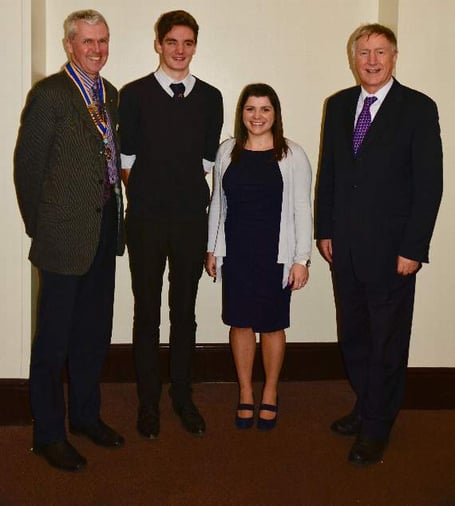
Jack is pictured with president David, head of Ysgol Dyffryn Taf Mr. Robert Newsome and science teacher Lucy Anthony after a presentation at the Narberth and Whitland Rotary Club meeting in The Plas Hyfryd Hotel, Narberth.
Participation in club activities with speakers like Jack Collier is a fundamental part of Rotary membership benefiting individual Rotarians and the club. Consequently, all members are encouraged to attend weekly meetings, social functions and visits, but this is not compulsory. All 32 members of the dual-gender club are volunteers.
If you would like to know more about the club membership and activities, contact secretary John Sleigh on (01834) 860014 or 07889 872 981.
Comments
This article has no comments yet. Be the first to leave a comment.