

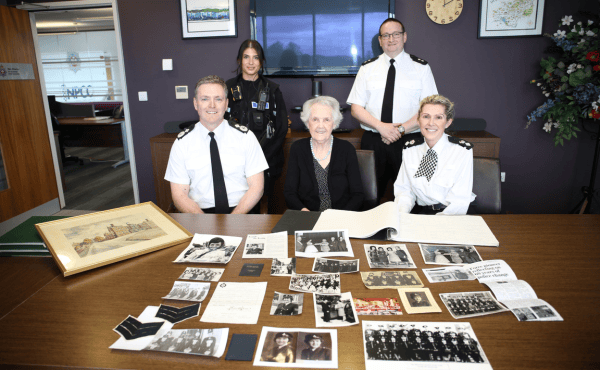
In 1953, Jean Evans walked the beat alone. No radio, no backup. Just a whistle and the courage to use it.
During the month in which International Womens Day falls on, Dyfed-Powys Police are celebrating women who inspire, lead and support within policing to strengthen communities; whilst reflecting on 70 years of change through the eyes of the women who became the Force’s first female Police Sergeant in 1958.
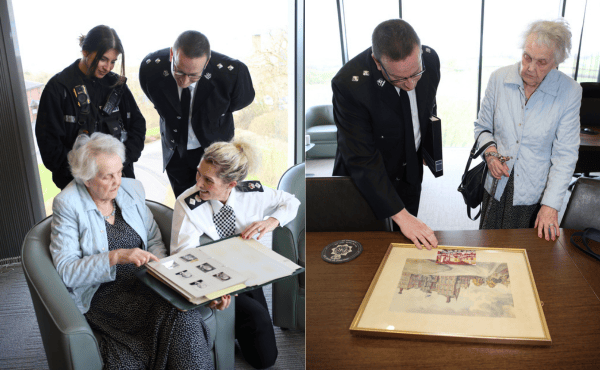
Jean Evans Carmarthenshire’s first Female Police Sergeant has been reflecting on her days in service during her commemorative visit to the Dyfed Powys Police’s HQ in Carmarthen, offering reflections and advice for the future of women in policing.
“You went out on your own…you just had a whistle, tuition and hoped for the best!” said Jean of her early days on the beat.


Jean from St Clears joined Carmarthenshire Constabulary in 1953, aged 21, after spotting an ad in the local paper.
Jean was one of only three or four women to apply and after attending an interview in King Street with Chief Constable T.H Lewis, became a “woman police officer”.
During her interview, the Chief Constable mentioned the need for women police sergeants and from that moment, she set her ambition.
In 1958, she was promoted to police sergeant in Carmarthenshire and Cardiganshire Constabulary, becoming the first female in the force to rise to this rank.
In the 1950s, discipline was strict, with policewomen being required to keep their hair short and forbidden from wearing jewellery or removing their hats in public.
“Looking sharp was essential, if you were seen without your hat, you would be put on a charge,” she explained.
Leading by example in a male dominated field, Jean was responsible for 16 policewomen in stations such as Aberystwyth, Ammanford and Llanelli, supporting them through board exams, progression and professional development.
Jean continued: “Senior policemen didn’t accept the introduction of female officers as much as the younger policemen, you had to prove your place in the job.
“They weren’t used to having women in stations and the married ones were worried their wives would think they’d get up to no good - which was ridiculous!”
As a Sergeant, Jean’s duties were predominantly dealing with local women and children by interviewing vulnerable victims of public displays of nudity, domestic calls and drunken disorderly conduct.
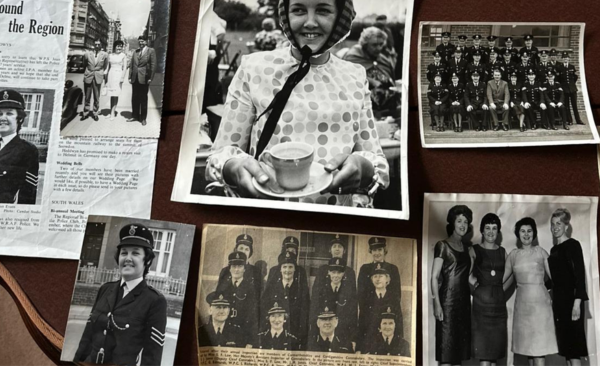
“You went on your own. You didn’t have another policeman with you…and I didn’t have any wireless. You just had a whistle, tuition and hoped for the best,” she remarked.
“I would regularly visit the town’s 39 pubs, especially on Saturday nights to monitor underage drinking and foul language to ensure order within the community.
“I loved my job being out on the beat all day, at times I felt if there was a stranger in town, I would be aware of it as we more or less knew everyone.”
One of the first major crime incidents Jean was involved in was the Carmarthen 1953 Pendine murders of John and Phoebe Harris.
Ronnie Harris, their nephew was convicted of the murders and was the last but one prisoner to be sentenced to death by hanging at Swansea Prison in 1954.
On 16 November 1953 the bodies of the missing farmer and his wife were discovered in a shallow grave at Cadno Farm. They had been battered to death by repeated blows from a circular blunt instrument - in fact, a hammer just like the one owned by Ronald Harries - and the bodies buried in a field of kale.
Harries was arrested, despite protesting his innocence, and charged with just the one murder. That was the practice of the time, even though there were clearly two bodies and two killings.
Harries continued to claim he was innocent throughout his trial, which began on 16 March 1954. Such was the interest, right across west Wales, that a crowd of several hundred gathered outside Shire Hall in Carmarthen, some of them having been there since 3.30am. Many of the crowd came from the Pendine area. Crowd control was provided by barriers made of trestle tables and rope.
Ronald Harries sat, immobile, in the dock, his arms folded and barely a gleam of emotion on his face as the story was told by the prosecution. A guilty verdict was inevitable and he was sentenced to hang at Swansea Prison.
As he left the court, Harries - handcuffed to a prison warder - managed to raise his hand to friends and acquaintances in the crowd.
Many previous executions in Swansea had been carried out in public, on the dunes outside the prison, but this one took place inside the prison on 28 April 1954. Ronald Harries was the last but one prisoner to be executed at Swansea; the final death sentence was carried out on one Vivian Teed four years later.
Harries had been blasé ever since his conviction but when the public executioners Albert Pierrpoint and Robert Stewart came to his cell on that final morning he is said to have collapsed and had to be assisted to the gallows.
His motive behind killing his distant relatives was never totally clear and he went to his death still protesting his innocence. In all probability the deed had been carried out with a view to financial gain but the murders had been poorly conceived and badly thought through.
“I was in court throughout the trial to support the families in the court proceedings and witnessed him being found guilty of murder,” said Jean.
“I knew Ronnie from my previous job working in a local shop and I hadn’t realised until attending the court sentencing, that I had gone to grammar school with his wife.”
When asked what advice she would give to women entering or established in policing now, her advice is simple yet powerful.
“Have the community at the heart of your duties. Local knowledge and walking the beat was always my priority. Do the best you can and always be polite,” Jean said.
Jeans visit to HQ via Police escort was all thanks to Temporary Chief Superintendent Jolene Mann, who added: “This International Women’s Day reminds us that when we give, we gain.
“Women like Jean, have helped pave the way for female leaders like me. Their determination opened doors and I am proud to play my part in keeping those doors open for our current and future generation.
“By mentoring, coaching and supporting women across both officer and staff roles, we continue building a truly inclusive organisation – one that reflects the communities we serve.
“When we share our experiences, knowledge and actively encourage and support one another, we strengthen our workforce and improve the services we provide to victims and our communities.
“I am committed to giving back and inspiring women – both within and outside of policing – to see this profession as a place where they can grow, lead and make a real difference.”
Today’s policing environment has significantly changed since becoming technologically advanced, more diverse and offering wider opportunities for progression, but the foundations remain the same: leading with truth, integrity and courage.
Jean’s legacy lives on, not only in the rank she achieved, but in opportunities now open to every woman who chooses to wear the uniform.
Comments
This article has no comments yet. Be the first to leave a comment.