
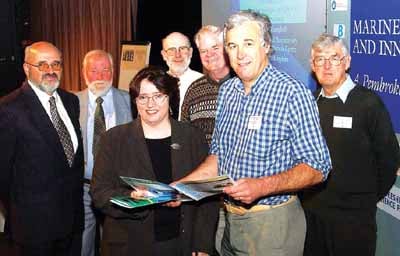
A marine sabbatical centre with the potential to offer research and development facilities for the design of drugs from marine organisms to impact on high profile and diverse human diseases such as cancers, cardiac arrhythmia, and epilepsy could lead Pembrokeshire technologies into the million dollar international market if the vision of the Darwin Centre for Biology and Medicine is realised.
Is this vision of the Darwin Centre feasible? "I believe it is possible," said Chairman of the Welsh Development Agency Roger Jones who added; "There are a number of milestones we have to pass but I for one would be a very enthusiastic supporter of it and I am sure that the board of the WDA would very much like to see it happen".
With the award of ERDF Objective One funding the feasibility for a Darwin Centre in the county is now underway. The questions which need answering in the feasibility study were addressed by speakers and delegates at a two-day marine conference at Pembrokeshire College last Thursday and Friday, an event which was organised by the Pembrokeshire Darwin Science Festival on behalf of their parent company the Darwin Centre.
WDA Chairman, Roger Jones OBE, wished the Darwin Centre 'every success for their ambitious plans for their Darwin marine centre' in his address to the conference. The WDA were major sponsors at the watershed event which saw international speakers joining forces with local experts to discuss the marine environment of Pembrokeshire under the guise of four main areas – what is special about the marine environment of Pembrokeshire, the molecular and cellular biology of marine model systems, education and the public understanding of science, the commercialisation of marine systems.


In his speech Roger Jones alluded to the message that marine system commercialisation offers significant potential for many coastal areas, including communities affected by recent job losses. He outlined the Agency's overall strategy, emphasising a holistic approach to the economic development of sensitive coastal areas and the contribution of research and development.
Also speaking about the commercialisation of marine systems, this time from an academic research standpoint was Professor Bill Ward, Centre for Research and Education in Bioluminescence and Biotechnology, Rutgers University, USA. He argued that in his opinion the biggest problem facing the commercialisation of basic research was the lack of mechanisms, facilities, and funding to move exciting and entrepreneurial basic research from the bench to the bank. 'We need to address better ways to seed promising research and to keep our academic entrepreneurs productive'.
Other speakers on the subject of commercialisation included: Ted Sangster, General manager, Milford Haven Port Authority; Michael Wilkins, Channel Marine Ltd, a company which provides an inshore mapping service; Dr Anthony Farmer, whose international consulting firm provide technical services and advise in coastal and marine resources management, commercial aquaculture and fisheries development; and Dr Eamonn Kelly, Bord Iascaigh Mhara (Irish Sea Fisheries Board).
Dr Kelly spoke about the 'Development of the inshore fisheries in Ireland'. This prompted Nic Wheeler, Chief Executive of the Pembrokeshire Coast National Park Authority to ask Roger Jones chairman WDA "could the WDA do something to assist natural inshore fisheries like the Irish Government?"
In a positive response Roger Jones said he thought it was "something we should definitely look at, because it feeds well into the 'Food from Wales' aspect".
On Friday Director of Southampton Oceanography Centre, Professor Howard Roe delivered the Alfred Russel Wallace Lecture entitled 'The Blue Planet – Challenges and Opportunities'. He discussed that in order to understand and to be able to rationally manage the oceans we must consider them as an interactive system, which is part of the total earth system. He described the many research challenges, which include the role of the oceans in global climate change and climate variability; natural resource management, both living and non-living; biodiversity and the health of the ocean; environmental risks; coastal zone management.
He urged people not to forget that amidst the strategic and relevant issues, oceanography, particularly deep-sea oceanography, is one area where we can still make important areas by serendipity. There were, he added, only a few people, some of whom were in the audience, who on a regular basis had held in their hands marine organisms which were previously unknown.
One of those people is deep-sea biologist Professor Peter Herring NERC at Southampton Oceanography Centre who, over the course of his career, has undertaken some 58 research cruises. The audience was enthralled as he showed video footage of some of the mysteries of the deep including 'black smokers' on the plate boundaries of the ocean floor.
What next? The Darwin Centre is using feedback gleaned from the round table discussions in the feasibility study into the possibilities of developing a marine centre in Pembrokeshire. The funding for the study has come from ERDF Obj1 and is to be completed by the end of September 2003.