
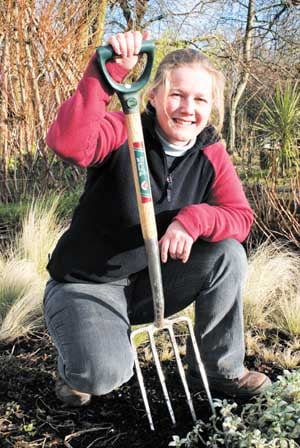
Pembrokeshire's Laura Davies is spearheading a campaign by Dwr Cymru Welsh Water to encourage people to reduce water waste to help the environment. And she is giving a message to gardeners in Wales: 'Ditch the sprinkler for a healthy and water efficient lawn this summer.' She says sprinklers are one of the biggest consumers of water in the garden - often needlessly. Laura, who grew up in Carew and was educated at Greenhill School in Tenby, is now senior horticulturalist at the National Botanic Garden of Wales. She is supporting the water company's efforts to promote water efficient gardening - encouraging people to use water wisely by avoiding lawn sprinklers, using water butts instead, and following natural ways of keeping plants healthy. As part of Welsh Water's 'Be Waterwise' campaign, Laura gives monthly tips on the company website, and also in a cartoon strip circulated to media throughout Wales. Laura, 33, who now lives in Llandeilo, but whose parents Allan and Diane Davies now live in Sardis, has a biology degree. Her love of plants led her to specialise in horticulture, taking her to jobs in various stately homes in England before returning to Wales. She is now responsible for the team that manages the outside gardens at the Botanic Garden. Welsh Water has launched the 'Be Waterwise' campaign as climate change may bring hotter and drier summers to Wales, increasing pressure on water resources. Encouraging wise use of water will conserve available supplies. Laura said: "In many gardens, water sprinklers are a waste of water as well as time. They just aren't needed. A watering can supplied from a water butt does the job well, without soaking the grass. "We never water our lawns at the National Botanic Garden; and even if they dry out during a heat wave they'll spring back to life after the first rains. We try not to water anything planted in the soil, except from when it is first planted. We want plants to send their roots down and find their own moisture, rather than relying on regular watering. "Where there are plants that need watering, then a water butt is the 'green' way to get a supply from rainwater - or even by recycling bath water and water from washing up." To see Laura's gardening tips, log on to http://www.dwrcymru.com">www.dwrcymru.com For the National Botanic Garden see http://www.gardenofwales.org.uk">www.gardenofwales.org.uk


LAURA'S WATER EFFICIENT GARDEN
By now, spring should be in full swing. Although we have hundreds of thousands of daffodils at the National Botanic Garden of Wales, everyone's garden should have at least a few of them - in the border, lawns or pots. Dead-head daffodil flowers as they fade to prevent the formation of seed heads which will take energy from the bulb. Also, don't tie the foliage in knots, but allow to die back naturally. If the leaves persist, or look particularly untidy, it is usually ok to cut the leaves back six weeks after flowering without affecting the health of the bulbs and hence next year's display. Start off your summer bedding by sowing seed in the heated propagator or greenhouse. Now is the time to prune summer-flowering deciduous shrubs such as Buddleia, hardy Fuchsias, Caryopteris, Perovskia and Lavatera. Many of these can be cut back to a 'stool' to control their overall size, and reduced back to the same point year after year. This is a good month for planting trees, shrubs, hedges and roses, particularly if you are on heavy or wet soils like us. Considerable damage can be done to the structure of soil by working it in the wet. We often work off planks to reduce compaction and prevent our boots gaining an extra six inches of sole! Once you can get on the soil, add as much organic matter as you can, whether it is your own garden compost, spent grow-bags, well-rotted manure or soil-improver. Not only will you help improve the fertility of the soil, you will also improve the structure, which makes for better drainage in the winter and water retention in the summer. And finally, a warm spell will set off weed growth with a vengeance. After you have weeded each flower bed, give it a good layer of mulch, up to six inches if using organic matter. At our garden, we also use inorganic mulches, such as gravel and crushed slate. Both types will help prevent weed growth and germination, keep plant roots cooler as the air temperature rises and also retain moisture within the soil, reducing the need for watering in the summer.
Happy gardening!