

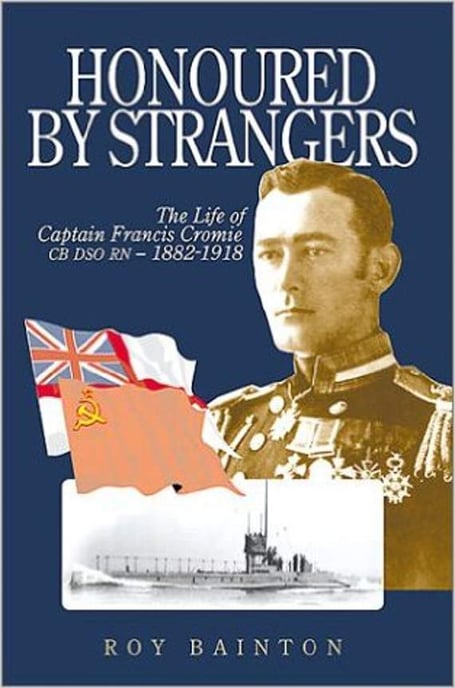
Writer Roy Bainton’s biography of World War I submarine hero Captain Francis Newton Allen Cromie, Honoured by Strangers, celebrates the achievements of a dedicated naval officer, who was raised in Haverfordwest and attended Haverfordwest Grammar School until joining the Navy aged 15 in 1897.
Cromie had remained a forgotten hero until Bainton uncovered his story following a trip to Sweden in 1999. With the aid of the Royal Navy’s Submarine Museum in Gosport, he was able to piece together this man’s short but impressive career.
Aged 18, he was decorated for his role in Naval Brigades during the Boxer rebellion in China. He was in command of a submarine at the age of 24, and won the Royal Humane Society’s Bronze Medal for saving the life of a drowning sailor in the English Channel.
In 1914, he was commanding the Hong Kong Submarine Flotilla when Winston Churchill, then First Lord of the Admiralty, called him back to Britain to lead an expedition of four submarines into the Baltic, to join the flotilla already based in Tallin. There Cromie’s 200 men and seven subs would soon do battle with the German Navy, with Cromie’s boat, HMS E19, sinking five ships in one day in October 1915. For these events he was decorated three times by Tsar Nicholas II.



When the Russian Revolution broke out, Lenin pulled Russia out of the water and the Russian Navy mutinied, killing over 1,000 officers overnight. Cromie became a mediator between the Royal Navy and the Bolsheviks. He met Lenin and Trotsky. With his skilled patient diplomacy and fairness, he saved the lives of numerous condemned sailors.
In 1918, when his men were sent home, he took his seven subs out to sea and scuppered them, rather than let them fall into German hands.
Although a married man, he was deeply involved with a Russian socialite, Princess Sophie Gagarin, and to prolong this liaison he stayed on at the British Embassy in Petrograd as Naval Attaché.
His involvement with espionage with the ‘Ace of Spies’ Sidney Reilly and the British Envoy Robert Bruce Lockhart led to him being duped in a scam by the Cheka (the forerunner of the KGB). When the Embassy was raided on August 31, 1918, Cromie, pistols in hand, defended it to the last, but died from bullet wounds on the staircase. He was buried in the Smolensky Cemetery, and Soviet sailors saluted his cortege as it passed along the Neva.
• Roy Bainton will be giving an illustrated talk on the life and murder of Captain Francis Combie CB DSO RN, 1882-1918, at the Picton Centre, Freemans Way, Haverfordwest, next Tuesday, October 11, at 7.30 pm.
He is also currently seeking interested production companies with the intention of this story becoming a TV documentary in time for the centenary of Cromie’s murder in 2018.
Comments
This article has no comments yet. Be the first to leave a comment.