
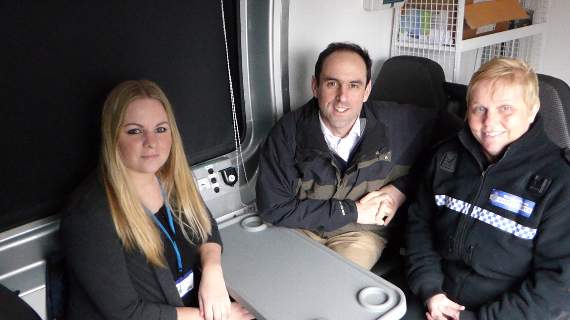
=People in mental distress during a Dyfed-Powys Police incident are now less likely to end up in a cell.
A new scheme saw mental health detentions to custody across Carmarthenshire, Ceredigion and Pembrokeshire fall from 100 in 2014 to 57 last year (Carms - down from 19 to 10, Ceredigion - 27 to 15, Pembs - 54 to 32).
The Dyfed-Powys Street Triage sees police officers and Hywel Dda University Health Board personnel work side-by-side to help vulnerable people with face-to-face and phone support.
Vulnerable individuals are now more likely to get the attention they need swiftly and with health service expertise.

-(1).jpeg?width=209&height=140&crop=209:145,smart&quality=75)

Police and health leaders have extended the innovative Street Triage from its pilot year, which ended in December, by two years.
Success was made possible by key support from Police and Crime Commissioner Christopher Salmon.
Mr. Salmon, who funded two unmarked consultation vans which travel to police incidents, said: “I’ve seen first-hand the work of this unit. They transform how we deal with the most vulnerable in the midst of crisis.
“By working together, police officers and mental health professionals are able to ensure the public are protected and the sick get treatment in hospital.”
The Street Triage was launched in early 2015 after concerns about the increased numbers being detained in cells under the Mental Health Act while the individual waited for assessment.
It is led from Carmarthen’s Dyfed-Powys Police HQ by PC Celt Thomas and mental health clinician Ed McHugh. Its core operating times are 4 pm - midnight.
When police officers arrive at an incident the pair are alerted if there is thought to be a mental distress element. Their response ranges from phone advice to attending the incident in their van. In all cases the aim is to get the appropriate health treatment, advice or guidance for the individual in the right health environment.
As a result, the numbers going to secure health locations is up - from 109 to 141. These included 44 going to the Cwm Seren Ward at St David’s Park Hospital, Carmarthen, 37 to the Bryngofal Ward at Prince Philip Hospital, Llanelli, and 57 to the St Caradog Unit, Haverfordwest. This year, as officers’ knowledge widens, it is hoped these numbers will fall.
Dyfed-Powys Chief Constable Simon Prince said: “The units provide our communities with mobile and dynamic assessment facilities during mental health detentions.
“The vision is to take bold and innovative steps to provide a better service for people who are suffering with issues relating to their mental health.”
The pioneering work has been recognised across Wales.
The Street Triage was recognised in the NHS Wales Awards for working seamlessly across organisations. In December, the Welsh Government unveiled a national concordat on how organisations will best work together to ensure people get the help they need during a mental health crisis.
The financial savings to the public purse are likely to be significant.
Libby Ryan-Davies, director of mental health and learning disabilities for Hywel Dda University Health Board, said: “The Street Triage service has provided a responsive alternative for people in mental distress who come into contact with the police.
“Police officers and mental health practitioners have worked cohesively to ensure that peoples’ needs are met at the earliest opportunity.
“This is an innovative project truly delivered in partnership, and the University Health Board is delighted to support its ongoing development.”
Commissioner Mr. Salmon said: “This great success shows how clear communication between two sets of professionals can address a problem early and appropriately.
“I’m delighted that organisations across Wales now recognise the importance of treating mental illness as a health issue, not a police one.
“The work of all those involved in delivering our local service is to be applauded; a huge amount of effort and expertise has resulted in a great new project.”
Comments
This article has no comments yet. Be the first to leave a comment.