
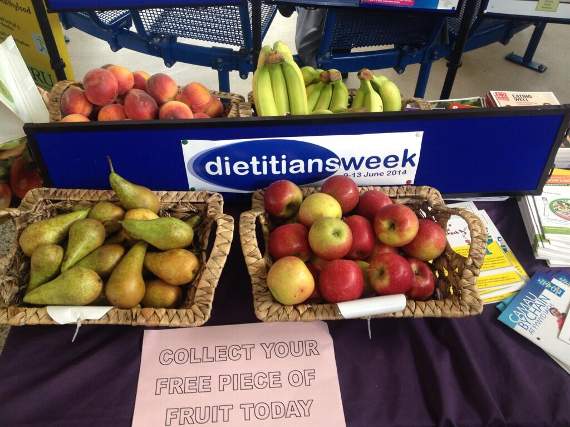
To mark National Dietitians Week 2016 (June 6-10), specialists from Hywel Dda University Health Board have been dispelling some common myths about dieting and giving expert advice for people who want to lose weight safely.
Paying close attention to the evidence and recognising how certain diets are ‘marketed’ to the public are just as important as dieting itself, says Claire Jones, the health’s board’s clinical lead weight management dietitian.
Many of us struggle to lose weight and it’s common to look for the next quick fix which many fad diets promote - but the reality is that, as weight gain occurs over a period of time, so weight loss is more likely to be successful if achieved gradually over a realistic time period.
Claire said: “It can be so tempting when you are struggling to lose weight to try the latest trendy diet which appears in a new book or in the media, especially when they are endorsed by a celebrity.




“But before embarking on the latest trendy diet, ask yourself whether this is based on evidence and whether the person marketing the diet is an expert in nutrition and weight management.
“Whether it’s the Atkins, Alkaline, Blood Group, Cabbage Soup, Dukan, Paleo - the list is endless - they all have common themes, such as avoiding or limiting foods within a food group, like dairy or carbohydrate; eating an abundance of a few types of food, avoiding certain food combinations or following a strict calorie restriction in the first few weeks of the diet.
“A drastic reduction in calories will lead to rapid weight loss at first - which can be very motivating - but the reality is that the weight loss will be down to depleted energy stores and water loss, rather than fat loss. This may even lead to muscle loss.”
Limiting food choice is likely to be difficult to stick to in the long term and it is possible that you will be risking your health by cutting out food groups which supply important nutrients the body needs.
Carbohydrates such as bread, potatoes and grains are often seen as the ‘enemy’, but in fact these provide a valuable source of vitamins and minerals as well as energy.
Claire added: “The issue is often more to do with portion sizes and what else you add to these foods, such as how much spread or butter you use, which then bumps up your calorie intake.
“Some of these diets promote large quantities of foods containing protein like meat, fish, eggs and cheese, but there is a lack of evidence to say whether eating like this in the long term is safe.
“Some diets claim to work physiological wonders - for example, the detox diet is claimed to cleanse and detoxify, but our livers already do this very effectively and there is no evidence that eating specific foods will improve this natural process.
“The reality is that you may lose weight to begin with, but in the long run, ‘fashionable diets’ are no more effective than good healthy eating, and because these diets cut out the main food groups many people cannot sustain it, so they end up gaining more weight than they lose.”
Instead, Claire said that making gradual changes to your diet while including a wide variety of foods and looking at how to increase your activity levels continues to be the best way to achieve a healthy weight in the long term.
She added: “If you are motivated and patient you will lose weight - after all, like the tortoise in Aesop’s fable, it’s slow and steady that wins the race!”
For more information about dieting safely, and about National Dietitians Week, you can visit the following links
NHS Choices – www.nhs.uk/livewell/healthy-eating
British Dietetic Association (BDA) - https://www.bda.uk.com/
Change 4 Life - www.change4lifewales.org.uk
Comments
This article has no comments yet. Be the first to leave a comment.