
Your cricket correspondent asks (April 30) whether readers can think of any other Test cricketers who have played in Pembrokeshire.
A fair few Glamorgan players have done so, and even if all of them have not been Test cricketers, some more of them certainly should have been.
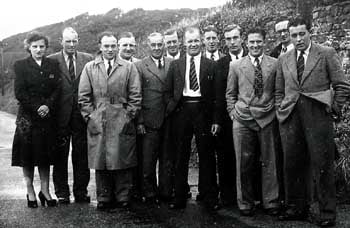
At the end of the 1947 season Glamorgan played three 'missionary' games at Narberth and Pembroke Dock and stayed with us at Amroth Castle. In addition to those in the accompanying picture, the party also included Wilf Wooller and J. C. Clay.
Others who came in 1950 included Jim Pressdee, Don Shepherd, Jim Pleass, Bernard Hedges, George Lavis, Ken Lewis, Gilbert Parkhouse, Alan Jones, Jim McConnon and G. L. 'Gerry' Williams, who played a few games as an amateur for Glamorgan that summer and went on to become sportsmaster at Millfield.



One of the most memorable of those visits was probably in 1955. Suffice it to quote from the Tenby Observer of Friday, September 9, of that year.
'WELL DONE JACK'
"The bat that Allan Watkins broke in two during his merciless treatment of the Pembroke County bowling on Monday brought in nearly £4 for Watkins' benefit fund. It was the prize in a special competition during Tuesday's play. The bat, autographed by the Glamorgan side and the umpires Messrs. J. G. Protheroe Beynon and C. H. S. Cobb, had the following inscription: 'This bat was smashed by Pembrokeshire bowler J. R. Thomas in a magnificent spell of hostile bowling during which he bowled three overs for 72 runs. The bat was used by Allan Watkins, of Glamorgan, who defended stubbornly throughout the ferocity of this attack, Narberth, September 5, 1955'.
"Three successive overs from Thomas were slashed for 72 runs. Watkins began one by sending the ball racing to the boundary for four. Then he hit four fantastic sixes in succession, high on the leg side to the left-hander, the biggest shots probably ever seen on the Lewis-Lloyd ground. It took him only two overs - 10 balls faced to compile 50 runs. He scored 68 in 24 minutes. When he hit his eighth six out of the ground, he broke his bat in two and completed his century in the morning. It included 9 x 6s and took 54 minutes in all."
Allan was 83 not out overnight - with a new bat next day he hit the first ball for four, followed by two more, completing his century with an almighty six, then strolling down the wicket to be stumped next ball.
It was Allan's benefit year, and I scored for Glamorgan at that particular game. Wilf Wooller said to me afterwards that it must have been just about the fastest century scored by any cricketer in any class of cricket anywhere any time. I had the broken bat off Allan and inscribed it accordingly. It needs little imagination to appreciate what the 'special competition' was.
As a chapel elder, the late H. G. Walters, proprietor and editor of the 'paper, could not possibly accept the word 'raffle'. The £4 raised would have been worth slightly more at that time than it would today.
A notable absentee from the game was Don Shepherd, away playing at the Scarborough festival.
At the outbreak of war, umpire Stuart Cobb, a respected sportsman, had evacuated his private school, Selwyn House, from London to Tenby before moving to Begelly, and one of his pupils was a five-year-old E. R. Dexter.