
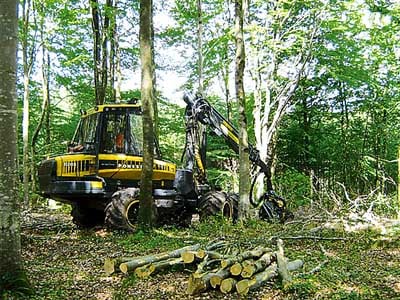
A growing demand for wood as a fuel for the future is helping to restore an ancient woodland that was once used by the landed gentry for hunting deer and wild boar almost 200 years ago.
Canaston Wood, near Narberth, was originally part of the Slebech Estate and is now managed by Forestry Commission Wales on behalf of the Welsh Assembly Government.
Today, the deer and boar are long gone and the pretty broadleaved woodland in the Pembrokeshire Coast National Park fulfils a different function as a popular destination for local people and tourists.
FC Wales has been restoring the woodland - which has been in existence for at least 300 years - to offer environmental and social benefits as well as helping to preserve the special landscape character of Wales.



Contractor Gary Robbins, of Llandovery, has just finished thinning the broadleaved trees, which will bring precious light to the forest's abundant wild flowers such as the bluebell, as well as benefit the insects and birds.
But, as well as improving the environment, the work will also help to provide hardwood logs to meet the high local demand for firewood.
Dave Ellerby, FC Wales planning forester in Llandovery, said: "The thinning work is part of good forest management and is important to improve the habitat and enhance the special Pembrokeshire landscape.
"Welsh broadleaved woodlands can be productive, too, and by meeting the growing demand for firewood and providing local employment this is a classic win-win scenario."
Dave said many broadleaved woods in Wales were somewhat neglected, but a viable firewood and biofuel market could be a stimulus for renewed management activity.
Gary has been working in the 362-hectare Canaston Wood for the past two years, thinning out the beech trees - which are not classed as native to Pembrokeshire - and favouring native trees such as oak and birch.
Comments
This article has no comments yet. Be the first to leave a comment.