

Recently at Tenby Arts Club, John Archer Thomson once again delighted everyone with his superb photography and detailed knowledge of the flora and fauna he was showing us. This year his presentation was about his journey home from Tasmania via Kangaroo Island and Singapore.
Kangaroo Island is the third largest island off Australia, and is off the coast near Adelaide. Adelaide has a Botanical Gardens with an interesting pigeon sporting a punk hair-do... John had also photographed some amazing huge water lilies, jacaranda trees, fruit bats hanging in the trees, rainbow parakeets, and a bicentennial tropical conservatory.
After a ferry ride across to Kangaroo Island, they visited American River and saw Australian pelicans bemused by a pied cormorant appearing out of the water with an octopus which was then taken by a large gull who struggled to eat it! There was also an Eastern reef heron, some black swans and some salt marsh plants similar to those found on the Pembrokeshire coastline, such as sea blight and a plant similar to samphire which also has photosynthetic stems. A black sponge proved interesting - you can blend it and leave it for about a week and it will reform itself exactly - this property means it is being used in research against cancer.
After a 100-mile drive to the accommodation at the other end of the island, John and his wife explored the paths around their hotel and saw a spindle beaked honey eater, a juvenile kestrel, and their first conestick, and endemic plant which recovers well from the frequent wildfires.



In the Hanson Bay wildlife sanctuary where a koala and her baby sat entwined in a tree - koalas have opposing finger and thumbs to assist in climbing trees - there was a New Holland honey eater and a slender smoke bush.
Little Sahara consisted of sand dunes with the occasional bush. Seal Bay indeed had seals - the third largest colony in Australia with over 100 seals. There were also Australian sea-lions (you can tell them apart from seals by their ears!), sea-purslane holding the sand together, and a mother seal leading her baby down to the beach for a swim. From the obligatory beach cafe, galahs (Australian parrots), and an Australian royal spoonbill, a white ibis, and some lovely bottlebrush bushes were spotted.
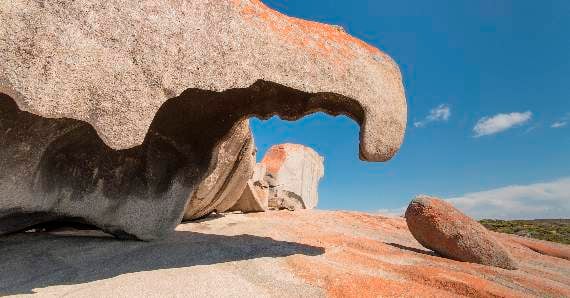
Vivonne Bay, voted one of the best beaches in Australia, produced bottlenose dolphins and a wattle bird. A lighthouse built in 1858 and the Admiral’s Arch followed, sporting a New Zealand fur seal floating on its back, a monitor lizard, some honey myrtle and a strange-looking duck-billed platypus with its babies. The Remarkable rocks, 500 million years old, are interesting shapes from having the salt spray dissolving them, and are covered in orange lichen - very photogenic!
Then it was back to the ferry, through a Christmas-ready Adelaide and on to Singapore. Having been to Singapore several times over the years, John said that he was continually amazed by how much a small place could renew itself, with buildings being demolished and rebuilt, and new land being reclaimed from the sea, sometimes on top of old landfill sites. As it is so highly populated for such a small area, most buildings are very tall, but still manage to have lots of greenery with rooftop gardens and trees growing on the balconies!
The high population also means that car ownership is at a premium, with a certificate to own a car costing £30-40 thousand pounds, and the car itself costing as much again! You can get hanged for dropping litter, but on the upside, it is a very multicultural place, with everyone celebrating everyone else’s festivals. Christmas was in evidence everywhere, with huge dancing statues and trees all over the city.
In 1819, Stamford Raffles claimed Singapore for the East India Company, and it then became part of the British Raj. In 1963, Malaysia became independent, and in 1965 Singapore gained its independence as an island state.
The Botanic Gardens had a superb orchid garden interspersed with little moss-covered statues. The paths were filled with people taking selfies, even one girl who had set her phone up on a tripod and was dancing in front of it!
The heat and humidity was broken briefly with a sudden heavy downpour of rain, so torrential it became funny. Retreating to the Gardens by the Bay, we saw inside two huge domes, the Cloud Forest and the Flower Dome. The Flower Dome is similar to the dome at our National Botanic Gardens or the Eden Project. The Cloud Forest has walkways leading up past huge waterfalls cascading down the full height of the dome, to a pond on the top floor with sun birds and bee-eaters happily feeding. These domes and the artificial trees in the surrounding outdoor gardens were also scattered with Christmas decorations, large and somewhat worrying rotating angels and toy soldiers... There were also lego sculptures of plants in among the real ones - lego pitcher plants in among real pitcher plants!
The final destination was the Merlion Park - the Merlion is the symbol of Singapore, and has been moved as the coastline moved further and further from its original position outside the Raffles Hotel. As usual, a fascinating evening!
A.D.
Comments
This article has no comments yet. Be the first to leave a comment.