

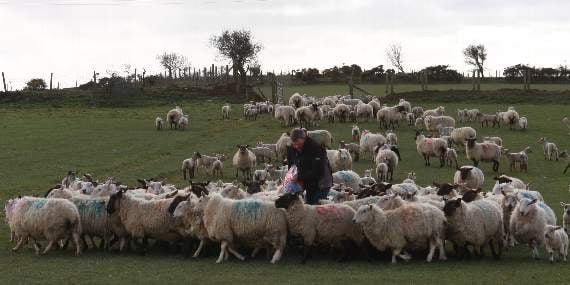
Easter is just around the corner and the worse of winter is (hopefully) behind us: an appropriate opportunity then to survey the agricultural scene and some of the likely Brexit implications.
Farmers are reflecting upon the weather over the winter months which has been relatively kind and, as April approaches, the level of grass growth is encouraging.
The lambing season is well underway and the earliest indications are that it has been trouble free although the constant threat of an attack from the Schmallenberg virus still exists.
The triggering of Brexit leading to the decreased value of sterling is affecting some sections of farm business and farm tractors, machinery and wearing parts have already become subject to a 10 per cent hike in costs.



The mart trade would appear to be unaffected as store cattle have been selling exceptionally well: a 19-month-old Limousin cross steer recently sold for £1,130 and a British Blue heifer of a similar age made £1,050 -both equating to 380p/kg. Similarly, suckler cows with calves at heel fetched up to £2,280, but this doesn’t indicate a more positive position for the sector.
With lack of profitability a concern, suckler producers could well have to rely even more on returns from the market for the future of their business. The forecast for this year is that adult cattle slaughter will be lower than in 2016, at 615,000 head, but still at a relatively high level.
The trade in last season’s lambs has also seen a strong demand with hoggets constantly making in excess of 175p/kg.
Moving into 2017, the improved trade position is likely to continue as uncertainty surrounding the UK leaving the EU will continue. This combined with higher levels of production in the UK is expected to lead exports to rise but, continuing falls in demand for sheep meat in France, will limit any increases.
This year, imports to the UK are forecast to fall driven by the weaker currency situation and tight supplies in New Zealand - the UKs largest supplier. Imports are forecast to decline some 4,300 tonnes (four per cent) to 103,000 tonnes with the largest declines seen in the first half of the year.
Higher levels of domestic production are also likely to put further pressure on imports leading to an increase in the level of supplies of sheep meat for UK consumption. Generally, supplies are expected to be higher throughout the year.
Given the difficulties in the dairy sector for part of last year, even more cows were marketed than were expected, as many producers continued to struggle with cash flow problems.
However, as 2016 drew to a close, the dairy sector began to look back on a downturn in prices that ended up lasting more than two years and look forward to 2017 with a measure of cautious optimism.
Whilst market prices have risen, this may be slower than many require and it is possible that a number of farmers will still be assessing the impact of the period of low prices on their businesses.
Under the EU’s Milk Production Reduction Scheme, one in five of UK farmers applied for funding to reduce production - the money not used as part of the 150m euros earmarked for the targeted reduction of 1.07mt (1.04m litres) “will remain available for agricultural expenditure and will finance other market measures that may prove necessary in the sector,” DG-Agri officials add.
The milk we put in our cereals each morning and in our cups of tea throughout the day depend upon many thousands of specialist producers milking cows 365 days a year to guarantee consumers fresh, high quality, locally produced milk supplies all year round. Historically, we have been able to take the availability of fresh milk for granted, but times have changed - and with Brexit now upon us, our fresh milk market may not be guaranteed indefinitely.
One local farmer who began dairy farming less than 40 years ago says: “When I started, it was a profitable farming enterprise, with brands dominating the market and the largest volumes being sold door to door. How things have changed, with supermarket private labels sourced through price-based tenders dominating sales, in a cut-throat competition between dairies and retailers for market share and consumer footfall.
“Farmers’ remuneration has fallen below the cost of producing liquid milk, and has also become discouraging as farmers weigh up its value against the lower cost, simpler spring calving production systems, which now allow them to expand output to optimise income.
“It was also a fantastic opportunity to remind people of the important work our farmers do - they don’t just produce food, which is recognised worldwide for its superb quality, taste and outstanding animal health and welfare standards, but they are the custodians of the countryside we all love so much.
“Our farmers manage 1.8 million hectares of land in Wales; that’s over 80 per cent of the land area in Wales and the Welsh countryside that is managed by your local farmer provides the backdrop for our tourism industry which is supposedly worth over £2.5 billion.
“And farming is also the cornerstone of the £6.1 billion Welsh food and drink supply chain industry, which employs 76,000 people in the food and farming sector. It’s worth remembering that all of this also helps to retain our young people in rural communities.”
Comments
This article has no comments yet. Be the first to leave a comment.