
Last Friday, the Tenby Arts Club was whisked off to the Falkland Islands with Nigel McCall, who was Photographer of the Year in 2013, winning with a photo of a starling murmuration over Carmarthen.
Nigel went to the Falklands in 2007 on his way to the Antarctic (also a slideshow worth seeing!) and was determined to get back sometime as he thought it was one of the best wildlife destinations in the world. He made it in 2010, after 18 hours of flying from RAF Brize Norton via Ascension Island to cover the 8,000 miles from the UK.
The Falklands are made up of more than 700 islands, with a total area of roughly half the size of Wales. Two thousand people live in the capital, Stanley, and 500 others are scattered over the rest of the territory. There are no tarmac roads outside Stanley, only gravel tracks, and there are more Land Rovers per capita in the Falklands than anywhere else in the world.
There is an internal airline, run by the government, and the next day's flight is announced at 6 pm each evening!

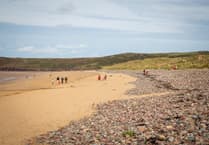
Nigel went first to Darwin, a settlement consisting of approximately three houses! He stayed in a Bed and Breakfast, and visited the British and Argentinean war cemeteries, San Carlos bay (bomb alley during the war) and Goose Green, again a name well known from the activities of 2 Para during the war.
The next stop was Carcass Island, where eight striated caracara (the rarest raptors in the world) were in the garden early in the morning waiting to be fed! The beach nearby produced more outstanding shots of the Falklands or Austral thrush, Magellanic penguins, the Falklands flightless steamer duck (which can desalinate its own water!), a night heron and a Cobbs wren. A pair of kelp geese was caught in mid courtship, with the male handing over, of course, a piece of kelp to an excited female. On Leopard beach, famous for its leopard seals, some Gentoo Penguins were seen courting.
After a boat trip in the Condor, the next port of call was Westpoint, an island about seven miles wide. The guest house also catered for cruise ship visits, putting out morning or afternoon tea for 100 guests, who also went to the nearby black browed albatross colony. Nigel also saw and photographed a Falklands robin (actually a long-tailed meadow lark), a grass wren and rockhopper penguins which had a devil-may-care attitude to match their bright yellow eyebrows.
On Pebble Island, shearing was in progress, with a team from the Lake District in attendance! There were also some buildings with beautiful corrugated roofs, oystercatchers, cormorants, a red-backed hawk, a well-camouflaged snipe with its chick and a sheathbill that lives on penguin poo! Next came Volunteer Point, with the most accessible King Penguin colony in the world and a double booked warden's hut which nevertheless produced the best toast...
On Sea Lion Island, we saw penguins heading out to sea in the early morning, elephant seals on the beach moulting, and a Falklands skua eating a stolen egg, among other wonders. In Stanley, in contrast, we were treated to views of Jubilee Villas, a short stone terrace named for the jubilee of Queen Victoria, the Governor's residence, the Falklands war memorial and museum, Christ Church Cathedral (the southernmost in the world) including a blue whale jawbone arch from 1934 commemorating 100 years of British rule of the Falklands.
To follow that (!!) this week the Arts Club presents the Pembroke and Monkton Local History Society on Community History told in Digital Stories. This is tonight (Friday) at St. Johns Hall, Warren Street, Tenby, for a 7.30 pm start. Everyone is welcome, £2 for members and £4 for non-members, including light refreshments and fraternisation at the end!
A.D.
Comments
This article has no comments yet. Be the first to leave a comment.