
A very rare Sunderland flying boat now has its own 'minders' with the formation of the Pembroke Dock Sunderland Dive Group in West Wales.
Over 20 local divers and helpers have signed up to the new group supporting the Pembroke Dock Sunderland Trust which aims to recover the wartime flying boat from its seabed resting place of nearly 70 years.
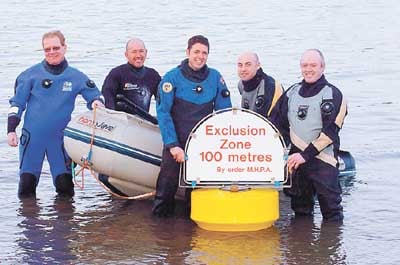
One of their first tasks is to mark the Sunderland site - between Pembroke Dock and Neyland - with a special buoy and sign identifying an exclusion zone around the area.
The sign was made by two members of the group, brothers John and Will Fenneberg, and the lettering was generously sponsored by Mr. Ted Bamford, of Llanion Signs, Pembroke Dock.


The group - now officially recognised by the British Sub-Aqua Club - is the only one allowed to dive on the Sunderland, with the permission of the Sunderland Trust. The 100-metre exclusion zone around the site was put in place by Milford Haven Port Authority to protect the Sunderland from further damage by fishing and diving activities and boat anchoring.
Group chairman Stephen Thompson said: "We now have our full complement of members and are totally committed to supporting the Sunderland Trust's aims. We regularly monitor the site and after placing the marker buoy we intend to clean up the aircraft removing things like ropes and lobster pots which have caught up over the years. Also we advise other divers and water users of this historic aircraft and its important place in our history."
Sunderland T9044, of 210 Squadron, sank at its mooring in a November 1940 gale and was not discovered for many years. It is the fourth survivor of one of the most famous aircraft types in aviation history and is a unique Mark I version. A Pegasus radial engine and other parts have already been recovered from the site, and the Dive Group will be retrieving other items this year for conservation by Sunderland Trust volunteers.