

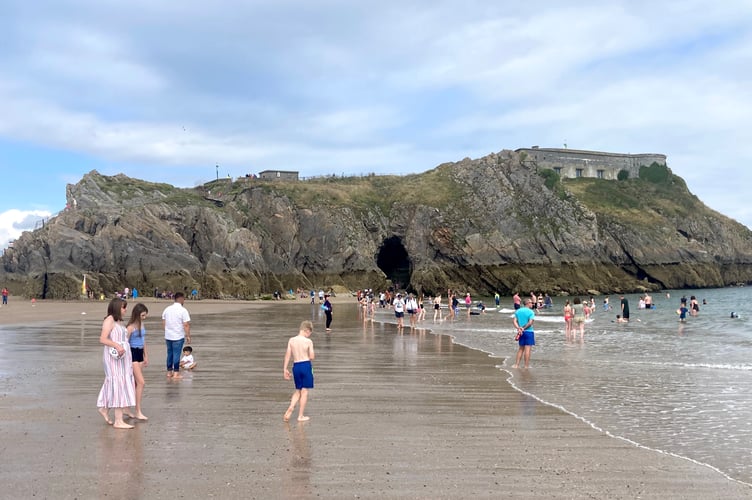
Local councillors are to meet with representative of Welsh Water to flag up concerns over sewage spills onto Tenby’s beaches.
Recent analysis of Environment Agency data revealed that Welsh Water had dumped sewage onto Blue Flag beaches 579 times, lasting an astonishing 6,757 hours.
The worst incident was on Poppit Sands Beach near Cardigan with sewage dumped 79 times lasting 1,518 hours.
There were concerns raised days before the return of the Ironman Wales event (which begins with a sea swim on Tenby’s North Beach) last September, after it had been confirmed sewage was pumped into an area of the sea near to the course, with the ‘Surfers Against Sewage’ campaign group highlighting through its interactive map (which monitors sewage discharges on the UK coastline) that discharges had been made on Tenby’s Castle Beach.




Ten of Pembrokeshire’s beaches picked up the coveted Blue Flag for 2022, with the award recognised around the world as a symbol of quality.
Amongst the ten were Tenby’s Castle and South beaches, but there are fears that they too may lose this status in 2023, following the coastal town’s North beach which lost its Blue Flag status in 2022 after the standard of the bathing water dropped down from being rated as ‘Excellent’ to ‘Good’ after an assessment by Natural Resources Wales showed that visible pollution was found in the sea from sewage.
In the published report by NRW on the North Beach, the organisation stated: “Natural Resources Wales continues to work with Pembrokeshire County Council to identify any sources of pollution.
“NRW samplers make visual observations of the beach at every visit. This includes assessments of sewage debris, animal faeces, litter and oil or tar.
“At Tenby North, data are available for the four year assessment period from 2017-2020. Sewage debris was observed in trace amounts on less than ten per cent of occasions. Animal faeces was not noted at this site.
“Trace amounts of litter were observed at the bathing water between twenty and thirty percent of occasions. Oil and tarry residues were not noted at this site.
“Heavy rain falling on pavements and roads often flows into surface water drains or highway drains, ending up in local rivers and, ultimately, the sea. The quality of bathing water may be adversely affected as a result of such events.
“NRW has developed a good working relationship with Dŵr Cymru Welsh Water and liaises regularly to identify problems that could affect bathing water quality.
“Tenby’s sewage effluent is pumped to the relatively new Tenby Wastewater Treatment Works at Gumfreston, where it is biologically treated and disinfected with ultra-violet light, to protect the bathing water quality at Tenby beaches. This tertiary treated sewage is then discharged via, a long sea outfall.
“Within the Tenby catchment there are a number of storm, emergency and surface water outfalls, that discharge around the town. These protect domestic properties in Tenby from being flooded by sewage during periods of heavy rainfall.
“The main pumping stations are in Tenby Harbour and at the Salterns. The Harbour Pumping Station has recently been upgraded to improve performance.
NRW went onto say that a project known as Event Duration Monitoring (EDM) was underway to install telemetry on Combined Sewer Overflows (CSOs) within 2km of a bathing water, so that Dŵr Cymru Welsh Water (DCWW) know when the CSOs are operating and can work to reduce spills, with one CSO near Tenby’s North Beach is included in the project.
Cllr Duncan Whitehurst asked for his concerns over sewage spills to be put on the agenda of Tenby Town Council, with the clerk confirming that a representative of Welsh Water would be attending the next meeting in February.
Comments
This article has no comments yet. Be the first to leave a comment.