

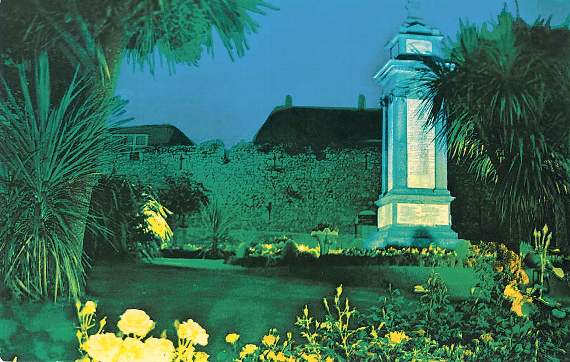
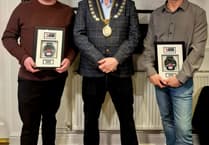
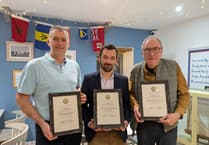
Yes, it is this month that we once again remember those that fought and gave up their lives for their country. I have made up a gallery of local people who served their country well but there are numerous others who will not be forgotten.
– By Albie Smosarski, Cofion Bookshop, Tenby –
I have taken a few excerpts from the book ‘Wilfred Owen’ written by Dominic Hibberd. Owen was a World War I solder and poet and recorded his feelings via letter and poetry:
“The anger that would find his later poetry was already beginning to build up, after only three weeks in France… the troops were cursing ‘our distinguished countryman,’ probably meaning Lloyd Geogre, the new Prime Minister. The Somme films that were still causing excitement at home were the laughing stock of the army, Wilfred said, as were the model trenches on display in Kensington. “The people of England needn’t hope. They must agitate. But they are not yet agitated even.” These comments do not mean that he had suddenly turned against the war, as modern readers sometimes assume, but rather that he was taking up the attitudes of a hardened soldier, scorning civilian complacency now that he had acquired the secret knowledge that could only come from battle experience. He did not say what the people of England should agitate for. Lloyd George had won popular support by calling for the fight to be ‘to a finish - to a knock-out,’ and the battalion may well have been cursing him for their being pushed too far ahead.
“…Wilfred was under the impression that the battalion was about to go back for a long rest, but he soon discovered his mistake…
“A few old communication trenches ran east-west across the ridge, but they seem to have been unusable. Wilfred and his platoon had no shelter whatever except the slight rise in the ground ahead of them. They lay out on the ‘burning snow’ under a lethal wind, unable to move by daylight and unable even to drink because their water cans were frozen. He managed to sleep for a while, but when he woke up he thought he was dead and in hell.
“The marvel is that we did not all die of cold. As a matter of fact, only one of my party actually froze to death before he could be got back, but I am not able to tell how many have ended in hospital. I had no real casualties from shelling, though for 10 minutes every hour whizz-bangs fell a few yards short of us. Showers of soil rained on us, but no fragments of shell could find us.
“I had lost my gloves in a dug-out, but I found one mitten on the Field. I had my trench coat (without lining but with a Jerkin underneath). My feet ached untl they could ache no more, and so they temporarily died. I was kept warm by the ardour of life within me. I forgot hunger in the hunger for life. The intesity of your Love reached me and kept me living. I though of you and Mary without a break all the time. I cannot say I felt any fear. We were all half-crazed by the buffetting of the High Explosives. I think the most unpleasant reflection that weighed on me was the impossibility of getting back any wounded, a total impossibility all day, and frightfully difficult by night.
“We were marooned in a frozen desert.
“There is not a sign of life on the horizon and a thousand signs of death.
“Not a blade of grass, not an insect; once or twice a day the shadows of a big hawk, scenting carrion.”
I think it says it all.
Comments
This article has no comments yet. Be the first to leave a comment.