
As reported last week, the greatest hoard of Civil War coins ever found in Wales has gone on display for the first time in the county in which they were discovered. Gold and silver coins dating back to the 1640s are the centrepiece of an exhibition at Scolton Manor Museum near Haverfordwest, which opened to the public on Saturday. The exhibition, entitled The Tregwynt Hoard: Coins, Cromwell and Cavaliers, was officially opened on Friday by Welsh Heritage Minister, Rhodri Glyn Thomas. It highlights the importance of the hoard as well as explaining the impact upon Wales and Pembrokeshire of the Civil War. The story of the Tregwynt hoard is a fascinating one. A local legend believed that buried treasure, connected to the French landing of February 22nd, 1797, lay in the grounds of Tregwynt Mansion near Fishguard. Worried guests attending a ball, frightened by the news that the French had landed at Carreg Wastad, buried their valuables in the grounds of the mansion before departing. Although this legend was well known, nothing was ever found to prove it. That was until one day in 1996 when a local metal detector enthusiast, Roy Lewis, uncovered a large hoard of gold and silver coins not from 1797, but in-fact belonging to the Civil War of the 1640s. The then owners of Tregwynt Mansion, Mr. and Mrs. Sayer, were carrying out extensive ground work and invited Roy in to search the disturbed earth. After some unsuccessful searching, intuition told him to carry out a sweep with his metal detector underneath trees in the grounds. Immediately, a positive signal resulted in the discovery of a hammered silver half-crown of Charles I (1625-1649), followed by hammered sixpences of Elizabeth I (1558-1603). The lost treasure of Tregwynt had been found. Over the next few days the significance of the hoard revealed itself. More and more coins were unearthed from the ground, and reported to Edward Besly, assistant keeper of numismatics at the National Museum of Wales, and the Pembrokeshire Coroner, Michael Howells. In total, 500 coins were recovered from the site at Tregwynt, along with shards of pottery and a piece of lead thought to make up the container and lid of the vessel housing the coins. A fine gold 'posy' ring, engraved 'rather death then falce of fayth' was also found. The coins cover the reigns of Henry VIII (1509 -1547), Edward VI (1547-1553); Philip and Mary (1554-1558), Elizabeth I (1558-1603), James I (1603-1625) and Charles I (1625-1649). It is thought the collection was most likely to have been buried in 1648, the year of rebellion in Pembrokeshire, one of a number of uprisings known as the 'Second Civil War'. The Governor of Pembroke Castle, John Poyer, who had always served Parliament loyally through the first Civil War, rebelled when told he was to be replaced. This brief uprising was put down at St. Fagans, near Cardiff. Cromwell chased the rebels back to Pembrokeshire and laid siege to Pembroke Castle. The hoard was bought for the nation with the help of Heritage Lottery Fund and housed at the National Museum Wales in Cardiff. The Pembrokeshire exhibition runs until October 31. The opening weekend of the Scolton Manor exhibition also played host to The Sealed Knot Society. Major General Rowland Laugharne's Company staged a re-enactment of the Battle of Colby Moor at the weekend.
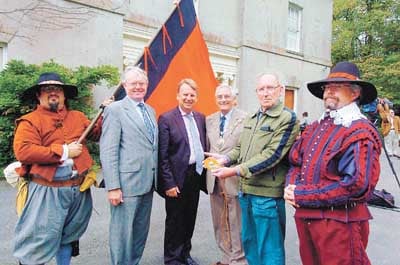
Roy Lewis is pictured holding some of the Civil War coins he found. Flanked by Sealed Knot members Jeff Vincent and Nigel Price are Pembrokeshire County Council chairman, Bill Roberts, Heritage Minister, Rhodri Glyn Thomas and Paul Loveluck, president of the National Musuem of Wales.


More About: