
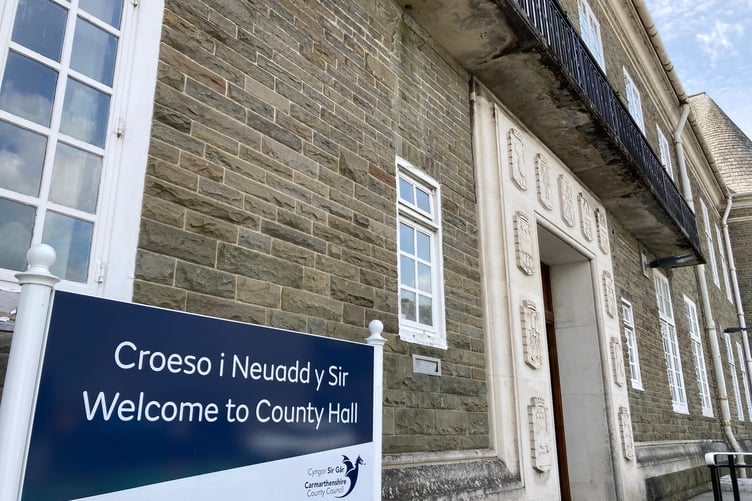
Carmarthenshire Council is well-run but needs to address overspending by schools and its children’s services department, a panel of experts has said.
The panel comprised current and former council chief executives from outside Carmarthenshire plus a councillor and former cabinet member from Denbighshire.
They spent around 240 hours talking to Carmarthenshire councillors, senior council officers, headteachers, and business and voluntary groups to assess how efficiently and effectively the council was spending its money, how effectively it was carrying out its responsibilities, and whether effective governance was in place.
The council’s net budget this financial year for day-to-day services like social care and bin collection is £524.6 million with the majority of it coming from central government. The Plaid-Independent-led authority hiked council tax by 8.9% – the sixth highest of Wales’s 22 local authorities – to help balance the books as well as approving savings and income-generating measures of £8.1 million.
The peer review panel said the council understood the significant financial challenges it and other local authorities were facing especially, in Camarthenshire’s case, deficit spending by several schools and overspending in children and family services.
The panel concluded: “Carmarthenshire is a well-run and values-based organisation with strong and visible leadership at political and officer level and has an awareness of its key challenges.”
It added: “There is significant pride within the organisation, with staff expressing a desire to perform well for the benefit of Carmarthenshire.”
The panel recommended increasing the pace of decision-making, and endorsed the work the council was doing to reduce school deficits and address the issue of some schools having not many pupils and lots of spare places.
Since the panel’s report in June, Carmarthenshire’s cabinet has approved proposals which could result in the closure of three primary schools, with a decision about a fourth school on hold.
The panel’s report, which was discussed by the council’s audit and governance committee, also said the authority needed to address a gap in its medium-term financial planning.




Committee chairman Malcolm MacDonald, who is a lay member rather than a councillor, said he sympathised with the council as it was hard to plan far ahead financially because central government funding came on an annual basis rather than longer term.
Director of corporate services Chris Moore said around 80% of the council’s net budget came from central government and was unpredictable from year to year.
Cllr Elwyn Williams said he believed the biggest threat to the council’s financial sustainability was overspending by schools. He asked what was meant in the panel report by the term “licence deficit” policy in relation to schools, and was told it was when schools couldn’t balance their books but submitted a plan to the council to recover their position in future years.
Mr Moore said the council had approved seven or eight licence deficits for schools and that another was on his desk awaiting a decision.
Lay committee member Julie James said the panel’s report showed the council had a “very, very compelling story to tell” and that in her view it should do so. In reference to the panel’s recommendation to increase the pace of decision-making, she said she felt it was already “pretty good” but added: “Clearly they feel we really need to put our foot down on the accelerator.”
Comments
This article has no comments yet. Be the first to leave a comment.