

‘Who Put That There!’ - the campaign is called by The Royal National Institute of Blind People (RNIB) against pavement obstructions, but many frustrated wheelchair users, pram pushers, and people with sight loss, are questioning why Pembrokeshire County Council is seemingly turning a blind-eye to A-Boards, tables and chairs blocking public pavements in resorts such as Tenby, where getting around the Walled Town’s narrow footpaths and cobbled streets is difficult enough as it is any way for some.
So what can be done about the continuing and escalating issue of A-Boards and A-Frames causing a huge hinderance to people who live in Tenby and those that visit the seaside town alike.
Having been approached by a couple of people who live in the walled town in recent weeks, who have elderly family members that are confined to a wheelchair or mobility scooter, it was a real eye-opener to see the difficulties they experienced, and the proliferation of offending obstructions that are placed around the town by businesses, some with two or three advertising boards, and some completely blocking pavements altogether on certain streets.
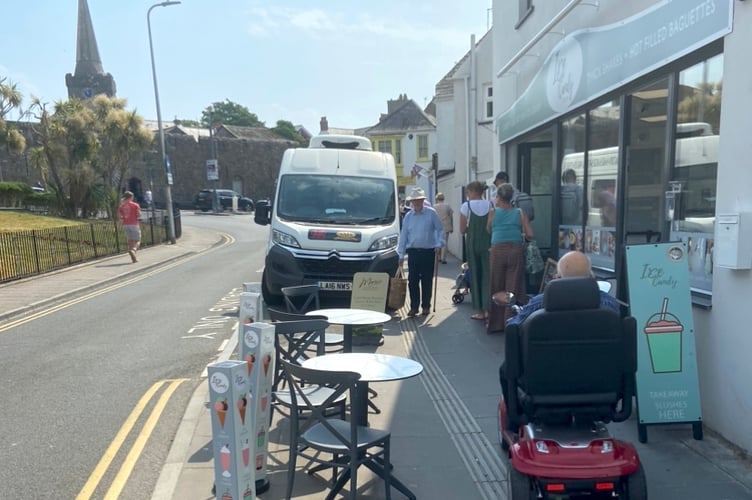


The Observer was told by those expressing their frustrations that the issue is nothing new, but seems to have gotten completely out of hand, and most disconcerting for such people is that there seems to be a complete lack of action or will from the Local Authority to take any control over the matter.
“It is despicable that Pembrokeshire County Council and the Town Council continue to turn a blind-eye to this, especially as they are trying to paint a picture of Tenby reaching ‘dementia friendly’ status in recent years,” was one view, whilst another stated: “Such businesses that continually and recklessly put obstacles in the way of less able-bodied people, should be ashamed of themselves - but the Local Authorities are the ones that should really hang their head’s in shame, for ignoring the matter for so long.”
“During windy weather too, such A-Boards collapse by the hour onto the pavement, and seeing the size and weight on some of them, it is surely only a matter of time before they land on a small child, causing serious injury.
“Who would be liable for this, should such an instance occur, the business responsible for putting out the offending A-Board or indeed the Local Authority for allowing it to remain blocking a public footpath?” they continued.
One of the offending A-Boards pointed out to us, was in fact for the Market Hall - a Pembrokeshire County Council run premises - and positioned on one of the narrowest sections of pavements in Tenby on Upper Frog Street.
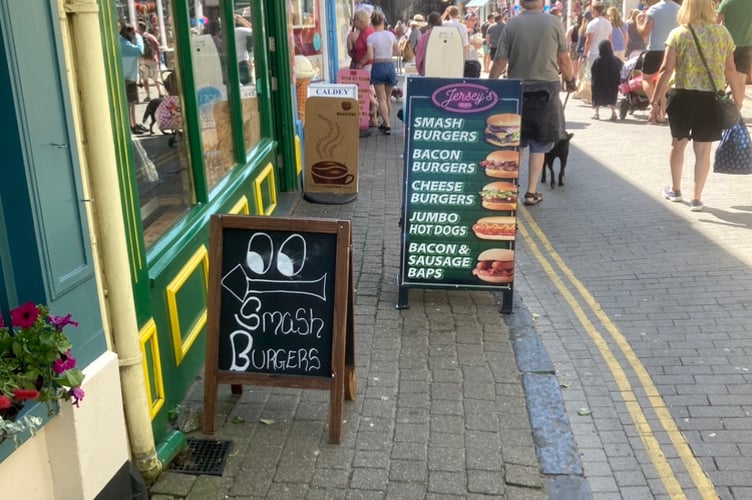
Such obstructions, we were told, are also making the few dropped kerbs scattered around the town completely useless, as they can't be reached on many of the pavements that they are positioned on, due to the volume of advertising boards blocking the way.
Concerns voiced to Tenby’s county councillor for the North ward, Cllr Michael Williams prompted him to contact Pembrokeshire County Council’s streetcare manager Marc Owen and Cabinet Member for Residents' Services Cllr Rhys Sinnett, this month, to call for strong action to be taken.
“I have raised concerns about the obstruction caused by these boards and A-Frames over several years to no effect. As I understand the law these advertisements constitute the offence of obstruction. Please confirm that I am correct in this interpretation, and who might be legally liable for any accidents caused by these obstructions?” stated Cllr Williams in his correspondence.
“I was recently invited to accompany a wheelchair user to walk around the Town. Frankly this was something of an eyeopener, and the situation is extremely difficult for anyone who is restricted in this way.
“It also means that individuals have to walk on the highway to go around the numerous obstructions. This is dangerous, in particular if anyone has young children.
“Why has no action been taken to remove these obstructions given the obvious dangers, and many complaints over several years, and what action will be taken to address a growing problem? The numbers appear to grow every year.
“The situation is exasperated by the often dangerously uneven condition of footpaths in the town centre,” he added.
Even though the County Council’s pedestrianisation scheme starts in July, encompassing the school holidays, with many sections of the town, including High Street and Tudor Square traffic free between 11 am and 5.30 pm each day, it was highlighted to the Observer by one wheelchair user just how seriously dangerous it is to try and get around areas such as St Georges Street, Upper Frog Street and St Julian’s Street (which do not come under the traffic free zones during the PCC led pedestrianisation scheme) when indeed pedestrians are forced onto the roads due to the volume of A-Boards, chairs and tables fully obstructing pavements, with vehicles not excluded from these roads at any time during the scheme.
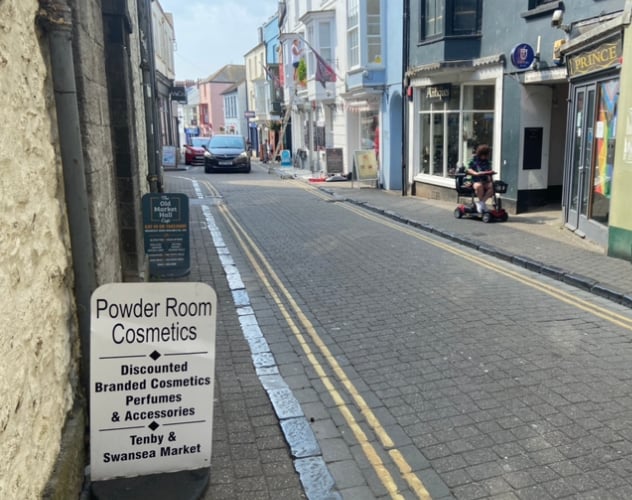
County councillor for the South ward, Cllr Sam Skyrme-Blackhall has conceded that the situation is getting worse, and has requested that the County Council’s Access Officer Jessica Hatchett visits the town to see for herself.
“The current situation is intolerable and needs to be resolved. Personally, I would like all A-Boards, signs and visual obstructions moved if they in any way impede peoples movement. We are not just talking about physical disabilities but hidden disabilities too,” remarked Cllr Skyrme-Blackhall.
“For many years, this situation has been managed by voluntary agreement and after my requests for action, another tour of all businesses was recently done by Council officers.
“However, I have not seen sufficient signs of improvement. If anything, the situation is getting worse. I have come to the conclusion, that voluntary agreements are not enough.
“If businesses are going to put anything out, they MUST leave sufficient space for a wheelchair and/or a buggy or pram to get past safely. Also, they must understand that they have a liability for what they put out. The law is clear.
“We need more ramps to safely come off curbs and these must not be obstructed. I also want to see time limits on scaffolding and it displayed when it is going to come down.
“We are a medieval town and access is difficult. But that is no excuse for obstructions making it harder still.
“I know businesses want to promote themselves but how about promoting our town as accessibility-friendly and removing these barriers,” she continued.
“I have asked the Access Officer for PCC to come and have a look and get a proper understanding of what it is like on the ground. I am assured that this is going to happen. But I am also calling for a letter to go to all businesses reminding them of their obligations and asking them to ensure accessibility is maintained. If not, there will have to be enforcement action and obstacles removed.
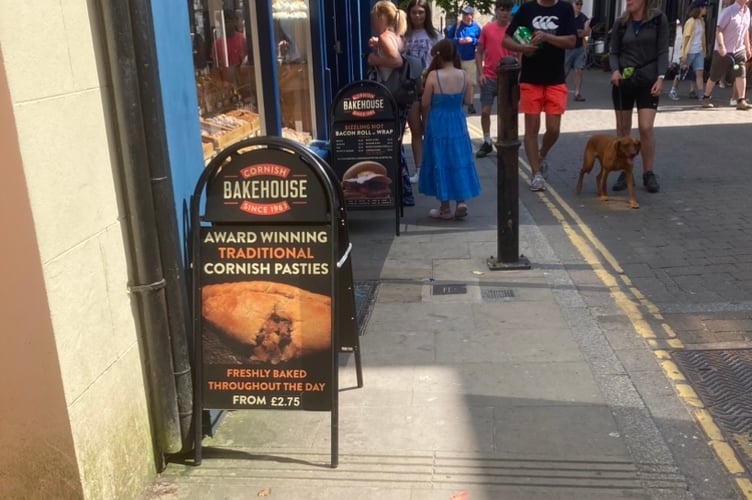
“Let’s face it, if someone dumped some old furniture the size of an A-Board in the middle of the road or pavement then it would be moved. Why is it not, just because it has advertising on it? It is time for people to take responsibility to sort this out.
“I have tried to get some of this work done quietly but I think we all need to realise that we need to be shouting more for those who struggle to get around,” she added.
The RNIB has highlighted the challenges faced by people with sight loss in our streets, and the hazards that A-Boards and street furniture pose to blind and partially sighted people.
“By their very nature A-boards and other pavement signs obstruct pedestrians from being able to move in a straight line along the pavement. They present a trip and collision hazard, especially to people who cannot see them and who use mobility aids,” commented a spokesperson.
“Being able to get around safely is important for everyone, but for people with sight loss some things can make it harder to do this.
“We all need to use our streets, whether that’s getting to work, going to the shops, taking care of our health or seeing friends and family. But for blind and partially sighted people, lots of things make it harder to get around, and such items can make a pavement more like an obstacle course for those affected by sight loss.
“Clear pavements are essential for blind and partially sighted people. The impact is that people with sight loss cannot see the obstruction until it is too late!
“The proliferation of A-boards can make it difficult for those with sight difficulties to negotiate the path. This can result in them walking into A-boards and injuring themselves, or inadvertently walking into the road whilst attempting to avoid these obstructions,” they continued.
“Falling over or bumping into an A-board can be painful and can adversely affect blind and partially sighted people’s confidence and mobility. The over use of A- boards can restrict their freedom and opportunity to participate in their local community.
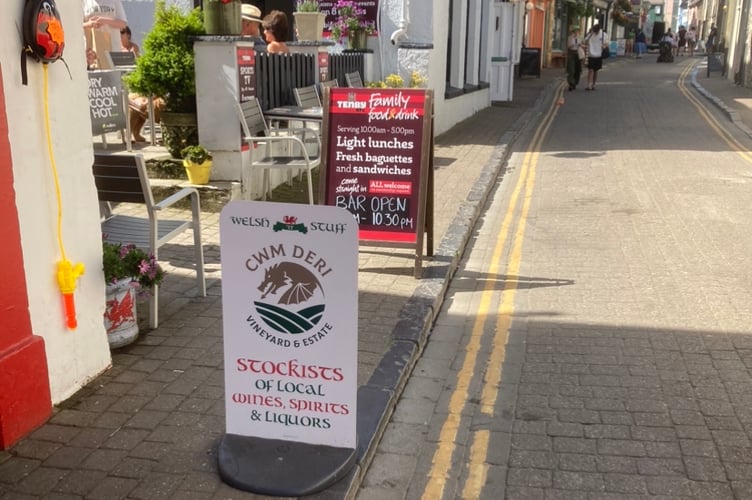
“Consequently, RNIB supports a complete ban on A-boards. This would enable many people to walk along their local streets without fear of colliding with heavy, painful obstructions. Currently, there is no evidence which suggests that a complete ban will have an adverse economic impact on traders.
“We believe a complete ban places all traders on the same footing regardless of the width of pavement outside their premises,” they added.
Complaints about A-Boards blocking public walkways and dropped kerbs are also rife in the neighbouring seaside village of Saundersfoot.
Cllr Chris Williams, county councillor for the South ward said that recently he had received a few calls from business owners requesting street furniture outside their properties, but at the same time he had also received more calls regarding A-Boards and furniture that were seen to be blocking the village’s pavements.
Cllr Williams said that he had invited PCC’s head of streetcare to Saundersfoot for a walkabout to assess the issues raised by residents and to speak to businesses that had requested street furniture.
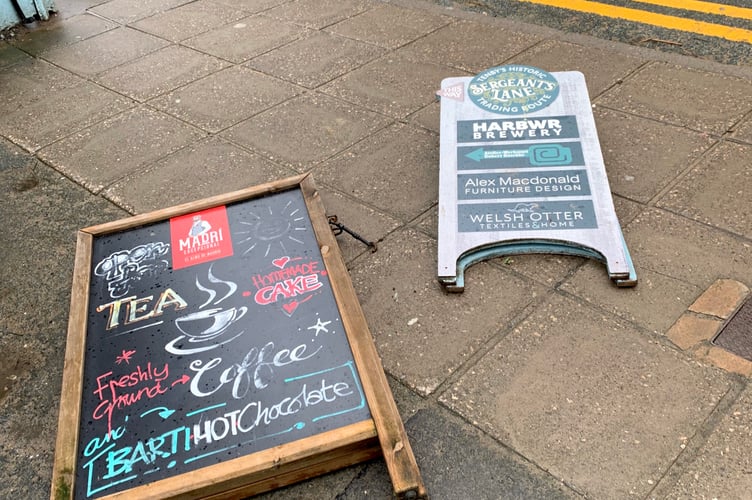
“It was apparent that some A-Boards certainly were an issue, especially one that was in front of a disabled dropped kerb,” said Cllr Williams.
“For obvious reasons if a small child or someone in a wheelchair was at this junction then the oncoming motorist would have great difficulty seeing them,” he stated, saying that he reported the issue to PCC and highlighted this as a ‘major safety’ concern.
“I also copied in the disability group, through PCC, stating I have concerns with visibility and that all A -Frames should be at the side on the building.
“It’s very hard for partially sighted residents or pedestrians who have to weave through, and many disability groups find this hard enough. We should make sure that there is a clear line for them to walk safely.
“All businesses that put out tables and chairs have to apply each year for their licence. This isn’t a problem and they must make sure that there is a correct passage for pedestrians to walk safely,” he added.
When contacted by the Observer on the matter a spokesperson for Pembrokeshire County Council, said: “The Council recognises that obstructions to pavements can cause problems for all pavement users and especially those with visual or mobility impairments.
“We are sorry to hear of the experience of wheelchair users and following correspondence on this issue with Tenby County Councillors, Officers have attended the town to assess the situation.
“Businesses were visited and reminded of their responsibilities not to cause an obstruction (obstructing the footway is an offence under the Highways Act 1980).
“Following discussions, the majority of businesses were happy to remove the A-Frames to a more suitable position.
“We will continue to closely monitor the situation and if there are instances of obstruction which are a concern for those with visual or mobility impairment, we will look at taking enforcement action. Clearly, this is a last resort, and we hope all businesses will recognise the issues and work with us positively,” they added.
Comments
This article has no comments yet. Be the first to leave a comment.