

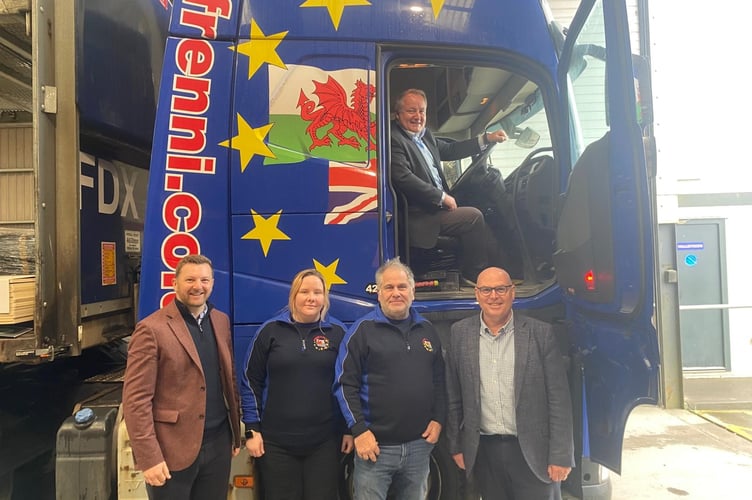
Transport infrastructure and rising costs are placing increasing pressure on the haulage sector, as highlighted during a visit to Frenni, a leading local road haulier in West Wales.
During the visit, Conservative Candidates for Ceredigion Penfro, Paul Davies and Samuel Kurtz, joined by Welsh Conservative Leader Darren Millar, met with the team at Frenni to discuss the challenges facing the haulage industry, with road infrastructure investment, escalating business and fuel costs emerging as key concerns impacting on the sector.
The business highlighted that poor connectivity is making it harder to move goods efficiently, access key markets, and remain competitive with other parts of the UK, issues that are particularly acute for road haulage operators who rely on reliable journey times.
According to the Road Haulage Association, the sector faces significant cost pressures, with fuel representing one of the largest expenses for operators, alongside rising wages, insurance, maintenance, and regulatory compliance costs. The RHA also highlights that the road haulage sector moves around 89% of all goods in the UK, underlining its critical role in keeping the economy functioning.




The UK Government is due to increase fuel duty from September and will link it to inflation from April 2027. These moves will put even more burden on businesses struggling with fuel price hikes as a result of the Middle East conflict which prompted Samuel Kurtz to write to the Chancellor last month urging her to take action to help businesses and residents in mid and West Wales.
Darren Millar, Leader of the Welsh Conservatives said: “It was incredibly valuable to hear directly from Frenni about the challenges they face day-to-day. Time and again, we hear the same message, our road networks are holding businesses back.
“Whether it’s delays, poor road conditions, rising fuel costs, the current environment is making it harder than ever to operate. We support the road hauliers in their efforts to lobby the UK Government to act now on fuel duty. In 2022, the Government introduced a 5p fuel duty cut when prices soared after Russia’s invasion of Ukraine - the current Government could support businesses and households with fuel costs this time too.”
Paul Davies remarked: “Hauliers like Frenni are absolutely essential to our economy, they keep goods moving across the country every single day. But they are being squeezed from all sides, from fuel costs to rising staff wages and wider business pressures. Without action, we risk putting that vital network under real strain.”
A key issue raised was the long-standing need to dual the A40, a vital route for freight and logistics connecting west Wales to the rest of the country. Without more investment journey times are increasing and adding further costs for operators.
“For a haulage firm, time is money,” said Samuel Kurtz.
“The A40 and M4 are a lifeline for us, and without proper investment, companies here are at a clear disadvantage. We need to see real progress, and real investment.”
Road safety was also discussed, particularly on the A477, where calls from Samuel Kurtz have been made for urgent upgrades to improve safety and reliability for HGV drivers and other road users.
“Improving the A477 isn’t just about convenience, it’s about safety,” Samuel said. “Hauliers are on these roads every day, and we need to ensure routes are safe, resilient, and fit for purpose.”
The visit also highlighted challenges around driver welfare, including a lack of suitable rest areas, secure parking, and basic facilities for HGV drivers across west Wales.
Paul continued: “Driver welfare is too often overlooked. If we want to support the haulage sector and tackle driver shortages, we need proper facilities which include safe parking, rest areas, and access to basic amenities.”
The wider transport network was also discussed, including the need to revisit major infrastructure projects such as the M4 relief road, which businesses say is essential for easing congestion and improving freight movement across south Wales.
In addition, concerns were raised about the impact of the default 20mph speed limit, with many in the haulage sector arguing it is increasing journey times, adding costs, and creating inefficiencies in delivery schedules.
Samuel said: “Hauliers understand the importance of road safety, but a blanket 20mph approach is not working for logistics. It’s slowing down journeys, increasing costs, and making it harder for businesses to operate efficiently.”
Setting out an alternative approach, Paul said the Welsh Conservatives would prioritise investment in infrastructure and take a more practical, pro-business approach: “We would get Wales moving again, delivering the A40 dualling, upgrading the A477 for safety, progressing the M4 relief road, improving facilities for drivers, and scrapping the blanket 20mph policy. At the same time, we must recognise the cost pressures facing the sector and back the businesses that keep our economy moving.”
Paul concluded: “Frenni is a great example of a hardworking west Wales haulage business playing a vital role in the UK economy. These are the businesses that ensure goods reach our shops, our homes, and our industries. With the right support, they can continue to grow, create jobs, and keep Wales moving.”
Comments
We've recently changed our login process. If you have an account for commenting, you will need to re-register on the login window.
This article has no comments yet. Be the first to leave a comment.