

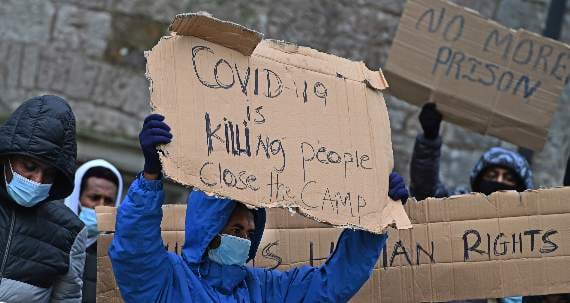
The UK’s leading crisis response charity has called for an immediate end to the use of military barracks – like the one at Penally in Pembrokeshire – for housing people who are seeking asylum.
The call comes as a new report shows too many asylum-seeking women, men and children in the UK are living in unsafe, unsanitary and isolated accommodation falling far short of expected standards, for months and even years at a time.
‘Far from a Home’ - a rapid review published this week by the British Red Cross, finds some of these issues have been compounded by mounting backlogs in asylum application decisions in recent years, the failure to secure enough community dispersal accommodation and more recently, the Covid-19 pandemic increasing demand for housing.
The Red Cross is concerned that the UK Government’s recently announced plans for reform of the asylum system – set out in the New Plan for Immigration – will fail to address these issues.




It is particularly alarmed by proposals to create a two-tier system which would see the majority of the current cohort of asylum seekers held in reception centres, potentially for many months as they await decisions on their applications.
The former barracks at Penally closed at the end of March following months of use as a reception centre, which was described by independent inspectors as “run-down and unsuitable”.
While living there, residents complained of not feeling safe on the site, of not being listened to when they raised concerns, and of a range of health issues and delays in accessing healthcare.
Alongside providing more safe and legal routes for people to reach the UK, and reducing delays in asylum decision making, the British Red Cross argues that providing clean, safe, community-based accommodation for people seeking asylum should be a priority within any reform of the system.
Mike Adamson, Chief Executive at British Red Cross, said: “We are very concerned about the living conditions asylum seekers are facing as they wait months for their application to be processed.
“We have heard from people without basic items like clean clothing, staying in rooms in disrepair, or with serious medical needs that have been ignored.
“We believe that people who have experienced some of the worst horror imaginable – fleeing war, persecution and violence – should be able to expect a safe, clean place of refuge when they arrive in the UK.
“We agree with the UK Government that the asylum system needs reform. But we have major concerns about the proposal to effectively create an unfair two-tier system, which would see anyone who arrives via another country being held in a reception centre, likely behind high fences, potentially for months and months.
“Alongside providing more safe and legal routes for people to reach the UK, forthcoming reform of the system needs to see the Home Office working with local authorities, devolved governments and charities, to increase community housing for people seeking refuge here.
“The UK Government also urgently needs to address and work through the immense backlog of cases, so pressures on the system are reduced.
“This is a once-in-a-generation opportunity to create a fair and effective approach to asylum, in line with British values of kindness and compassion.”
The charity’s review ‘Far from a Home’ is based on the experiences of over 100 people living in various asylum accommodation, and insight from Red Cross staff and volunteers who supported 30,000 people last year.
It found:
• people living in filthy clothes as they had nothing else to keep them warm
• accommodation providers ignoring or not believing requests for medical attention
• rooms in a state of disrepair – in one place a roof collapsed despite the person living there repeatedly reporting problems in advance
• parents ‘desperate’ after spending ten months stuck in a single room, unable to comfort their frustrated and crying children
• accommodation staff using a master key to enter rooms and search belongings, without permission
• people feeling anxious and fearful, as they wait for months for a decision, without the right to work or support to move on with their lives.
Red Cross teams have also worked with female survivors of sexual abuse and human trafficking who have been placed in mixed gender hotels, sometimes with male only staff, effectively leaving them confined to their rooms, as they were afraid to leave.
British Red Cross is also concerned about the compounding impact on women, men and children’s existing mental health problems that being confined to one room for months or years, with little interaction with local communities, is having.
By nature of fleeing war zones or persecution, and after making dangerous journeys in search of safety, people seeking asylum and refugees are more likely to have mental health needs than the wider UK population, including higher rates of depression and Post-Traumatic Stress Disorder.
Between January 2020 and early February 2021, Red Cross teams have supported more than 400 people living in asylum accommodation who have case notes mentioning suicidal ideation or attempts.
This includes pregnant women, people with disabilities, children and people over 75 years old.
Edmore Hute is a Red Cross Refugee Support Manager. He leads an emergency refugee support team set up last year to respond to the urgent needs the Red Cross has been witnessing.
“We’re witnessing too many women, men and children living in accommodation where they don’t feel safe, and it’s taking a toll on people’s already delicate mental health,” he said.
“We have to remember the contexts people have come to the UK from - these are people who have been through some of the worst experiences imaginable. The asylum system needs to provide safety, with understanding of the traumas people seeking refuge have been through and continue to go through, like being separated from family, sometimes indefinitely.”
Report recommendations - British Red Cross is concerned the current asylum reform proposals will fail to address the wider problems contributing to the issues found with accommodation.
Systemic issues include not enough asylum dispersal accommodation available and concerning delays with decision making causing a significant backlog.
While fewer people have been entering the UK asylum system during the pandemic, fewer people have also been leaving asylum accommodation.
According to the latest published figures from the Home Office, the highest number of people on record are waiting for an initial decision. These huge delays have been exacerbated by the pandemic, but the backlog existed prior to Covid-19.
The British Red Cross wants to see some immediate improvements to asylum accommodation, as the women, men and children currently in hotels, barracks and other housing cannot wait until the reforms become law for the basics to be provided.
These urgent recommendations include:
1. Immediately end the use of military barracks
2. Increasing the supply of asylum accommodation, working with local authorities, devolved governments and support organisations
3. Accelerating asylum applications by people from countries with high overall grant rates, to speed up decision making and decrease the backlog of cases
4. Introducing a formal, independent inspection process, to monitor quality and effectiveness of housing provided and to improve accountability
5. Publishing a plan for moving people out of hotels into community housing that is clean and safe
6. Carrying out health and vulnerability screenings when a person first enters the asylum support system to ensure housing meets peoples’ and families’ specific needs
7. Providing financial support to everyone in asylum accommodation and facilities that allow self-catering
8. Ensuring everyone in asylum accommodation is registered with a GP and has access to mental health support
9. Providing internet access throughout asylum accommodation and mobile phones for people without them
10. Putting in measures to respect people’s privacy and to ensure no one is forced to share a room with an unrelated adult
11. Ensuring people in accommodation are well informed and have support, including knowing how to escalate issues and that they will be taken seriously
British Red Cross is committed to working with the Home Office and the next Welsh Government to support the development of asylum reforms that will meet people’s needs, empower communities to welcome people, and provide safety to those who need it.
Comments
This article has no comments yet. Be the first to leave a comment.