
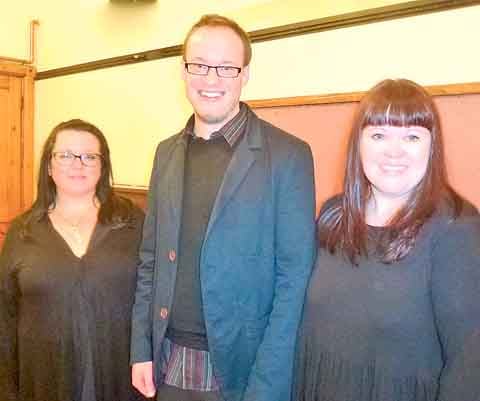
On Friday, members of Tenby Arts Club were treated to a feast of early music from around Europe by the AMA vocal trio.
The trio consisted of Andrew Cusworth, and sisters Angela and Marilyn Allen. We are very fortunate to have these three talented and committed artists in Pembrokeshire.
The singing was all a cappella (or unaccompanied), the three voices in harmony, with the singers taking their notes from Andrew's iPhone!
The concert was made up of Renaissance music written for civic, courtly and religious purposes.


.png?width=209&height=140&crop=209:145,smart&quality=75)
Marilyn took the audience through the first section which featured continental motets, or settings of religious texts to music. We sampled music from Italy with Palestrina's Jesu Rex Admirabilis, a setting of a Latin text - the main language of much religious music. Next was a motet by Vittoria, who was considered the Spanish Palestrina, Tanquam Agnus; this was followed by a piece by Lotti, Vere Languores and then Non Nobis Domine by that prolific composer, Anon. Angela and Marilyn then sang a duet, Oculus Non Vidit by Lasso.
The next three pieces were British in origin: O Lord Turn Not Away by Mundy, Attend Mine Humble Prayer by Byrd, and Out of the Deep by Tomkins, a composer from Pembrokeshire - his family was from Cornwall, but his father was a vicar choral of St. David's and he studied music under Byrd.
Angela then took us through the next section, madrigals. This was courtly music and was about nature, love and loss - the subjects of modern pop songs. Madrigal singing came from Italy, but became popular at Queen Elizabeth I's court as she was very fond of music and dancing.
We heard three madrigals by Morley who was an influential English Composer and organist at St. Paul's Cathedral, London: O Fly Not Love was followed by Do You Not Know and Though Philomela Lost Her Love.
The next two pieces, As Deadly Serpents Lurking and O Now Weep Now Sing were by Weelkes. Weelkes was at some point employed at Chichester Cathedral and could be drunken and unruly and was fond of bad language!
This section closed with Your Shining Eyes by Bateson and Of All The Birds by Mundy. It is amazing to think that this music has survived from the 16th century and is kept alive by music groups like AMA.
Andrew presented the third section which was the most formal and featured religious music for the Mass. All the pieces were by William Byrd who was a composer at the time of Elizabeth I and James I. The pieces were Haec Dies, Alleluia Vespere Autem Sabbathi, and the Agnus Dei from the Mass For Three Voices.
Byrd was an interesting character because, like Shakespeare, he was a Catholic, a Recusant, and yet prospered in what were difficult and dangerous times. Byrd knew Thomas Paget who was implicated in the Throckmorton Plot.
Queen Elizabeth granted Byrd, with his tutor and friend, Thomas Tallis, sole publishing rights for music and manuscript paper in the Kingdom, and when they lost money in the business, she gave them some land to cover their debts.
If you'd like to find out more about the AMA vocal trio or hear some of this wonderful music, check out their website http://www.amatrio.com">www.amatrio.com and email [email protected]">[email protected]
Kath Brown, chairman of Tenby Arts Club, introduced AMA and gave the vote of thanks which was followed by refreshments - excellent biscuits, tea or coffee.
This week is a talk by photographer Nigel McCall entitled Home and Away, 7.30 pm, at St. Johns. All are welcome.
Comments
This article has no comments yet. Be the first to leave a comment.