
An enthralled audience listen intently to a fascinating account of a series of visits to Libya on Friday night. Jamie Owen, the face of BBC Wales news and president of Tenby Museum and Art Gallery, accepted an invitation from Sue Baldwin, the museum's honorary librarian, to give a talk at the museum and chose as his subject his recent trips to Libya. Jamie explained that the BBC World Service Trust had asked him if he would be willing to visit a number of Middle East countries to help train and develop local staff to produce programmes like the BBC's Question Time. Programmes of this nature are a new concept in the so-called 'Arab Spring' countries. After years of dictatorship and oppression, free speech is a new and exciting concept. Jamie, along with several colleagues, visited a number of countries, including Egypt, Jordan and Libya. Those who work in the public sector will be familiar with being told 'We are going to send you on a course.' This course was however something very different to the usual run of the mill training exercise. The course Jamie attended involved going to Hereford to learn how to identify gun fire, what to do if you are kidnapped, car security, checking vehicles for bombs, how to disappear into a crowd etc. Following the course, Jamie explained how he needed to apply for a new passport as he had previously visited Israel and the West Bank. Eventually, he was on an almost empty plane flying to Tripoli. On the flight with Jamie was John Kirby, director, and Brian Thomas, engineer. Brian proved to be very popular in Libya as he could fix almost anything. Over the next 12 months, Jamie made three trips to Libya during which he kept a diary and observed the country descending deeper and deeper into chaos. The television studios in Tripoli still had blood on the walls and bullets in the glass. Most of the staff had either fled or been killed. The Libyan television service was failing and the concept behind the visits was to pass on skills and ideas and train a new younger generation. Jamie and the team began by reviewing the existing programme output and advising how it could be improved. Jamie provided two examples of programmes he was involved with - 'Good Morning Libya', Tripoli's Breakfast television programme and 'Question time'. Good Morning Libya suffered from low ratings with the two presenters sitting wide apart as is traditional in Libya. A recording of Question Time was bedevilled by power failures but was eventually in the can. Jamie noted a lack of women in the question time programme and was told that was because no one is interested in the views of women. Working with their Libyan colleagues, Jamie and team suggested improvements to the programmes. One problem Jamie mentioned was how do you motivate and inspire people? Money is not the motivation; it is the belief that Libyan television must tell Libya's story. When Jamie first visited Tripoli, he explained that he was able to walk about and enjoy the capital. On his later visits, he was confined to going everywhere by car. The ruthless dictatorship of Colonel Gadaffi has been replaced by a ruthless disorder. Terrorism and mindless thuggery are the new dangers. Jamie recalled one particularly frightening experience on the way back to the airport for the flight home. Unusually for Libya, his taxi had arrived at the hotel on time at 3 am in the morning. During the journey to the airport, his mobile 'phone rang and the hotel manager informed him that his taxi had arrived. Panic set in - had he been kidnapped! The outcome was quite simply, his taxi driver had stolen the fare from another taxi driver. Arriving safely at the airport, Jamie then discovered his flight home had been cancelled! Jamie explained that since returning home, he had remained in contact with his Libyan colleagues. The talk was followed by a lengthy question and answer session. Sue Baldwin thanked Jamie on behalf of the museum for a very interesting insight into the Arab spring countries. The talk was a new concept for the museum, looking at history in the making, and turned out to be a very successful evening. It was also a very timely talk as the next morning the BBC news channel was reporting that the British Government was closing the embassy in Tripoli and urging all British citizens to leave Libya as soon as possible. An evacuation by British warship was being organised for the following day.
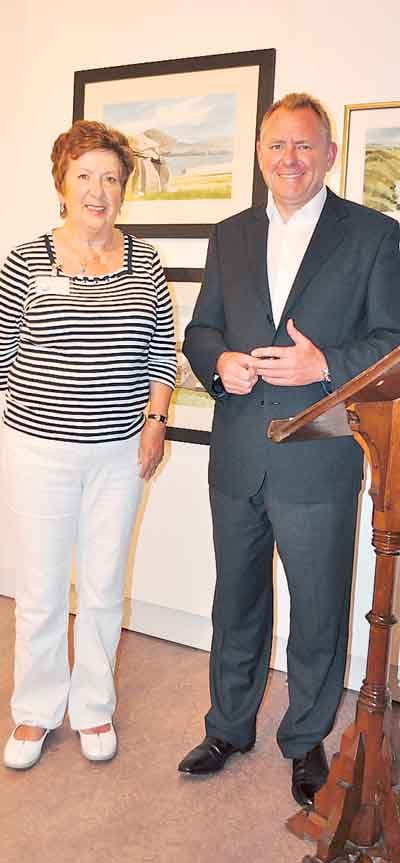
Jamie Owen and Sue Baldwin, honorary librarian.
Comments
This article has no comments yet. Be the first to leave a comment.