
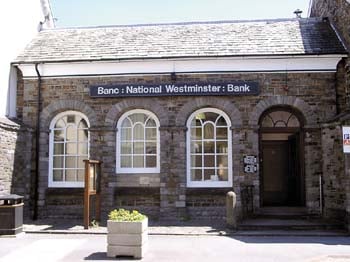
Whitland branch was opened by National Provincial Bank of England in July 1902. National Provincial Bank of England, established in 1833, had 200 branches by 1900, including an extensive network of Welsh branches. In all likelihood it was the manager of the flourishing Narberth branch nearby who drew the attention of the directors of the bank to Whitland as a possible location for a new agency.
Whitland, a small market town, was located at the heart of a thriving agricultural district. Its economy in the late 19th century was based on the cultivation of wheat and barley and the raising of dairy cattle.
The town's greatest prosperity had come with the opening of a station on the South Wales Railway in 1854. Although at first no more than a small halt on the single track line to Milford Haven, Whitland eventually became the principal junction for the entire West Wales peninsular. The Pembroke and Tenby Railway joined the line at Whitland in 1868 and the Whitland and Cardigan Railway was opened in 1886.
Whitland station bustled with activity as freight and passenger traffic increased, and was extended by the construction of sidings, an engine shed and two signal boxes.


The bank, persuaded that prospects at Whitland were good, opened a part-time agency in the town from July 8, 1902, initially trading from the front room of Central House in St. John Street.
Three days later, on July 11, 1902, the following notice appeared in the Carmarthen Weekly Reporter: 'On Tuesday, the National Provincial Bank of England opened a branch in St. John Street, Whitland. The bank will be open Tuesdays and Fridays, the manager being Mr. R. Williams, manager of the Narberth branch'.
The branch's opening days coincided with both the weekly market for butter, cheese and eggs and the cattle fair held every third week. The early customers were largely farmers, as well as such local tradesmen and professional people as the postmaster, innkeeper, chemist, blacksmith, butcher, schoolmaster and carpenter.
There was only one other bank in the town and the branch was an immediate success, leasing part of the new Town Hall to provide more prestigious premises in late 1904.
In February 1906, the manager of Narberth branch suggested that the bank open daily at Whitland. The suggestion was not taken up, but the business at Whitland was clearly thriving and moved to larger rooms in a house in King Edward Street, adjoining the Town Hall, in late 1913.
The outbreak of the First World War in 1914 ushered in a period of staff shortages and controls and in 1915 the Whitland agency's hours were reduced to one day a week.
After the war, in 1918, National Provincial Bank of England merged with Union of London and Smiths Bank to become National Provincial and Union Bank of England. Whitland branch was renamed accordingly and on July 2, 1919, finally became a daily branch office to Narberth, open from Monday to Saturday.
In part, this reflected the huge growth of Whitland, prompted not only by the burgeoning railway industry, but also by the establishment of a growing milk processing business in the town. Set amidst the West Wales grazing lands, Whitland was an ideal location, with excellent railway links, for transporting perishable milk and milk products, and ample water supplies. In 1914 the creamery, known as Somerset and South Wales Dairies, moved to its present site.
In 1924, National Provincial and Union Bank of England shortened its name to National Provincial Bank. The bank was by this time keen to find more suitable permanent premises for its branch in Whitland. In February 1930, the bank bought, at auction, a property called Waltham House in St. John Street. The premises, comprising a double shop with a 36- foot frontage, occupied a prime site. The existing building was demolished and a new purpose-built banking house was constructed which opened in July 1933.
The outbreak of the Second World War again brought problems to the banking industry, but in Whitland it saw a resurgence of rail traffic and an expansion of the creamery to supply canned evaporated milk for the Forces.
In the 1960s, however, the growth of road haulage and cutting of branch lines, witnessed the demise of the railway business in Whitland. The Cardigan line and Whitland engine shed closed and the station was reduced to an unmanned halt.
In 1968, Westminster Bank and National Provincial Bank, along with National Provincial's subsidiary District Bank, announced their intention to merge. The operations of all three banks were combined over the following 18 months and they began to trade as National Westminster Bank from January 1970.
In 1978, the premises of Whitland branch were extended to the rear to provide a new staff room and stationery store.
Meanwhile, the local creamery expanded rapidly, with massive capital investment, to become one of the largest and most modern such factories in Europe. The announcement, in late 1994, that the factory was to close shocked the local community and undermined Whitland's economy, although the site later re-opened as a trans-shipment depot.
Whitland has continued to change and develop with the construction of the A40 bypass in the mid-1990s.
In 1995, Whitland branch became a dependant sub-branch to NatWest's nearby office in St. Clears.
NatWest is proud of its close association with Whitland and, a century after it first opened for business, the branch continues to provide a quality service to the local community.
• Researched and written by Group Archives at National Westminster Bank, June 2002.